



American Electric Power serves 5.6 million customers in 11 states and runs 40,000 miles of transmission line, the largest network in the country. On 21 October it posted two senior security jobs on the same day, with the same pay range, both on site in Columbus or Austin: a Managing Director for OT Security and a Managing Director for AI Security.
The OT job is what you would expect from a utility: substations, SCADA, protective relays, nuclear plant controls. The AI job is the unusual one. It describes a “Cyber AI” program inside the cybersecurity organisation, with two halves: protecting the company’s own AI, and using AI to run security better. The posting calls them AI Security Operations and AI-enabled cybersecurity products and engineering.
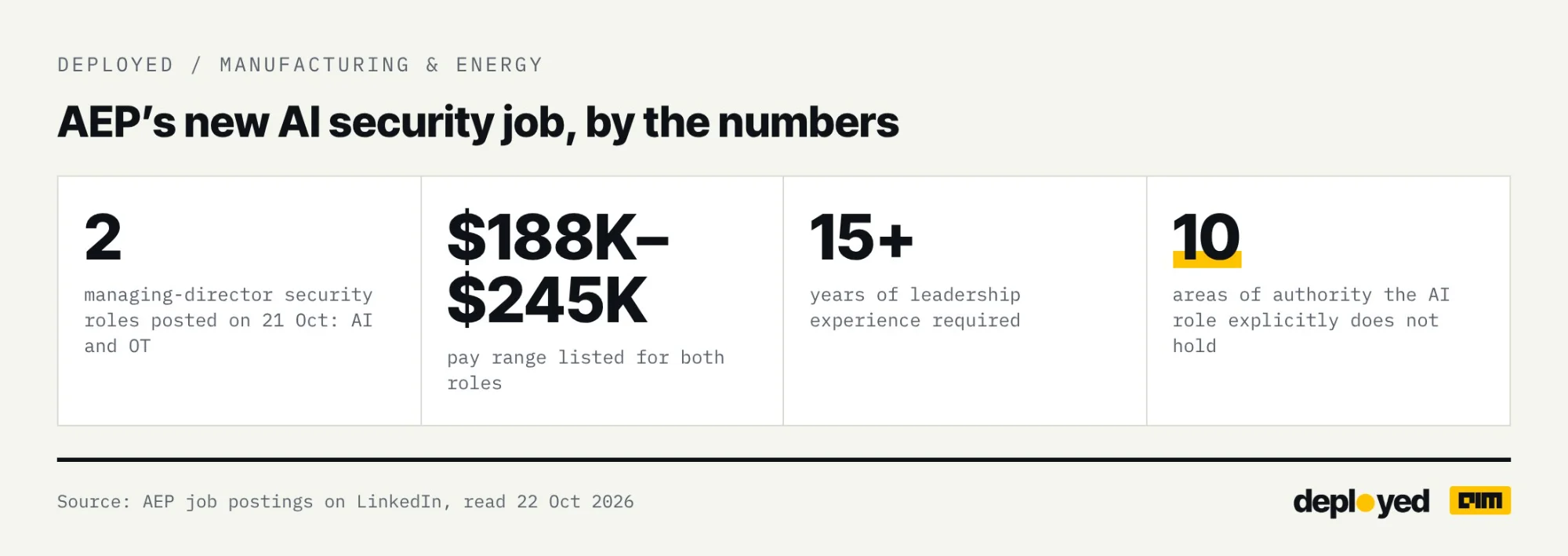
On paper it is a big job. The holder sets the multi-year Cyber AI strategy, builds the teams, guides the investment and “represents cybersecurity in enterprise AI decisions.” The pay range is $188,524 to $245,080.
Then comes a section most job ads do not have. It is headed “Role Boundaries”, and it lists what the new managing director does not control.
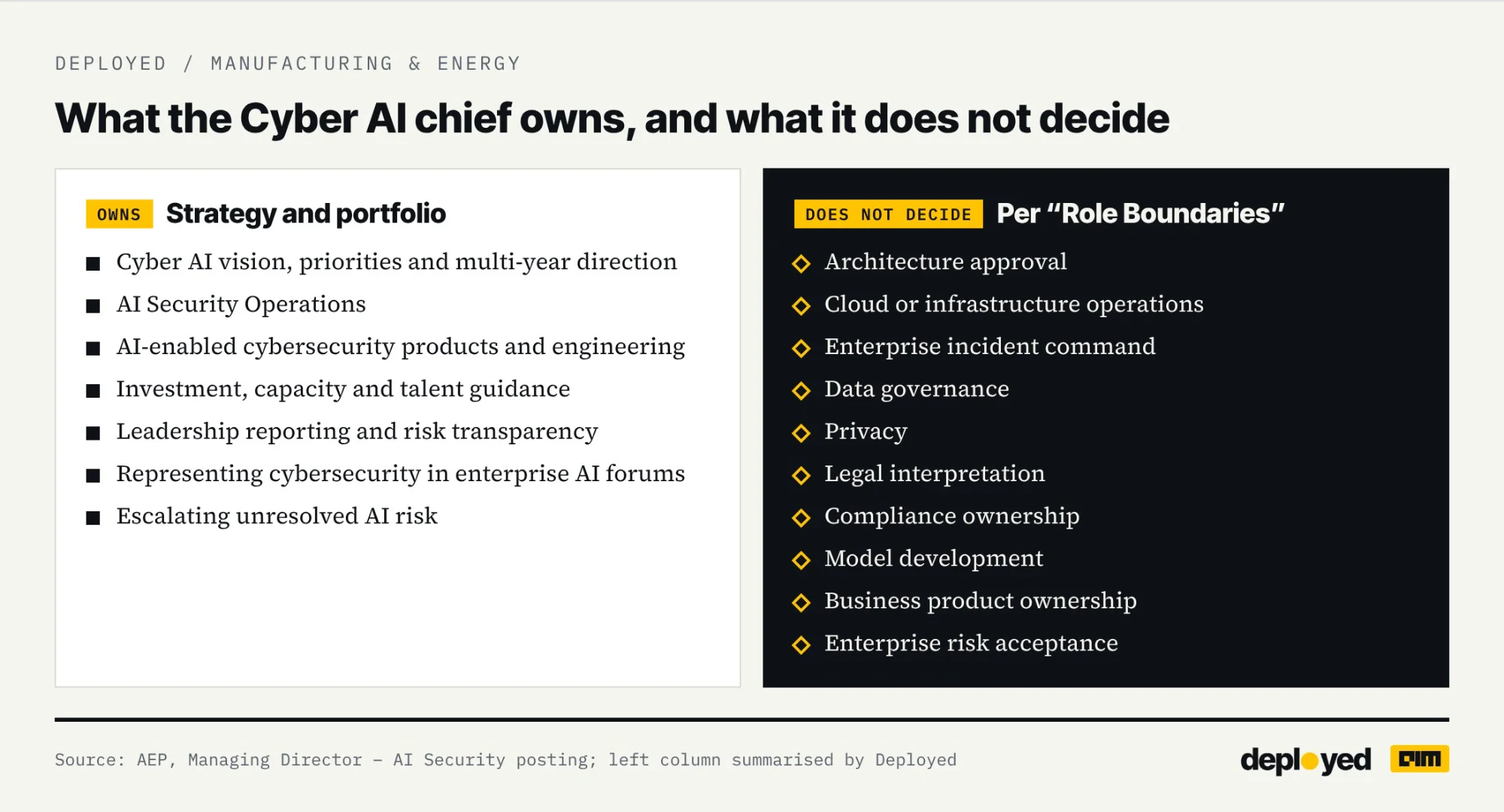
Ten things the AI security chief cannot decide
The posting says the role “does not replace established enterprise authority” for architecture approval, cloud and infrastructure operations, enterprise incident command, data governance, privacy, legal interpretation, compliance, model development, business product ownership or enterprise risk acceptance. Those stay with their existing owners. The job’s tools are strategy, portfolio, reporting and escalation.
That last item matters most. If a business unit wants to deploy an AI agent that the Cyber AI team considers unsafe, the managing director can escalate it. Accepting or rejecting the risk belongs to someone else.
Our view: for a company that keeps the lights on for 5.6 million customers, that is the wrong design. As AI spreads through a utility’s operations, it will end up close to the systems that keep the grid running. The person accountable for AI security should be able to stop a deployment, not just write a memo about it.
The OT job gets the sharper tools
Read the two postings side by side and the difference is plain. The OT Security director is asked to establish “delegated decision authority” across business units and vendors, and to keep the technical depth to challenge high-consequence engineering conclusions. The AI Security director gets “decision boundaries” and “escalation paths”.
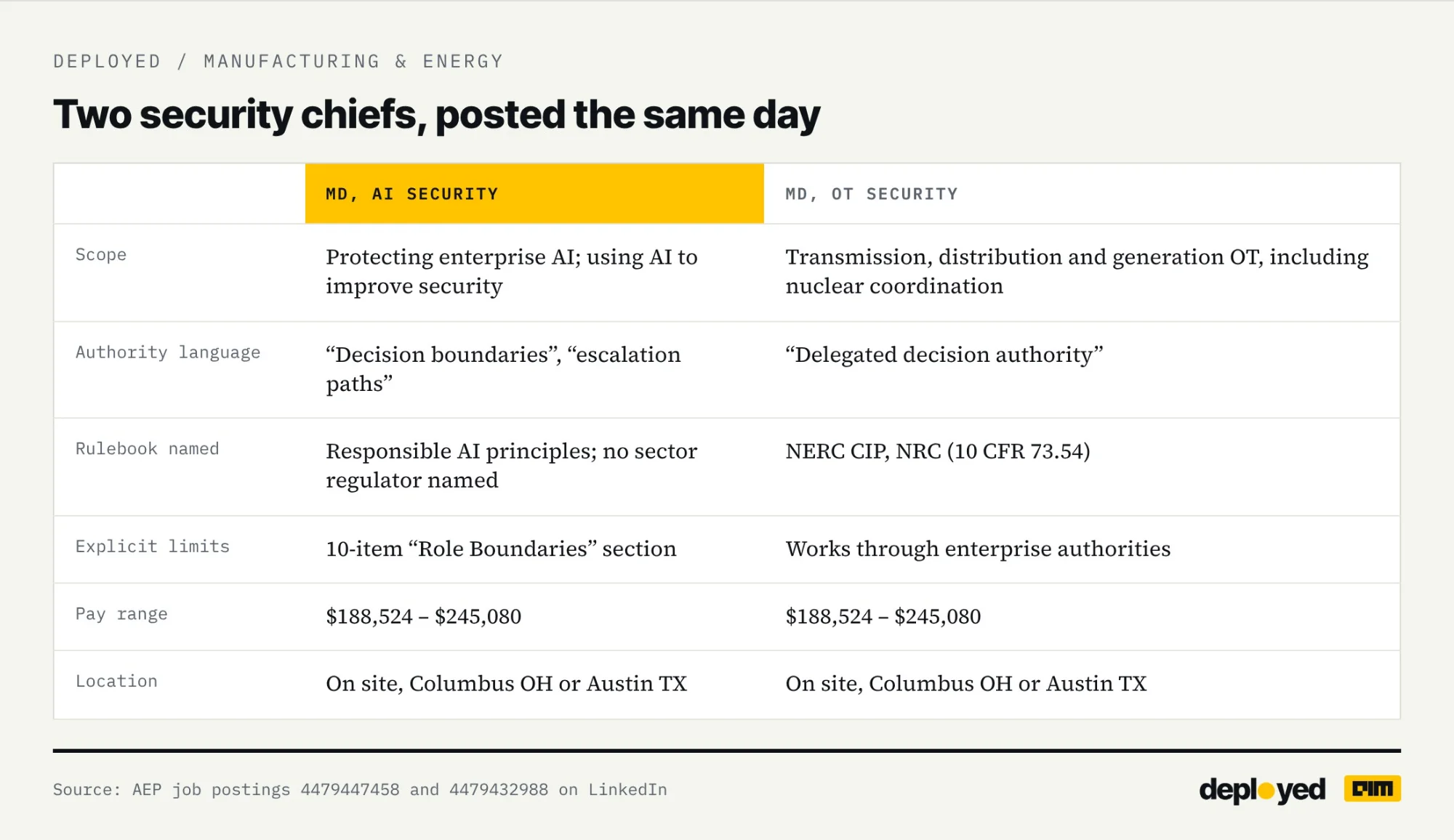
The OT side has years of NERC CIP and NRC rules behind it, which is why its authority is easier to write down. AI has no settled equivalent for utilities yet. That is an argument for giving the AI role more room, not less, until the rules arrive.
The case for AEP’s design
There is a good argument on the other side. AI now touches almost every function. A single AI security owner with a veto over all of it would become a bottleneck, and would duplicate the risk, privacy and architecture functions that already exist. Separating the people who advise from the people who accept risk is how well-run companies avoid fiefdoms, and the posting says as much: the role works through the existing architecture, risk, privacy and legal functions “rather than duplicating those functions.”
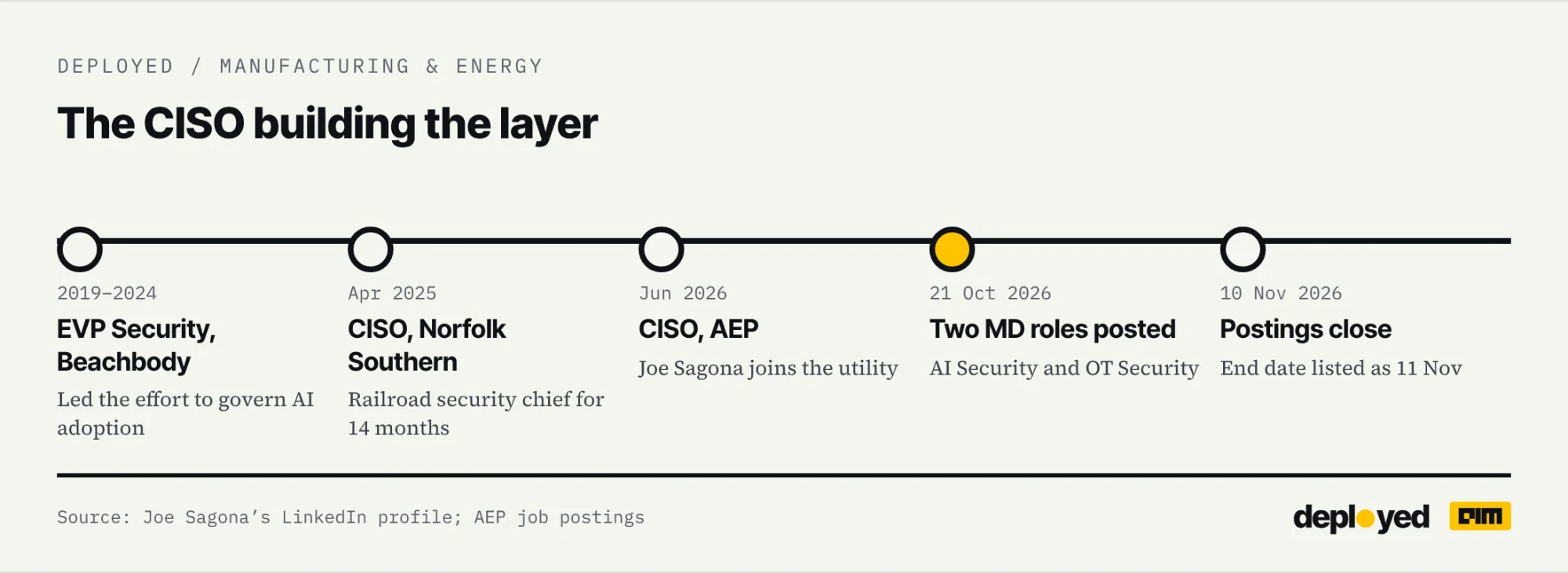
It may also be a sign of who is building the structure. Joe Sagona became AEP’s chief information security officer in June, after a year as CISO at Norfolk Southern. At Beachbody, according to his LinkedIn profile, he “spearheaded the effort to govern AI technology adoption.” Two managing-director searches within five months of his arrival suggest a CISO building layers deliberately. An AI security leader who has to win arguments, not issue orders, may be exactly what he wants.
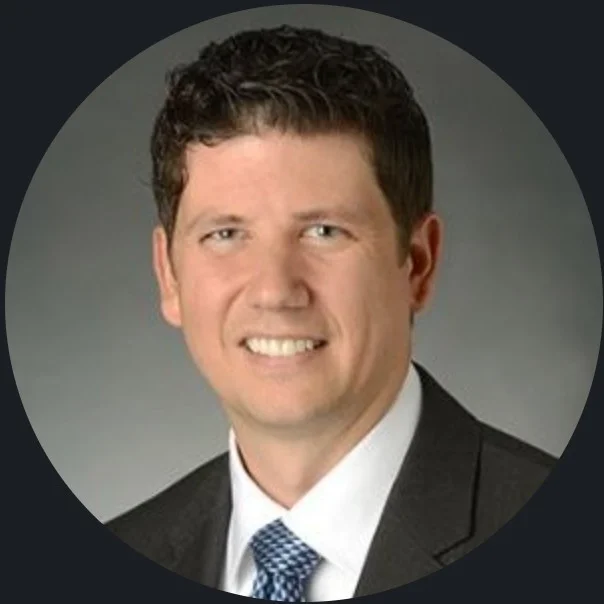
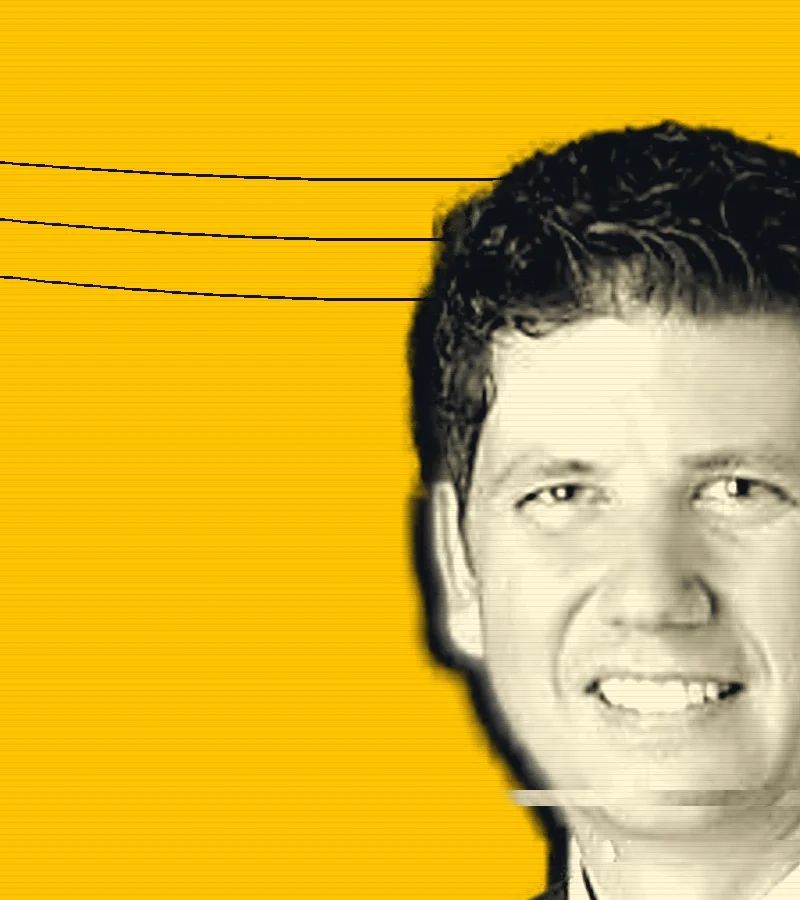
Joe Sagona, Chief Information Security Officer, American Electric Power. Photo: LinkedIn
What to watch
Whoever takes the job will learn quickly whether escalation works. The first test will be an AI deployment that a business unit wants and the Cyber AI team does not. If that conflict reaches a decision-maker fast and gets settled on the evidence, AEP’s model will look wise. If it stalls, the utility will have hired a strategist for the one area where it needs a referee.
Three questions for Joe Sagona
- Who at AEP accepts or rejects AI risk when the Cyber AI team and a business unit disagree?
- Will the new managing director have any authority over AI systems that connect to operational technology?
- Why do the AI and OT security leaders share a pay range but not the same decision rights?
Deployed has not yet spoken to AEP. Details are from AEP’s AI Security and OT Security job postings on LinkedIn, AEP’s website and Joe Sagona’s public LinkedIn profile.