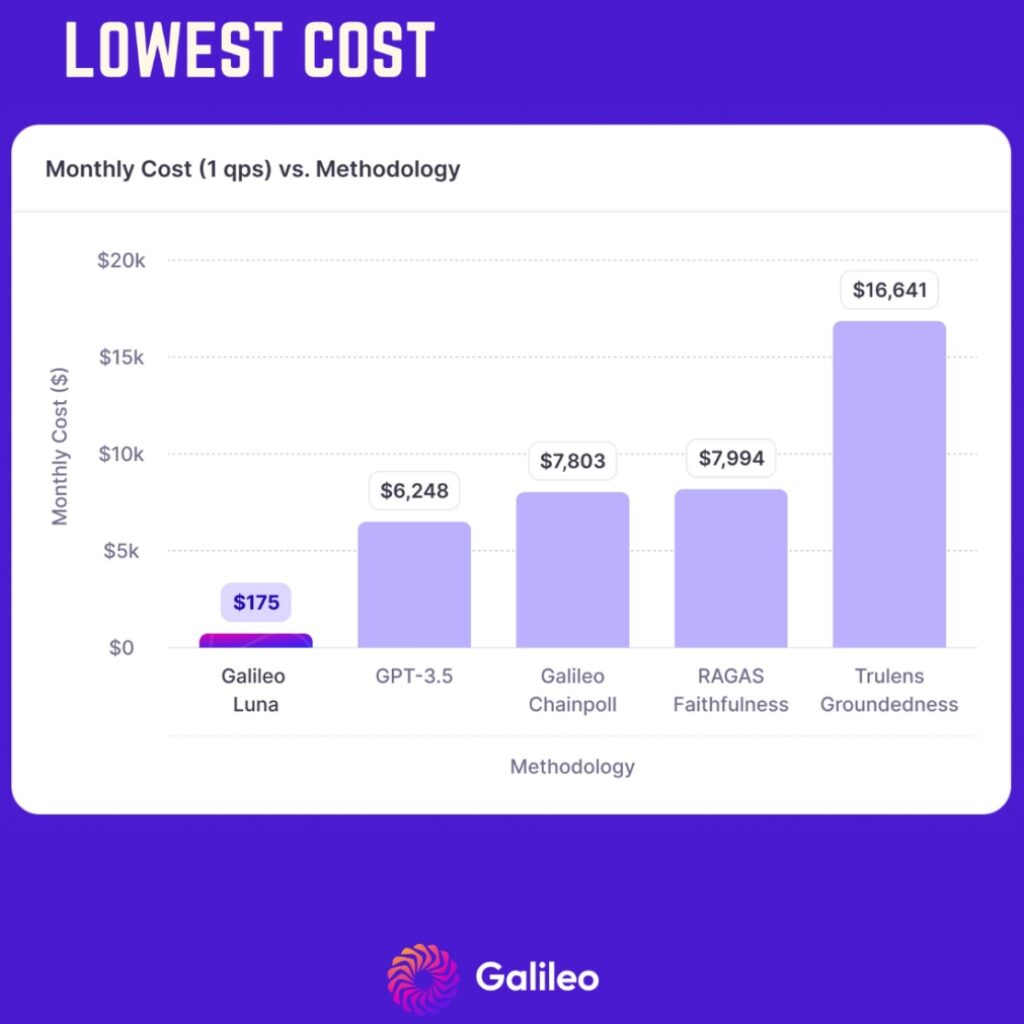

In a move that could accelerate the enterprise adoption of generative AI, startup Galileo has unveiled a novel suite of AI models specifically designed for evaluating the outputs of large language models like GPT-3.
The new offering, dubbed Galileo Luna, represents a first-of-its-kind approach to GenAI evaluation using what the company calls Evaluation Foundation Models (EFMs). These specialized models are finely tuned for tasks like detecting hallucinations, toxic language, data leaks, and malicious prompts in the responses from AI systems.
"For gen AI to achieve mass adoption, it's crucial that enterprises can evaluate hundreds of thousands of AI responses for hallucinations, toxicity, security risk, and more, in real time," said Vikram Chatterji, Co-Founder and CEO of Galileo. "In speaking with customers, we found that existing approaches, such as human evaluation or LLM-based evaluation, were too expensive and slow, so we set out to solve that. With Galileo Luna®, we're setting new benchmarks for speed, accuracy, and cost efficiency. Luna® can evaluate millions of responses per month 97% cheaper, 11x faster, and 18% more accurately than evaluating using OpenAI GPT3.5."