
Enterprise AI, in production.
    Four desks, one beat.

    From Stealth To Superintelligence, Meet Deep Cogito

    ManufacturingNews

    From Stealth To Superintelligence, Meet Deep Cogito

    Deep Cogito plans to release even larger Mixture-of-Experts (MoE) models with parameter sizes reaching 109B, 400B, and 671B

    Last updated

    A new open-source AI research startup, Deep Cogito, has come out of stealth mode with a bold mission: to rethink how intelligence can be scaled. Founded in San Francisco in June 2024 by former DeepMind and Google researchers Dhruv Malhotra and Drishan Arora, and backed by early investment from South Park Commons, the company has now unveiled its first major release—Cogito v1, a suite of advanced language models ranging from 3B to 70B parameters.

    Unlike many reasoning-focused models that suffer from high computational demands and latency, Cogito models are engineered to seamlessly shift between a standard mode for speed and a reasoning mode for complex tasks. This flexibility allows them to maintain high performance while remaining efficient—solving a long-standing tradeoff in AI deployment.

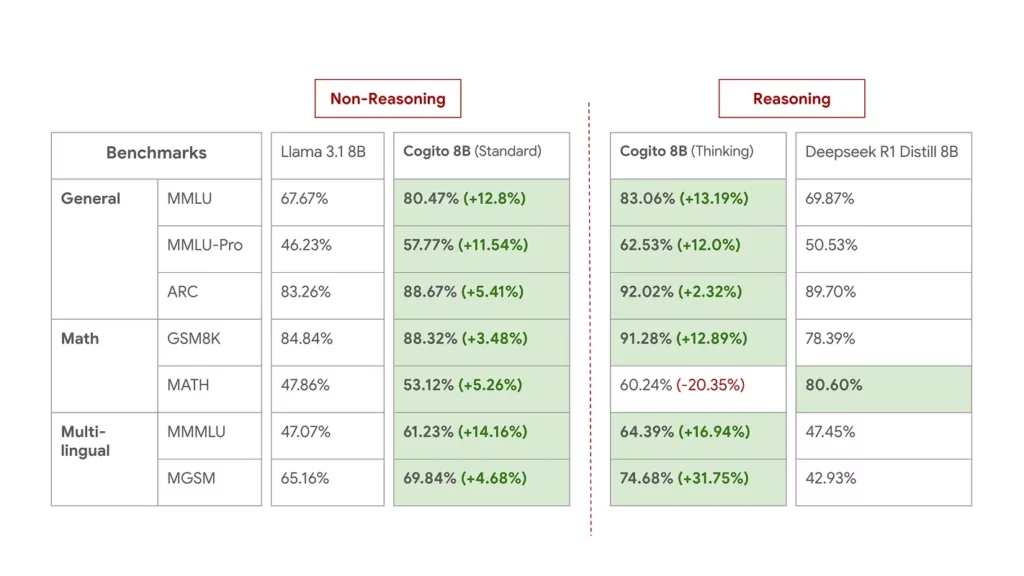
    Despite the compact development timeline, the results are impressive. According to the company, its flagship 70B model not only matches but outperforms Meta’s LLaMA 4 109B Mixture-of-Experts (MoE) model across key benchmarks. These include mathematical reasoning, language comprehension, and LiveBench, a well-regarded general-purpose AI evaluation.

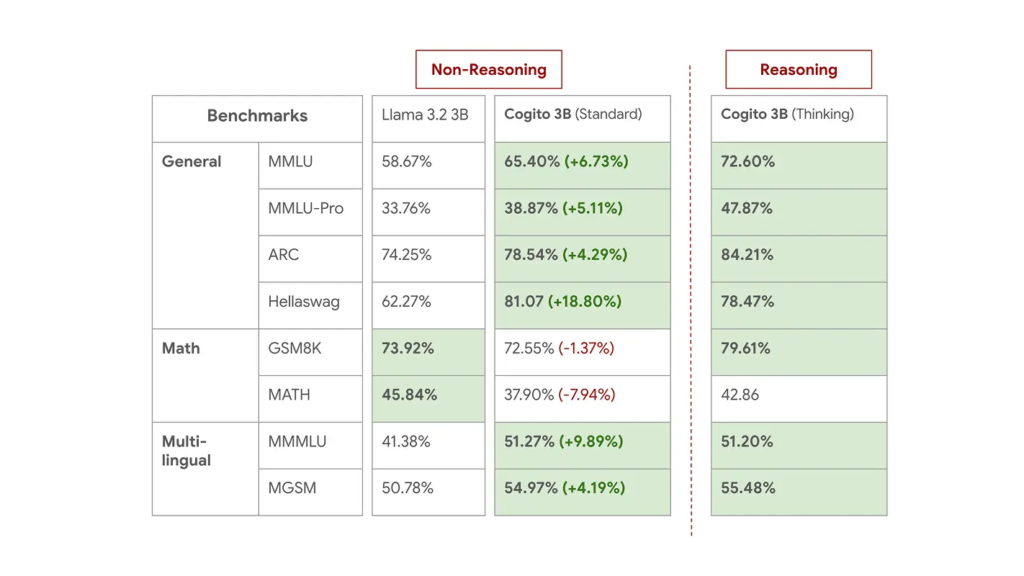
    Source: Deep Cogito
    Source: Deep Cogito

    The driving force behind this breakthrough is a novel training methodology called Iterated Distillation and Amplification (IDA). Rather than relying on traditional strategies like reinforcement learning from human feedback (RLHF) or distilling from larger teacher models, IDA enables the model to improve through cycles of self-improvement. In each iteration, the model first engages in more compute-intensive reasoning—often using recursive thinking or internal subroutines—to generate higher-quality responses. These enhanced outputs are then distilled into the model's own parameters, making them part of its native capabilities. Over time, this iterative loop allows the model to improve its performance based on its own reasoning rather than being capped by the limitations of a fixed human overseer or a larger model.

    by AIM Media HouseFree · No paywall

    Keep reading. It's free.

    Create a free Deployed account to finish this story and every story on the site. Choose the briefings you want with it:

    or

    No credit card. One click to unsubscribe. Already a reader? Sign in

    About the author

    Deployed

    Related stories