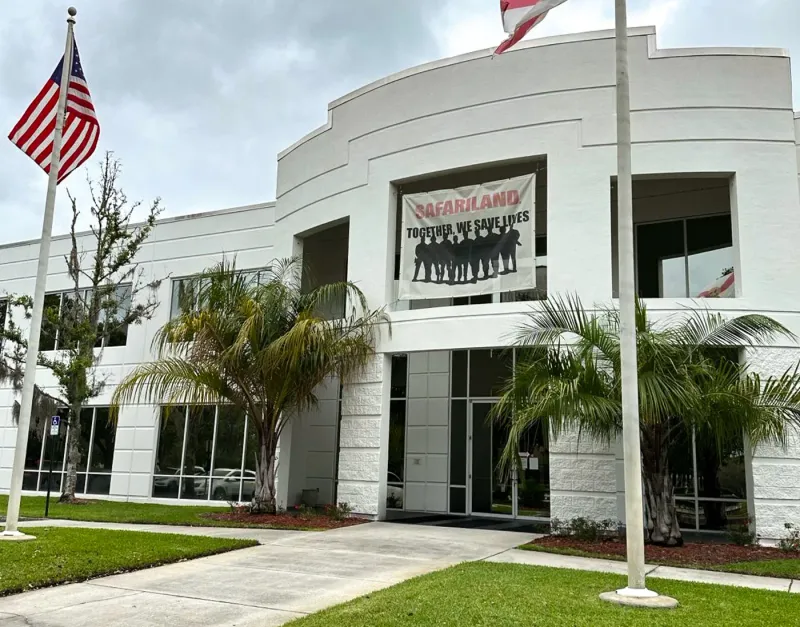
On 22 October, The Safariland Group posted a LinkedIn listing most AI watchers will scroll past. It seeks an AI Specialist for Artificial Intelligence and Automation in Jacksonville, Florida, who will lead the insertion and deployment of AI into the Cadre Operating Model and grow AI use across the company through in-person, face-to-face training of the people who own its processes.
Safariland is the flagship brand of Cadre Holdings (NYSE: CDRE), which makes body armour, holsters, bomb-disposal suits, blast sensors and blast-attenuating vehicle seats for police forces, militaries and nuclear operators. This is the first dedicated AI role we could find in its public listings, and it is the kind of quiet hiring signal Deployed's manufacturing desk tracks closely. It arrives in a strong year. Second-quarter net sales reached $207.1 million against $157.1 million a year earlier, the orders backlog hit a record $368 million, and management raised full-year guidance to between $749 million and $769 million. Chairman and CEO Warren Kanders credited part of that result to the Cadre operating model itself.
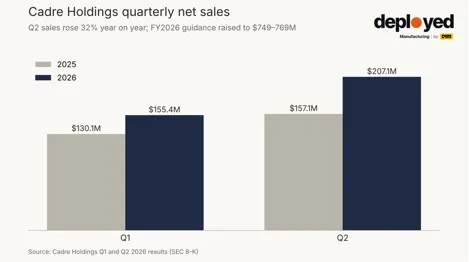
Cadre's growth has come largely from acquisitions alongside demand for armour, duty gear and nuclear safety products.
A lean system meets a language model
According to a 2025 investor presentation, the Cadre Operating Model is a behaviour-based, leadership-centric way of working built on lean tools, variability reduction and Kaizen. Its chief architect is Brad Williams, an industrial and systems engineer from Virginia Tech who joined Safariland as its first chief operating officer in 2017 and became president in 2019. Cadre's published management team lists no separate COO today, which makes Williams the executive whose answers matter most.
Lean purists will raise an eyebrow. Kaizen relies on people walking the gemba and seeing waste for themselves, and a chatbot that summarises a value stream map could weaken the very habit the system exists to build. Vendors argue the opposite. Retrocausal, led by CEO Zeeshan Zia, built a Kaizen Copilot trained on Lean Six Sigma and Toyota Production System principles for industrial engineers to carry onto the shop floor. Cadre's listing takes something from each camp: it wants AI tools on the floor, and it insists the learning happen face to face.
Zeeshan Zia's Retrocausal sells generative AI built around lean principles.
The in-person bet has data on its side
Classroom training sounds dated, yet the evidence favours it. BCG's AI at Work 2025 survey of more than 10,600 employees found regular generative AI use stuck at 51% among frontline staff, against 85% of leaders and 78% of managers. Usage rose sharply where people received at least five hours of training with in-person coaching. A McKinsey survey of manufacturing COOs found that only 2% say AI is fully embedded across their operations, and in India a Kyndryl study found only 25% of Indian organisations feel workforce-ready for AI.
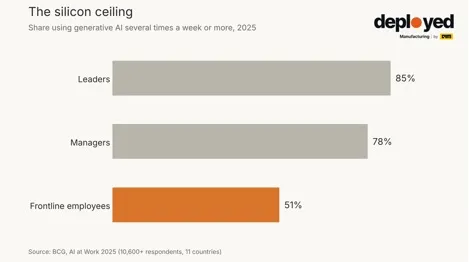
The frontline gap Cadre's in-person model is designed to close. An animated version is included in the asset pack.
One hire, a long list of acquisitions
The harder question is scale. Kanders has said Cadre has deployed more than $400 million on acquisitions since January 2024, a run that includes Cyalume Technologies, Carr's Engineering, TYR Tactical and Alien Gear Holsters. Each deal brings its own plants and process owners, and Cadre reports roughly 2,500 full-time employees. Placing AI adoption across all of that on one specialist invites the charge of under-investment.
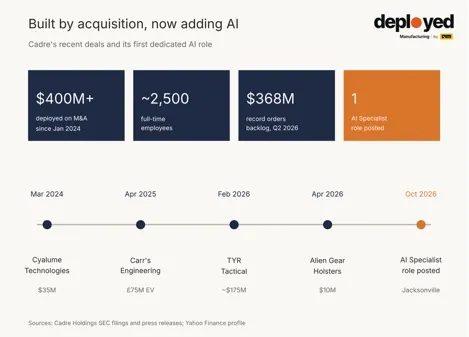
Four acquisitions in roughly two years, followed by the first dedicated AI role.
Peers have chosen bigger titles. Stanley Black & Decker made Mukesh Dalal chief AI officer with a goal of $1 billion in value from AI and analytics, Ford hired Mano Mannoochahr as chief AI and data officer in 2026, and GM appointed Barak Turovsky as chief AI officer in March 2025, though he left the role that November. Caterpillar has pushed AI into its construction equipment through its work with NVIDIA. Josh Crist of executive search firm Crist Kolder has reported that just over 8% of industrial companies have added a chief AI officer.
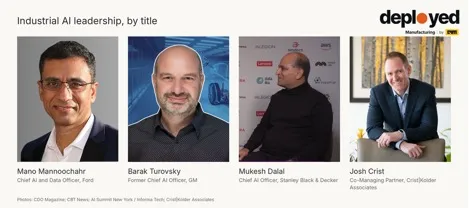
Industrial peers have built AI leadership around C-suite titles.
The counter-argument deserves equal weight. Cadre has placed the role inside its operating model, so AI projects will be judged on the same waste, cycle-time and responsiveness measures as any Kaizen event. A single specialist tied to hard operating metrics may well outperform a larger AI team without them.
The question the listing leaves open
Cadre sells products certified to stop bullets and absorb blasts, which makes traceability essential. Its customers include General Dynamics European Land Systems, under contracts worth $86.4 million for blast seats, and the US Department of War, under a blast exposure monitoring programme worth up to $50 million. In policing, Axon's Draft One shows how quickly AI meets resistance from buyers and courts: the King County Prosecuting Attorney's Office in Washington has barred AI-written police reports, and Kyle Police Department in Texas leaves Draft One unused at its district attorney's request. Cadre's use is internal, though its buyers will still want to know where generative tools touch quality records.
Five questions for Brad Williams
- Which processes get AI first: planning, quality, procurement or customer service?
- Will generative tools ever touch test data or records tied to certified products?
- How will AI results be measured within the operating model?
- How will plants from TYR Tactical and Alien Gear be brought into the programme?
- Is this hire the first of a team, or the template for how Cadre wants AI to scale?
Cadre has made its name buying durable businesses and running them through one disciplined system. Its first AI role suggests it plans to treat AI the same way, as another tool for that system to absorb. Whether one specialist with a training room can carry that across a growing global footprint is the bet worth watching in 2027.


 Manufacturing