

 Pharma


“How do you make money? Spinoffs, split-ups, liquidations, mergers and acquisitions.” - Mario Gabelli, American Stock Investor and CEO of Gabelli Asset Management.
Now is that statement all true? In the world of technology, acquisitions are a common strategy for large companies to expand their capabilities, enter new markets, or eliminate competition. However, not all acquisitions lead to success. IBM's ambitious Watson Health initiative, boosted by the success of its Watson AI in other industries, eventually failed due to a series of critical errors. Despite IBM investing around $4 billion to expand its Watson Health portfolio and purchasing many startups, including Truven, Phytel, Explorys, and Merge, the effort failed to meet its expectations. A crucial cause was a lack of explicit problem description and domain expertise in healthcare, resulting in a wide deployment of AI with no unique use cases established. For example, Watson's cancer diagnosis tool, which was trained on hypothetical instances from a small dataset, struggled with real-world applicability and accuracy. The initiative's overhyping and underperformance eroded its credibility, which was worsened by integration issues across many healthcare systems. Ultimately, IBM's financial mismanagement and failure to achieve healthcare providers' long-term aspirations resulted in the rumoured sale of Watson Health's assets for $1 billion in 2022. This story demonstrates the vital necessity of strategic focus, data quality, and reasonable expectations in AI-powered healthcare innovation. "Being a first mover is not necessarily an advantage," sources said.
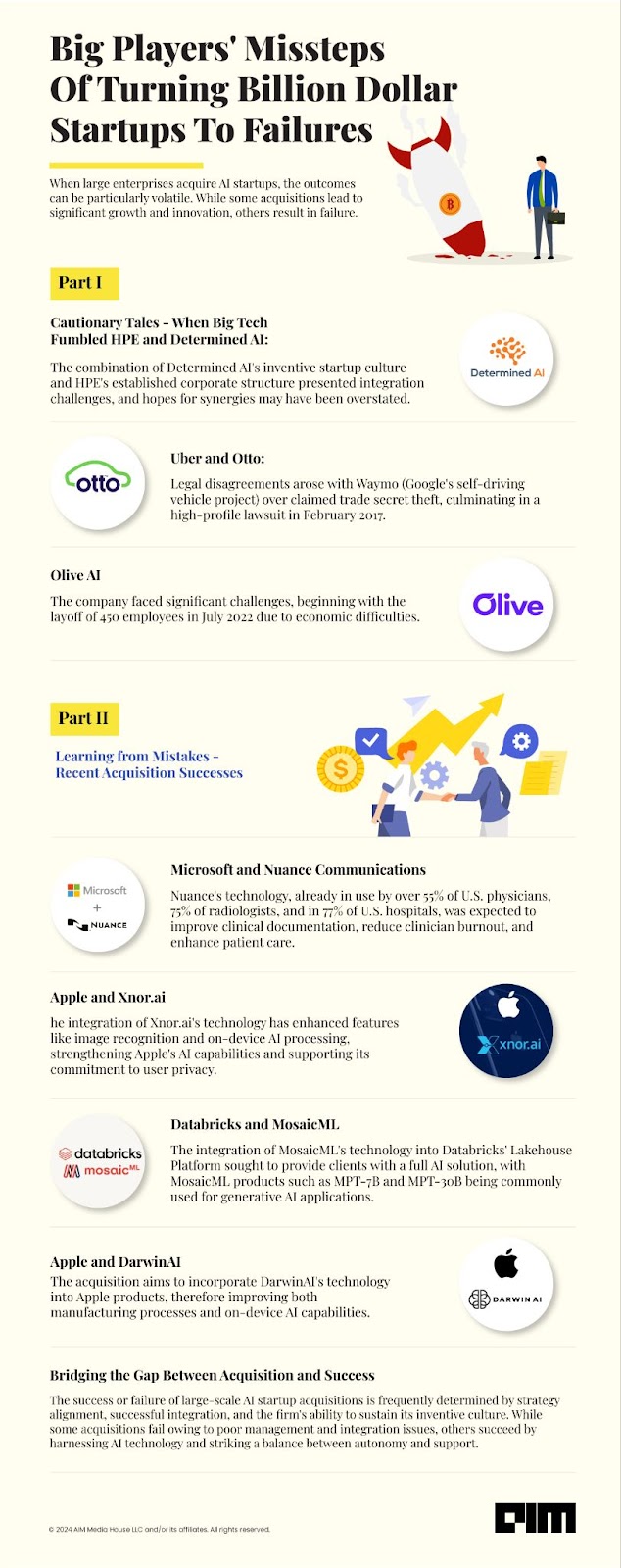
When large enterprises acquire AI startups, the outcomes can be particularly volatile. While some acquisitions lead to significant growth and innovation, others result in failure. When major organisations acquire AI startups, they frequently face integration issues caused by disputes between the startup's nimble culture and the enterprise's inflexible institutions. This cultural mismatch can inhibit innovation and slow growth. Furthermore, the loss of autonomy that comes with purchase might reduce the startup's inventive drive and increase employee unhappiness. Misalignment of strategic goals complicates matters further, since the acquiring company's focus on short-term advantages may differ from the startup's long-term aims. Furthermore, overestimating synergies and possible advantages might result in unwarranted expectations and disappointment. Poor post-acquisition financial management, particularly the failure to connect ongoing R&D investment demands with the acquirer's financial plans, can put additional strain on resources and lead to failure.
