

 Pharma

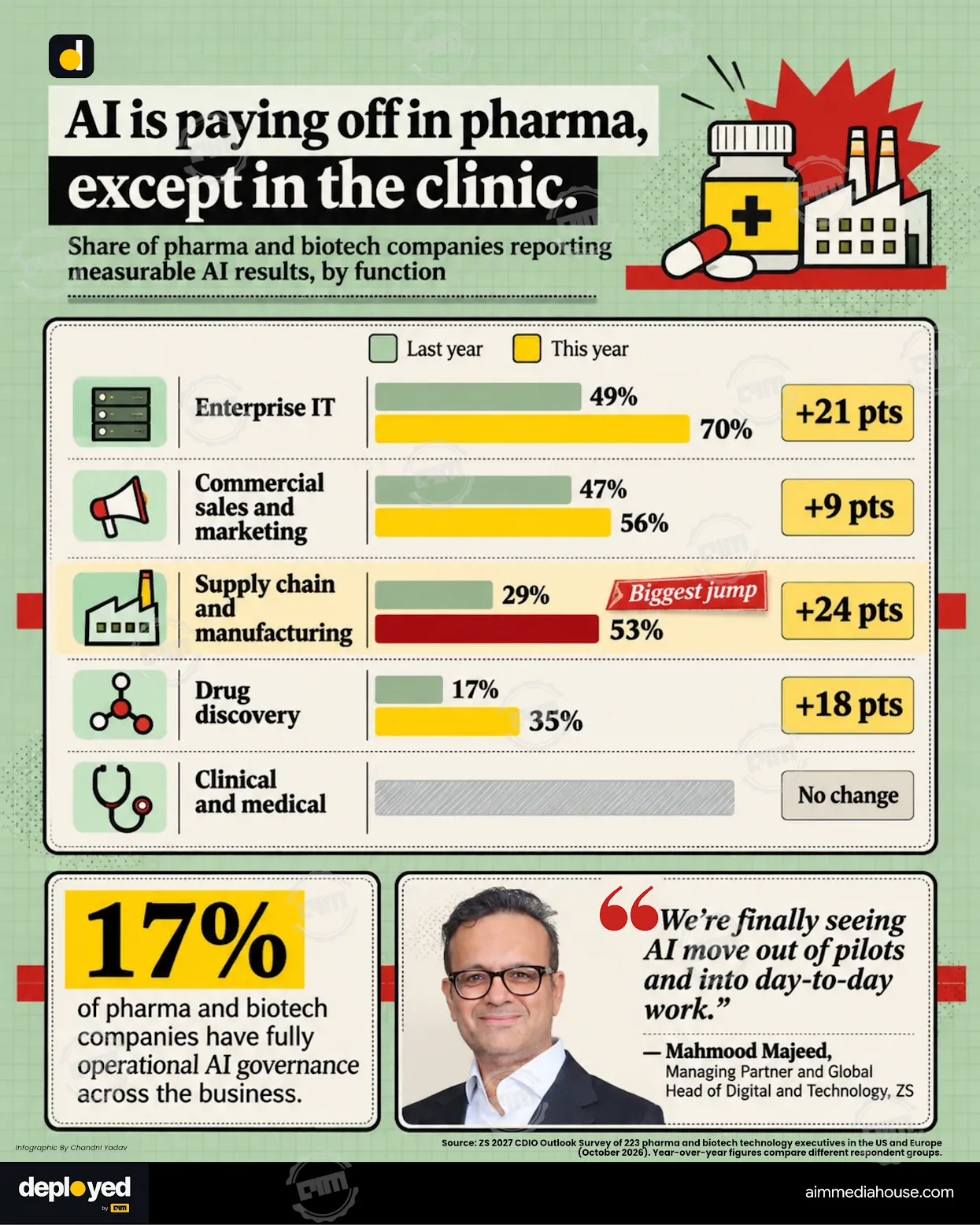
- 01AI is showing measurable results in the pharmaceutical industry, particularly in supply chain and manufacturing, where outcomes increased from 29% to 53%.
- 02Only 17% of pharmaceutical and biotech organizations have fully operational AI governance across their enterprises, with 55% still in the process of defining or rolling it out.
- 03The share of measurable AI outcomes in drug discovery rose from 17% to 35%, while clinical development results remained unchanged.
Show all 5Show less
- 04Pharmaceutical companies classified as AI value leaders prioritize data for AI as mission-critical and are more likely to redesign roles for AI-supported work compared to others.
- 05A significant portion of life sciences leaders express concerns about AI usage within their organizations, with 79% stating that AI's risk and return should be evaluated against current human-led processes.
Follow Deployed on Google
AI is delivering measurable results in pharma. Most of them are coming from the parts of the business furthest from the patient.
ZS surveyed 223 technology executives at pharmaceutical and biotechnology companies in the US and Europe for its 2027 CDIO Outlook, released in October.
The share reporting measurable AI outcomes in supply chain and manufacturing rose from 29% to 53%, the largest jump of any function. In drug discovery, it rose from 17% to 35%.
Commercial sales and marketing rose from 47% to 56%, and enterprise IT from 49% to 70%. Clinical and medical results were essentially flat.
"We're finally seeing AI move out of pilots and into day-to-day work," said Mahmood Majeed, managing partner and global head of the digital and technology business at ZS.
Where AI Is Working
The functions reporting the strongest gains share one thing: they look like operations in any other industry. Supply chains, manufacturing lines, IT systems, and commercial teams run on structured data and repeatable processes, and AI is producing results there first.
Among the companies ZS classifies as AI value leaders, 71% say AI now executes decisions within defined limits in supply chain and manufacturing.
Even there, the final call stays with people. In regulated manufacturing, Majeed said, "decisions about release, disposition or corrective action still sit with a qualified person."
The value leaders, 38% of respondents, report measurable outcomes across at least three of four core business areas. They are doing several things differently.
72% consider data for AI a mission-critical priority, compared with 46% of other organizations. 54% prioritize validating AI before regulated use, compared with 40%. And 48% are redesigning roles for AI-supported work, compared with 27%.
They are also more likely to keep core data engineering in-house, at 69% versus 53%, and nearly 1.5 times more likely to expect significant increases in 2027 spending on data infrastructure and platform modernization.

The week's drug discovery, trials and health-system deployments. Wednesdays.
ZS surveyed a different group of respondents each year, so the year-over-year changes reflect broad trends across the industry rather than shifts within the same companies.
Drug discovery has doubled its share of measurable results in a year, from a low base. Clinical development, where trials, patient data, and regulators meet, has not moved.
The Governance Gap
Results are spreading faster than the rules around them. Only 17% of the pharma and biotech organizations ZS surveyed have fully operational AI governance across the enterprise. Another 55% are still defining or rolling it out.
A separate survey of 135 life sciences leaders, released October 28 by ACTO, a vendor of responsible-AI tools, points to the same gap. 64% have an AI governance process either fully established (22%) or in development (42%). The other 36% have none, or rely on a one-time approval gate. 58% say the industry lacks clear standards for responsible AI.
The same survey found 23% of organizations do not monitor or discuss employees' use of unauthorized AI agents. Asked who should be accountable when an AI agent acts, respondents split: 34% said the end user, 28% legal and compliance, 22% the AI vendor, and 16% IT.
The top internal barrier was not technology. Regulatory, legal, or compliance hesitation ranked first at 21%. Technical readiness ranked last, at 9%.
The leaders themselves are divided. 69% rate their personal comfort with AI as high, while 54% say they are concerned about how AI is being used inside their own organization. And 79% say AI's risk and return should be judged against today's human-led baseline.
"Traceability should be built into the system from the beginning as opposed to being added afterward," Majeed said.
Pharma's AI results are concentrated in the functions where the work is most like other industries and the stakes are easiest to contain.
A delayed shipment can be rerouted. A flawed clinical decision cannot be reversed as easily, and every step is subject to regulatory scrutiny.
That is also where the governance gap matters most. Only 17% of companies have enterprise-wide AI governance in place, and the industry has not agreed on what responsible AI should look like. Moving AI into clinical work will require both.
The factory has already shown AI can deliver in pharma. The question is whether the industry can build the controls the clinic needs before it tries.
Last updated
