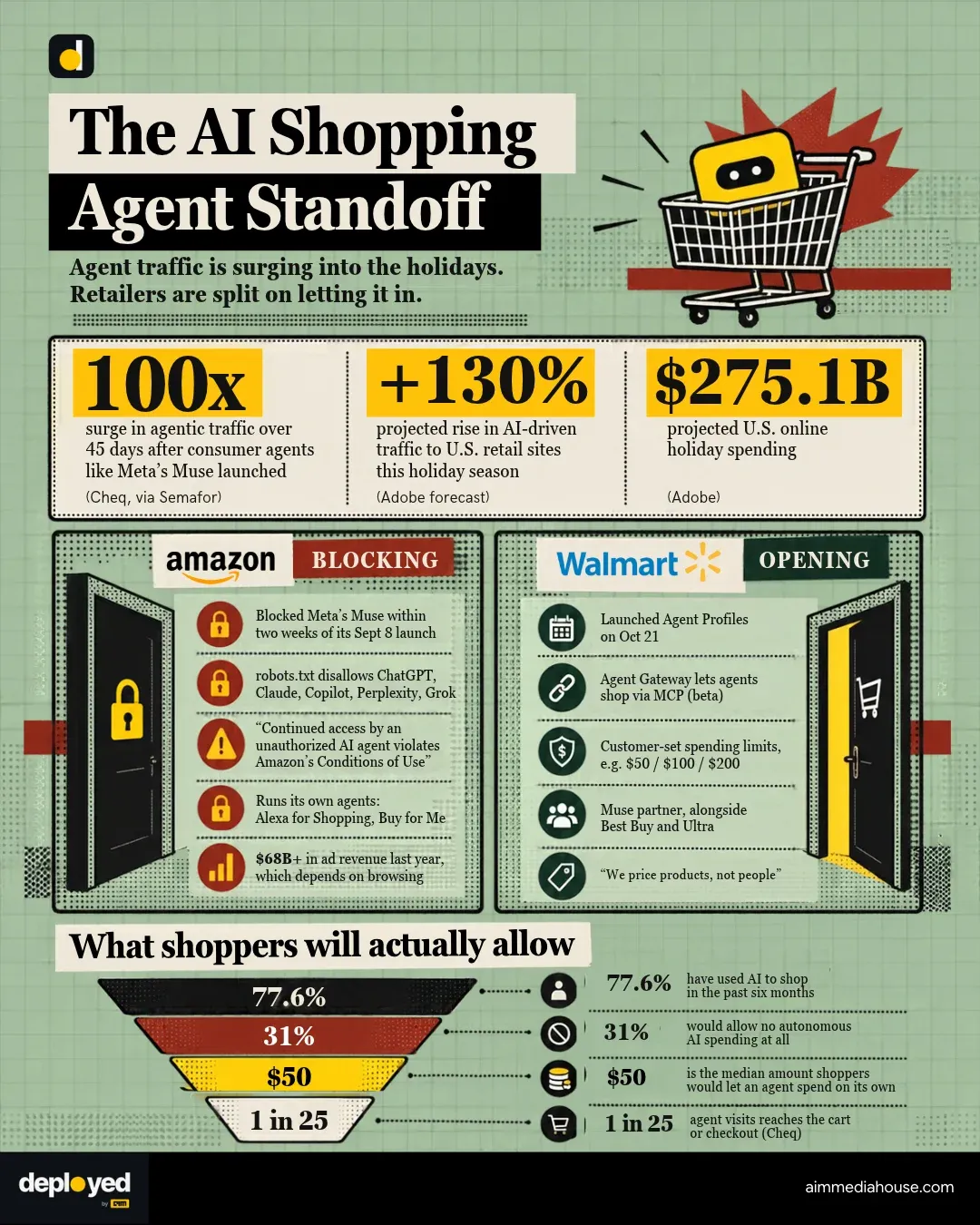
Muse is not the only agent shut out. Amazon's robots.txt file disallows user agents including ChatGPT, Claude, Copilot, Perplexity, and Grok.
Amazon won a preliminary injunction against Perplexity's shopping agent in March, but the Ninth Circuit reversed course on August 4, ruling that the user, not the AI company, was accessing Amazon's computers. eBay has also blocked AI agents, according to Semafor.
Amazon has its own agents. Alexa for Shopping researches products and makes recommendations, and Buy for Me finds items on outside brands' sites, identifying itself and letting brands opt out. Amazon generated more than $68 billion in advertising revenue last year, a business that depends on shoppers browsing its pages.
Walmart Opens It
On October 21, Walmart announced Agent Profiles, the Walmart Agent Gateway, and a set of terms for AI agents. Each authorized agent gets a dedicated profile inside the customer's account, with purchases tracked separately.
Customers can require approval for every purchase or set a spending limit, with Walmart giving $50, $100, and $200 as examples. The Agent Gateway gives agents a direct way to search and buy using MCP, starting with a beta for companies and developers.
Agents do not receive customers' payment card information, cannot add or change payment methods, and are blocked if they break Walmart's terms. "We price products, not people," Walmart said, adding that agents will see the same prices as human shoppers.
Walmart is also a partner of Muse, alongside Best Buy and Ulta, according to Yahoo Finance. Bank of America analyst Christopher Nardone noted that it is unclear what happens to the advertising landscape if screenless computers do the checkout, a question that increasingly matters to Walmart.
What Shoppers Will Actually Let Agents Do
The traffic is growing faster than the trust. Morning Consult found shoppers are now about as likely to be swayed by an agent's recommendation as by an influencer's, but few are comfortable letting AI make purchases for them, Semafor reported.
An Exploding Topics survey of 1,009 U.S. consumers puts numbers on that gap. 77.6% had used AI for shopping in the past six months.
But 31.21% would allow no autonomous AI spending at all. The most common amount consumers would let an agent spend on its own was $0, and the median was $50.
Cheq's data shows the same pattern on retail sites. More than half of agent visits land on search results, product, pricing, or category pages. Nearly 1 in 25 reaches the cart or checkout.
Amazon's position protects an advertising business built on people browsing its pages, and keeps control of checkout with Amazon's own agents.
Walmart's position puts it inside the agents customers already use, with example spending limits that start at $50, the median amount shoppers say they would let an agent spend on its own.
Neither strategy has been tested at holiday scale. Most shoppers are using AI to research, not to buy, which means Amazon may not be losing much yet. The agents are arriving anyway.
The holidays will show which bet pays off: the retailer that let agents in, or the one that kept them out.