


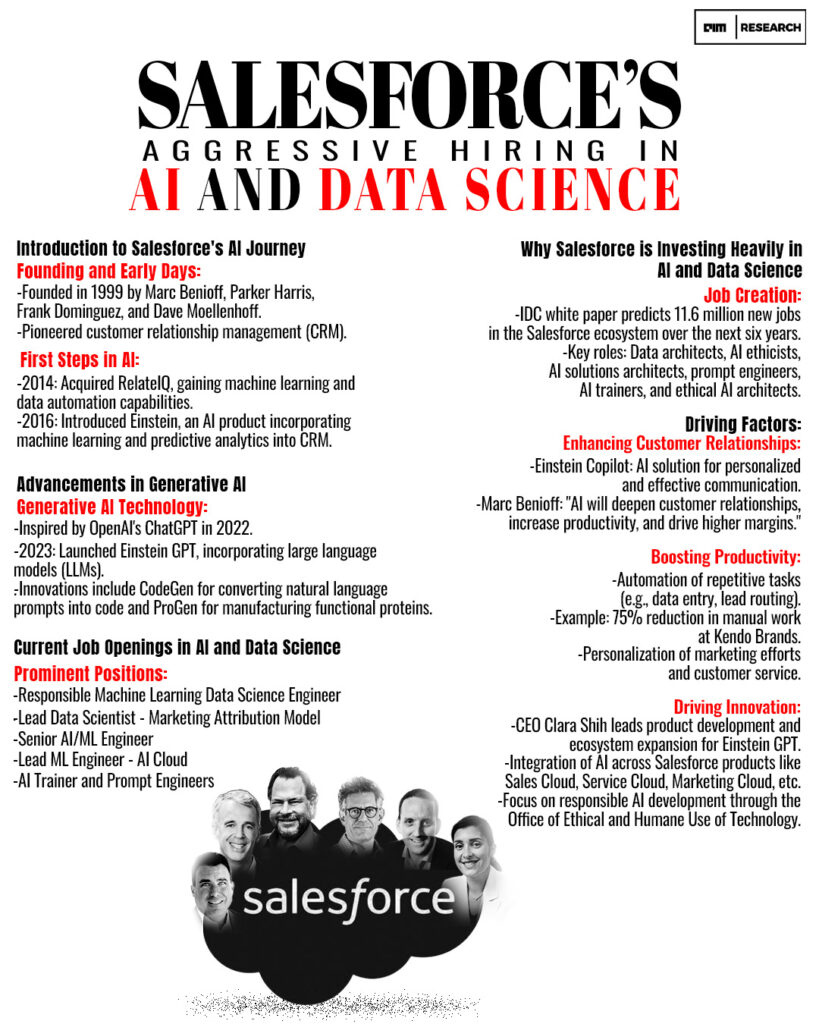
Since its founding in 1999, Salesforce, a pioneer in customer relationship management (CRM) worldwide, has led the way in digital transformation. Salesforce was once an advanced cloud-based CRM solution created by Marc Benioff, Parker Harris, Frank Dominguez, and Dave Moellenhoff with the goal of revolutionising how companies manage customer interactions and data. Salesforce's foray into artificial intelligence (AI) dates back to 2014, when the business acquired RelateIQ, a machine learning and data automation specialist. Through this calculated action, Salesforce's ecosystem gained access to AI capabilities, opening the door for further advancements. During the Dreamforce conference in 2016, Salesforce unveiled Einstein, their inaugural AI product. By incorporating machine learning and predictive analytics into Salesforce's CRM, the renowned scientist Einstein sought to democratise artificial intelligence (AI) and make it usable for companies of all sizes. This allowed users to make data-driven choices and obtain deeper insights.
The launch of generative AI technology marked a significant milestone in Salesforce's AI progress. The promise of generative AI was demonstrated by OpenAI's introduction of ChatGPT in 2022, which led Salesforce to include comparable features in its products. Large language models (LLMs) were created as a result, and in 2023 Einstein GPT was introduced. The company's AI research team, led by notable individuals like Silvio Savarese and Richard Socher, has been instrumental in expanding AI applications, from generative models to predictive analytics. Innovative technologies like CodeGen, which converts natural language prompts into executable code, and ProGen, which employs artificial intelligence (AI) to manufacture functional proteins for medicinal purposes, are the product of these efforts.
Why Salesforce is Investing Heavily in AI and Data Science
According to a recent IDC white paper supported by Salesforce, there will be a significant increase in employment over the next year for positions such as data architects, AI ethicists, and AI solutions architects. Over the next six years, 11.6 million new jobs are expected to be created inside the Salesforce ecosystem alone. In response to the growing array of opportunities driven by artificial intelligence (AI), Salesforce Chief People Officer Nathalie Scardino reportedly said in a TOI report that the company is actively hiring for roles like prompt engineers, AI trainers, and ethical AI architects.
