What Are the Top AI Startups in Space for 2024?

By applying AI to improve data processing, streamline in-orbit operations, and manage autonomous systems, these startups are setting new standards in space operations and opening up exciting opportunities for the future.
The space industry is experiencing a significant shift as innovative startups harness the capabilities of artificial intelligence to reshape our approach to exploration and technology beyond Earth. As access to space becomes increasingly attainable, these companies are breaking down traditional barriers, allowing a diverse range of players to engage in satellite technology, space tourism, and more. With ambitious missions like lunar exploration on the horizon, private enterprises are not only cutting costs but also enhancing operational capabilities in remarkable ways. By applying AI to improve data processing, streamline in-orbit operations, and manage autonomous systems, these startups are setting new standards in space operations and opening up exciting opportunities for the future.
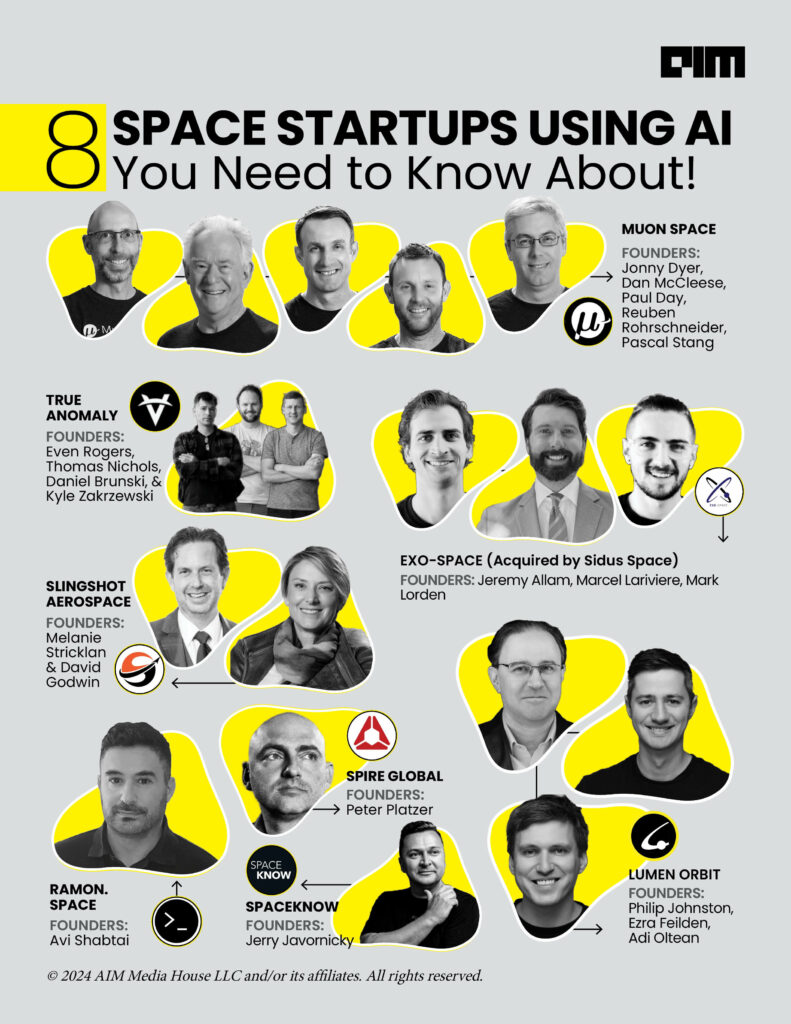 >
>Muon Space
Founders: Jonny Dyer, Dan McCleese, Paul Day, Reuben Rohrschneider, Pascal Stang
>
>AI Initiatives:
>
>1. Advanced Satellite Constellation
>Muon Space utilizes cutting-edge AI technology in its satellite constellation to monitor environmental pollution, focusing on tracking greenhouse gas emissions and critical environmental data from space.
2. Precise Pollution Tracking
>With sophisticated sensors, the company identifies pollution sources, such as methane leaks from oil and gas operations, enabling targeted environmental management.
3. Collaboration on FireSat Project
>In partnership with Google, Muon Space is developing over 50 satellites equipped with custom infrared sensors to detect and track wildfires with exceptional accuracy.
4. Rapid AI Analysis
>The AI-driven FireSat system analyzes imagery quickly, assessing local infrastructure and weather conditions, and providing updates every 30 minutes. It can detect fires as small as 5x5 meters, far exceeding current satellite capabilities.
5. Supporting Emergency Response
>Data generated from Muon Space's efforts supports emergency response initiatives, creates a historical record of fire activity, and aids in scientific research on wildfire behavior, enhancing the ability of governments and organizations to manage environmental impacts.
True Anomaly
Founders: Even Rogers, Thomas Nichols, Daniel Brunski, and Kyle Zakrzewski
AI Initiatives:
1. Enhanced Jackal Satellites
>True Anomaly leverages AI and machine learning to boost the capabilities of its Jackal satellites, focusing on mission planning and autonomous operations.
2. Optimized Flight Trajectories
>AI integration allows for optimized flight paths, ensuring safe and effective mission execution during maneuvering and image capture.
3. Autonomous Orbital Pursuit
>Jackal acts as an "autonomous orbital pursuit vehicle," making real-time decisions in complex scenarios like uncooperative rendezvous and proximity operations.
4. Space Domain Awareness Applications
>The company is developing a suite of Space Domain Awareness (SDA) applications that utilize powerful analytics and AI to enhance operational efficiency.
5. Mosaic Software for Training
>True Anomaly’s Mosaic software functions as an integrated operating system for space security, using AI to support Jackal’s operations and providing realistic training scenarios against AI-driven adversaries.
Exo-Space (Acquired by Sidus Space)
Founders: Jeremy Allam , Marcel Lariviere , Mark Lorden
AI Initiatives:
>
>1. FeatherEdge AI Platform
>Exo-Space’s FeatherEdge AI platform uses advanced machine vision algorithms to process Earth observation data in real time, providing immediate insights from onboard imaging systems.
2. Quick Crisis Response
>The platform enables rapid detection of environmental crises, such as illegal fishing, natural disasters, and oil spills, facilitating timely action for governments and organizations.
3. Integration with Sidus Space
>Exo-Space's technology powers Sidus Space’s LizzieSat satellite constellation, delivering near-real-time intelligence to commercial and government clients.
4. Hardware-Agnostic Solutions
>Their proprietary software adapts to the latest processor advancements, ensuring ongoing upgrades without requiring complete system changes.
5. Strong Contracts and Future Focus
>With contracts extending through 2025, Exo-Space is enhancing space-based edge processing, building on-orbit computing satellites to provide data analytic solutions across various industries.
Slingshot Aerospace
Founders: Melanie Stricklan and David Godwin
AI Initiatives:
1. Collaboration with DARPA
>Slingshot Aerospace, in partnership with DARPA, developed the Agatha AI system to identify anomalous spacecraft within large satellite constellations.
2. Inverse Reinforcement Learning
>Agatha employs Inverse Reinforcement Learning (IRL) to evaluate behaviors and discern the intentions of tracked objects, surpassing basic anomaly detection methods.
3. Processing Vast Space Data
>The system can process extensive space data, including high-resolution astrometric, contextual, and photometric information from multiple sources.
4. Successful Sim-to-Real Transfer
>Trained on over 60 years of simulated constellation data, Agatha effectively bridges the "sim-to-real transfer" gap, applying its capabilities to real-world commercial constellations.
5. Scalability and Explainability
>Agatha is scalable and adaptable, with potential applications in genomics, biomedicine, agriculture, and utility optimization. Importantly, it provides "explainability," offering context for flagged anomalies, which is crucial for building trust in AI systems.
Ramon.Space
Founder: Avi Shabtai
AI Initiatives:
1. Specialized AI and ML Processors
>Ramon.Space designs unique AI and machine learning processors tailored for space applications, enabling Earth-like computing capabilities in the harsh environment of space.
2. Essential Infrastructure for the Space Economy
>Their technology serves as critical computing infrastructure for the burgeoning space economy, catering to satellite manufacturers, operators, and service providers.
3. Versatile Computing Platform
>The Ramon.Space computing platform supports a wide range of data-driven applications across sectors like satellite communications, remote sensing, autonomous robotics, and space exploration. It features the NuStream storage solution and a robust AI DSP machine for real-time data analysis.
4. Radiation-Resilient Design
>Ramon.Space prioritizes reliability with its radiation-resilient processors, ensuring high performance and mission success in challenging space environments.
5. Proven Track Record
>With an impressive zero failure rate, Ramon.Space technology has been deployed in over 50 deep space and satellite missions across the solar system, collaborating with space agencies, governments, and commercial providers worldwide.
SpaceKnow
Founder: Jerry Javornicky
AI Initiatives:
>1. Automated Geospatial Analytics
>SpaceKnow employs deep learning algorithms and partnerships with satellite image providers to perform large-scale, automated geospatial analytics.
2. Long-Term Imagery Analysis
>A proprietary, AI-powered analytics engine, combined with the world's most comprehensive collection of earth observation imagery.
3. Valuable Insights for Governments
>Governments can leverage these AI-driven insights to monitor illegal constructions and assess environmental changes, enhancing regulatory efforts.
4. Support for Prime Contractors
>Prime contractors benefit from tracking construction progress through satellite data, ensuring projects stay on schedule and within budget.
5. Investment Strategy Enhancement
>Investors can analyze company activities, such as vehicle presence, to predict revenues and inform investment strategies, transforming satellite data into actionable intelligence for financial services and economic forecasting.
Spire Global
Founder: Peter Platzer
AI Initiatives:
1. Extensive Nanosatellite Network
>Spire Global has launched over 100 nanosatellites to collect vital global data around the clock, focusing on maritime, aviation, and weather information.
2. Key Data Types
>Their satellites gather three primary data types: maritime Automatic Identification System (AIS) data for ship geolocation, aviation Automatic Dependent Surveillance-Broadcast (ADS-B) data for aircraft tracking, and weather Radio Occultation data for atmospheric insights.
3. Cloud-Based Data Processing
>Spire processes and analyzes raw data using cloud-based systems, offering it alongside curated datasets like weather information for comprehensive insights.
4. Predictive Analytics
>They provide predictive analytics, such as forecasting vessel locations, which benefits various industries, including governance, defense, and freight companies.
5. Versatile Industry Applications
>Spire's services are crucial for trade sanction monitoring, insurance firms, search and rescue operations, and aviation safety. Their weather data supports agriculture, tourism, and industries like chemical suppliers, enhancing demand forecasting and operational timing.
Lumen Orbit
Founder: Philip Johnston, Ezra Feilden, Adi Oltean
AI Initiatives:
>
>1. Vision for Space-Based Data Centers
>Lumen Orbit is developing megawatt-scale data centers in space, scalable to gigawatt capacity, to meet the growing energy demands of AI development, such as training models like GPT-6.
2. Advantages of Orbital Operations
>The company aims to leverage unique benefits of space, including abundant solar energy, efficient passive cooling in the cold vacuum of space, and the scalability of orbital facilities free from terrestrial constraints.
3. Cost and Environmental Benefits
>Lumen Orbit estimates operational costs for a space-based data center could be as low as $8.2 million over a decade, significantly lower than the $167 million for a ground-based facility. Energy expenses may drop to just $2 million over ten years compared to $140 million for a comparable terrestrial center.
4. Strategic Partnerships and Prototypes
>In partnership with NVIDIA's Inception Program, Lumen Orbit plans to launch a demonstrator satellite in May 2025 equipped with GPUs 100 times more powerful than any previously operated in space. This satellite will initiate the first AI model training in orbit.
5. Addressing Technical Challenges
>While the vision is promising, Lumen Orbit faces challenges such as protecting technology from solar radiation, developing effective heat management systems, and overcoming logistical issues related to space-based operations.
Key Takeaways
- Explore how AI is revolutionizing the space industry and enhancing operational capabilities.
- Discover startups breaking barriers in satellite technology and space tourism through innovative AI applications.
- Learn about Muon Space's advanced satellite constellation focused on monitoring environmental pollution.
- Understand the role of AI in improving data processing and managing autonomous systems in space.
- Recognize the growing accessibility of space, allowing diverse players to engage in exploration.