Banking
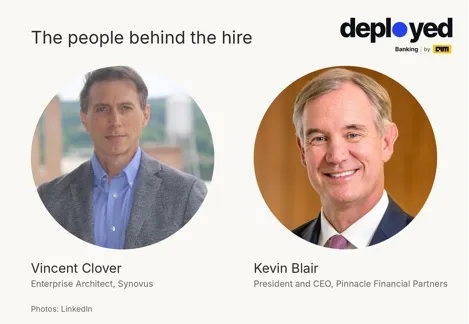
On 22 October, Vincent Clover, an enterprise architect at Synovus in Columbus, Georgia, posted that his team is hiring an AI Engineer to modernise the bank's operations. He wants someone hands-on who loves to build "production-grade agentic systems", along with robust retrieval strategies, orchestration frameworks and tool integration. The role, listed as job 26962, is open in Columbus and two other locations.
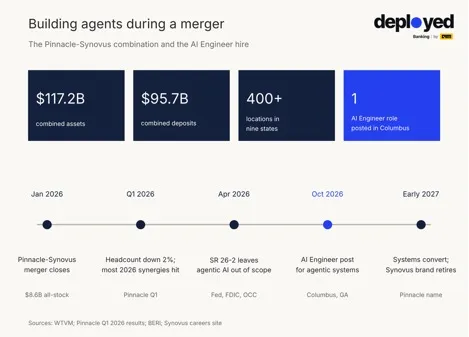
The timing is what makes it interesting. Synovus no longer stands alone. Its $8.6 billion all-stock merger with Pinnacle Financial Partners closed on 2 January 2026, creating a lender with about $117.2 billion in assets, $95.7 billion in deposits and more than 400 locations across nine states. Kevin Blair, who ran Synovus, is now president and CEO of the combined company. Both banners continue through 2026, and systems and branding are due to consolidate under the Pinnacle name in early 2027.
The post and the posting tell different stories
Clover's post describes an agent builder. The formal job description on the Synovus careers site reads closer to an IT operations role. It lists firewall compliance, incident response, runbooks, capacity monitoring and support for business partner software, and asks only for familiarity with retrieval augmented generation. It even carries a standard physical requirement to lift up to 10 pounds. The same careers site lists an AI Business Analyst opening in Atlanta, which suggests the bank is staffing its AI effort across both of its Georgia hubs.
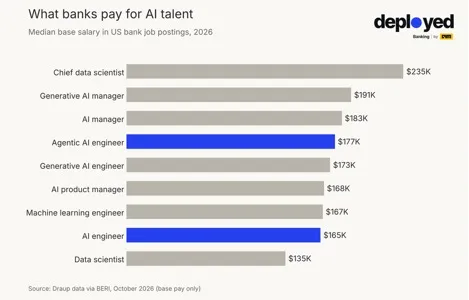
Template job descriptions are common in banking, and the gap may say more about HR process than intent. It still matters, because pay bands usually follow the description. According to Draup data published by BERI, the median base salary for an agentic AI engineer in US bank postings this year is about $177,000, against roughly $165,000 for an AI engineer and $135,000 for a data scientist. A role scoped and paid as IT engineering may struggle to land the person Clover is describing, especially when Lloyds Banking Group alone is targeting around 300 agentic AI hires in 2026.
Build or buy, during a conversion
The bigger argument is whether a regional bank should insource agent engineering at all, and whether it should do so mid-integration. Pinnacle's first-quarter results showed headcount down 2% sequentially and most of the year's expense synergies already captured, with management pointing to AI-driven productivity as a lever. Engineers hired now will build on Synovus systems that are scheduled to convert within months.
Vendors are offering an alternative. Deployed's banking desk has tracked Fiserv's agentOS, which lets banks deploy and govern agents on a provider's platform, and Goldman Sachs is working with Anthropic to build agents for core banking tasks. U.S. Bank has argued that the hard part is decision design, which no vendor can supply. Clover's bet sits with that view: agents that touch lending, servicing and compliance workflows are better understood by the people who run them, and an in-house team reduces dependence on any single platform.
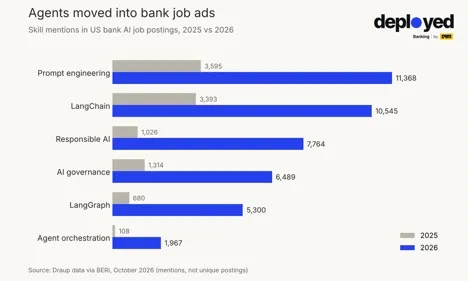
The market is moving the same way. Draup counted 1,967 mentions of agent orchestration in US bank AI postings in 2026, up from 108 a year earlier, while LangGraph mentions rose from 680 to 5,300. An Accenture survey found 56% of banking executives expect agents to be broadly adopted in credit assessment, loan processing and know-your-customer work within three years. Builders comfortable with agentic RAG are becoming the scarce input.
The rulebook gap
In April, the Fed, FDIC and OCC replaced their long-standing model risk guidance with SR 26-2, aimed mainly at banks above $30 billion in assets. A footnote describes generative and agentic AI as novel and places them outside the guidance's scope. Pinnacle sits far above that threshold. A bank that builds its own agents is, in effect, writing its own model-risk playbook for them, which may explain why governance skills now outnumber model-building skills roughly two to one in bank job ads.
Five questions for Vincent Clover
- Which banking operations will the first agents handle?
- Will they be built on Synovus systems or on Pinnacle's target stack?
- How does the role's pay band compare with market rates for agentic engineers?
- Who owns model risk for agents, given SR 26-2's carve-out?
- Is this the first hire of a Columbus-based AI engineering team?
Pinnacle has promised a sustained commitment to Columbus, and an AI engineering hire there is one concrete way to keep it. It also keeps engineering judgement close to the operations that agents will change. Whether that engineer ends up building agents or keeping the lights on during a conversion will show how seriously a $117 billion regional bank intends to own its AI.