
Salesforce Counted 3.2 Billion AI Tasks Done Without a Human

Deployment metrics measure cost. Work metrics measure value. Salesforce just started reporting value.
Most enterprise AI metrics measure what companies have bought. Seats licensed. Models deployed. Pilots approved. Salesforce published something different on August 26, 2026.
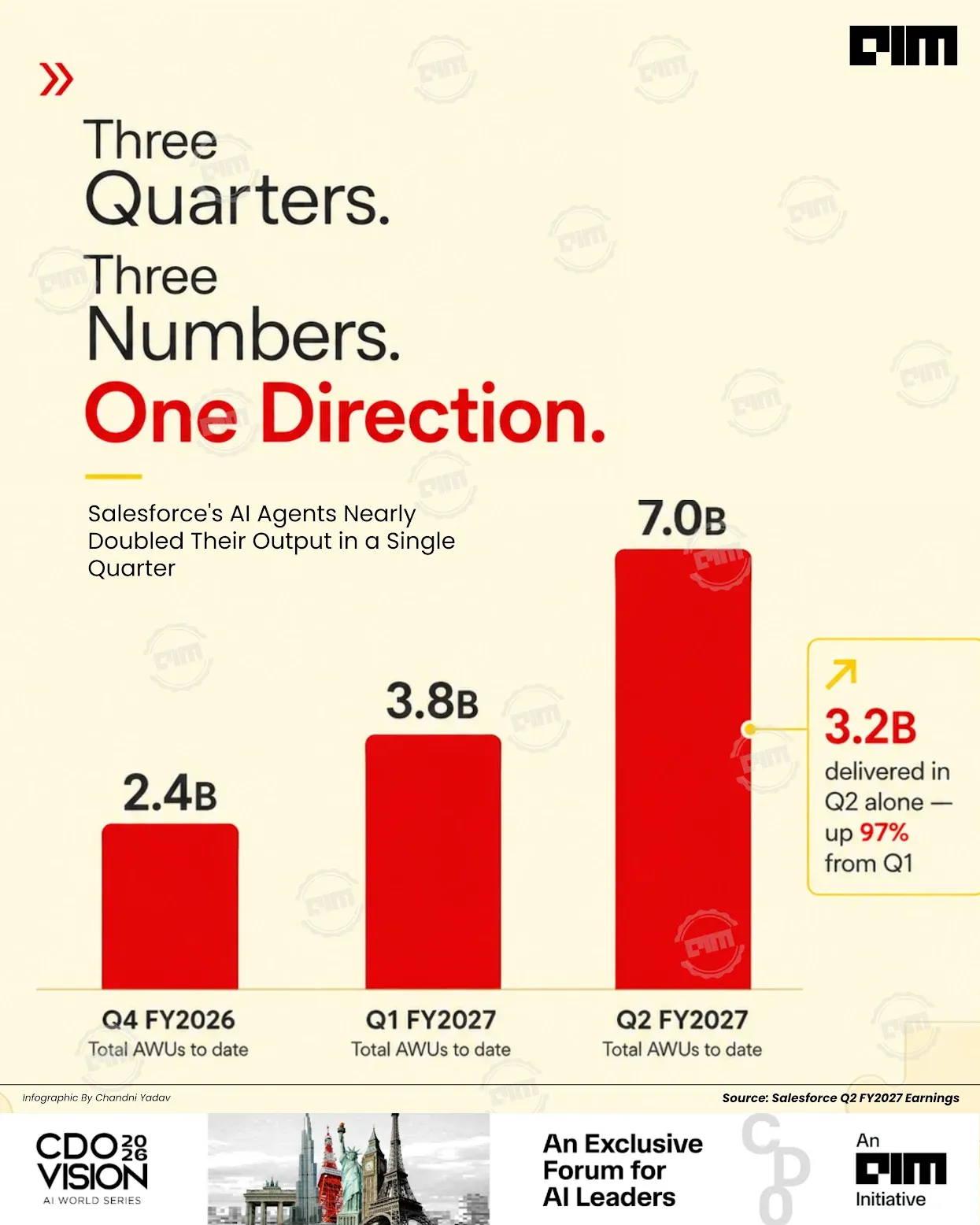
Agentic Work Units. Discrete tasks completed by an AI agent without human intervention. A meeting prepared before a sales call, or a customer query resolved without a rep ever seeing it.
In Q2 FY2027 alone, 3.2 billion of those tasks by Salesforce were completed, up 97% from the previous quarter. Seven billion total to date, with nearly half delivered in the last three months.
Deployment metrics measure cost. Work metrics measure value. The enterprise AI industry has been reporting cost since 2023. Salesforce just started reporting value.
The AWU Is Not Just a Metric
The SaaS company defines an Agentic Work Unit as a discrete task executed by AI agents in production, not a token processed or a dashboard viewed. A task completed.
The definition is important because it sets a higher bar than every other AI usage metric currently in circulation. Token counts measure compute consumed. The Agentic Work Units (AWUs) measure outcomes delivered.
>
The ten largest AWU customers at Salesforce increased their total Salesforce spending by more than 1.5 times over the previous year. The customers generating the most autonomous AI work are spending significantly more on the platform overall. That correlation is the commercial validation behind the 3.2 billion figure.
Slackbot users grew over 150% quarter over quarter in Q2, the fastest Net New Annual Order Value growth since the Slack acquisition.
The AWU architecture spans both Agentforce and Slack, meaning the 3.2 billion tasks occurred not just within CRM workflows but also within the collaboration layer where enterprise work actually occurs.
When a sales rep's meeting is automatically prepared in Slack before they open Salesforce, the agent has moved from a feature within a product to an infrastructure layer beneath the work itself.
Salesforce's own Agentic Enterprise Index, which analyzed production data from businesses that have been running agents continuously since February 2025, gives the AWU figure its industry context. AWU output across the Agentforce platform is growing at a 15% compound monthly growth rate as of April 2026.
Retail agents alone grew 18 times their AWU output during the analysis period. In regulated industries, agents are not just doing more tasks but doing more sophisticated ones, outpacing technology and retail in agent sophistication by 66%.
The average employee tripled their AI agent interactions over the same period, and Slackbot users are averaging 68 sessions per week since general availability in February 2026. These are production metrics from businesses that have been running agents every single month for over a year.
The Numbers Behind the Number
Agentforce ARR exceeded $1.5 billion in Q2, up 240% year over year. Combined Agentforce and Data 360 ARR reached nearly $3.9 billion, up 210%. Revenue for the quarter was $11.35 billion, up 11% year over year, the highest quarterly revenue in Salesforce's history.
Full-year FY27 guidance was raised to $46.1 billion to $46.4 billion, an increase of $200 million or $300 million in constant currency, according to Salesforce.
However, the adjusted non-GAAP EPS of $5.90 included a $ 2.53-per-share gain from strategic investments, specifically, a $2.6 billion gain from Salesforce's Anthropic stake.
The ARR growth rate, the AWU trajectory, and the customer expansion data all point to Agentforce moving from a pilot product to a platform enterprises are building their workflows around.
Data 360 ingested 104 trillion records in Q2, up 355% year over year, with 82 trillion via Zero Copy, a data-sharing architecture that allows enterprises to connect their data to Agentforce without moving or copying it. The Zero Copy volume grew 731% year over year.
Agents can only complete discrete tasks autonomously if they have access to current, accurate data. The 104 trillion records ingested in a single quarter is the supply chain that makes 3.2 billion autonomous tasks possible.
Why the AWU Metric Matters Beyond Salesforce
The AWU is a challenge to every enterprise deploying AI to answer the same question honestly: how many discrete tasks did your AI agents complete without human intervention this quarter?
The WRITER AI Adoption survey found that 97% of executives say they have deployed AI agents but only 23% report significant ROI. The AWU metric is the most specific instrument available for closing that gap, as it forces a distinction between AI that is running and AI that is working.
Salesforce has published 3.2 billion instances of AI working. Every enterprise technology leader should now have one question on their agenda: what is our AWU equivalent?
Not deployment count or token consumption. Discrete tasks completed without human intervention. The enterprises that cannot answer it do not yet know whether their AI is working or just running.
Key Takeaways
- Salesforce reported 3.2 billion AI tasks completed without human intervention in Q2 FY2027.
- This marks a 97% increase in AI task completion from the previous quarter.
- Salesforce shifts focus from deployment costs to measuring the value of AI work metrics.
- Agentic Work Units (AWUs) define discrete AI tasks done autonomously by Salesforce's AI agents.
- Salesforce's new reporting emphasizes the effectiveness of AI over traditional deployment metrics.