

 Manufacturing

Deployment record
In the tracker →- Organisation
- WAI Global
- System
- Director, Enterprise AI Automation & Transformation
- Stage
- Hiring
- Function
- AI operating discipline
- Built on
- Microsoft Copilot, Power Platform, Azure AI
- Scale
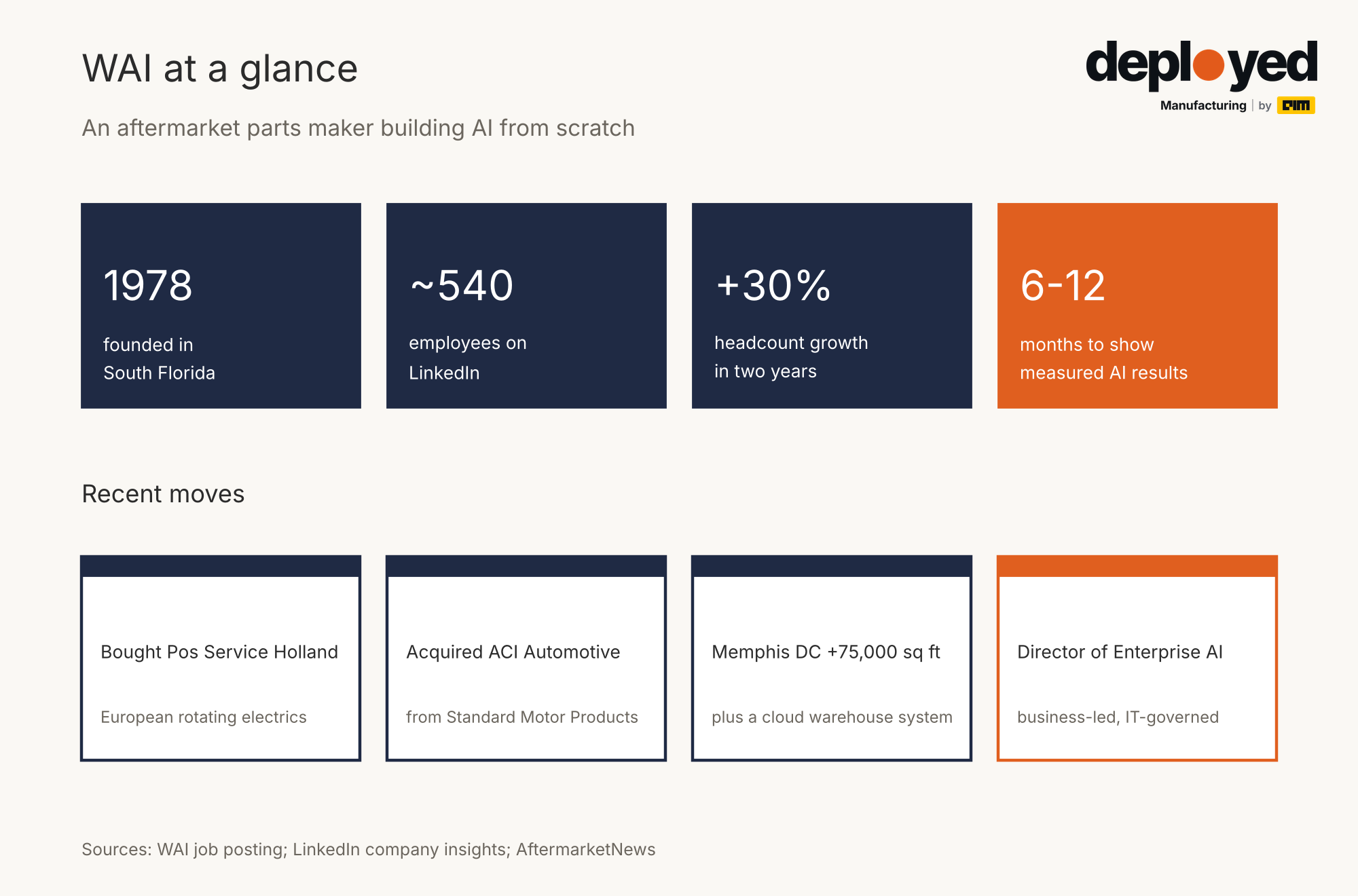
- 540 employees
- 01WAI Global is seeking a Director for Enterprise AI Automation & Transformation to establish an AI program within a year, focusing on practical applications rather than research or generic innovation.
- 02The company has recently expanded through acquisitions and warehouse enhancements, creating a need for AI-driven solutions in various business functions.
- 03WAI's preferred tools for AI implementation include Microsoft Copilot, Power Platform, and Azure AI, with success metrics tied to productivity, quality, speed, service, and cost avoidance.
Show all 5Show less
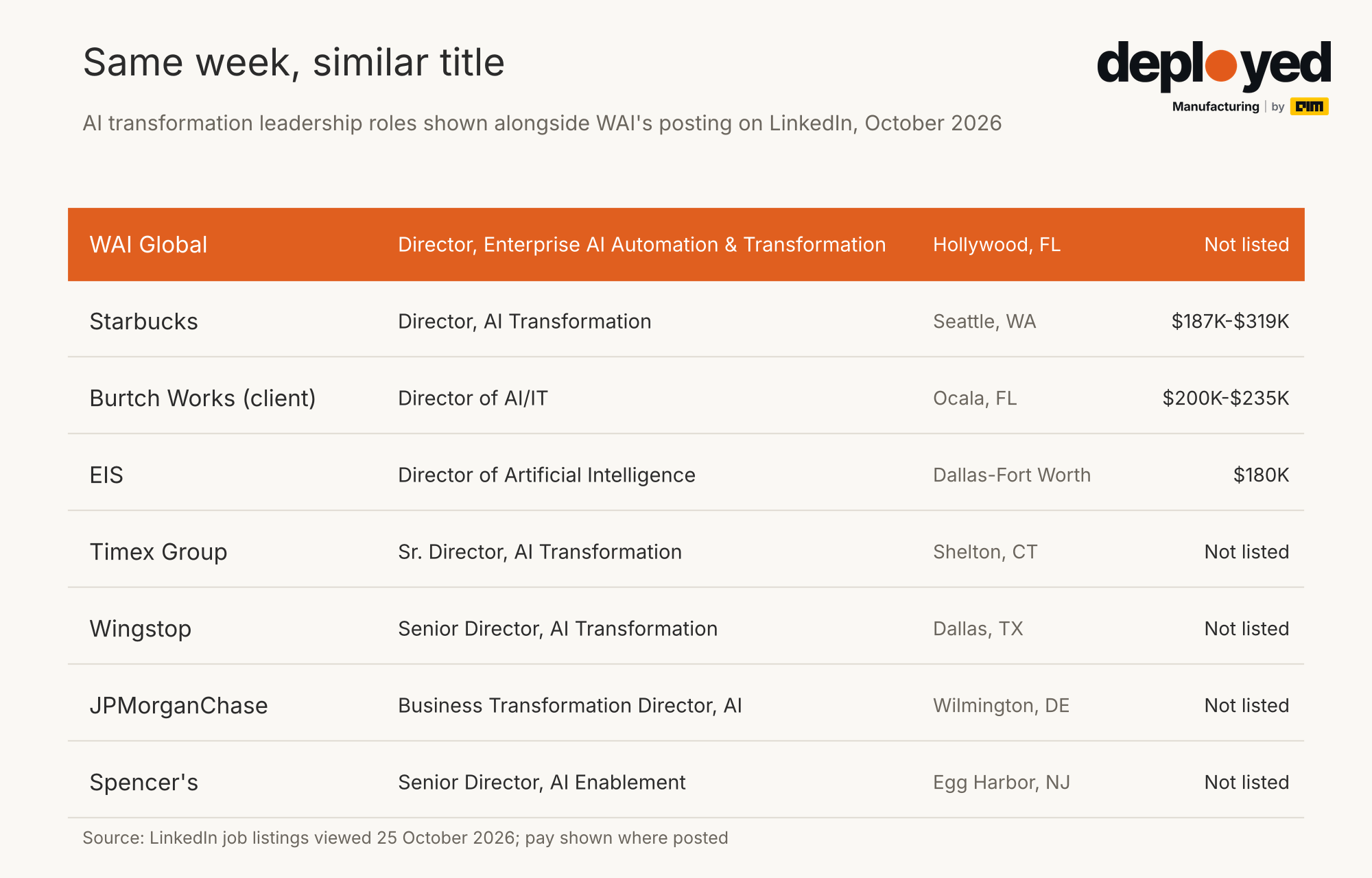
- 04The AI initiative comes amid broader industry trends, with many companies, including Starbucks and JPMorganChase, also hiring for AI transformation roles.
- 05WAI's smaller size allows for quicker process changes compared to larger enterprises, potentially facilitating faster AI integration and measurable results.
WAI Global
Follow Deployed on Google
On 22 October, WAI Global posted a role titled Director, Enterprise AI Automation & Transformation at its Hollywood, Florida headquarters. Nothing in the listing suggests the company has had an AI leader before. The job description says the hire will build the programme from the ground up under a "business-led, IT-governed operating model", and it is unusually direct about what the job is not: "not a research lab role, a generic AI innovation role, or a pure platform engineering role."
The stated goal is to help WAI "move from AI interest to AI operating discipline." The director will run intake, governance and prioritisation, then deliver use cases with Finance, Customer Service, Supply Chain, Sales Support, Operations, HR, Product and Catalog, and Shared Services. Platform architecture and model hosting stay with IT. The preferred toolset is Microsoft Copilot, Power Platform and Azure AI, and success is expected inside six to twelve months, measured in productivity, quality, speed, service and cost avoidance.
A parts maker in a hurry
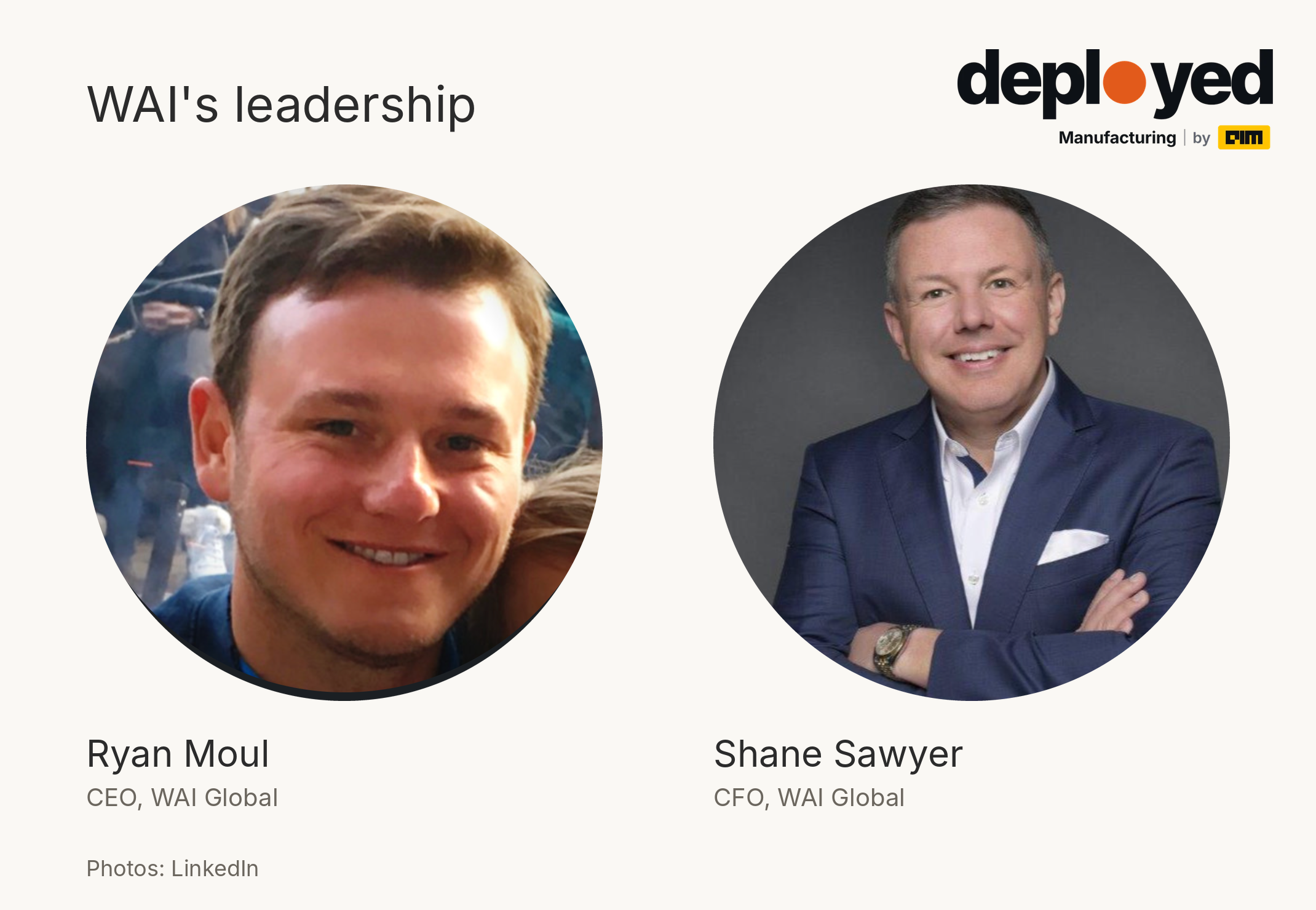
WAI was founded in 1978 and has grown into a global supplier of rotating electrical parts. The company promoted Ryan Moul to chief executive, after years running operations and legal, with Jeff Sween and Doug Moul moving up to co-chairmen. Shane Sawyer is now chief financial officer and Seth Moul leads North America. The company has been busy since. It bought Pos Service Holland from Nordian Capital Partners to deepen its European business, and acquired ACI Automotive, the window-regulator and motor line, from Standard Motor Products. In July it added 75,000 square feet to its Memphis distribution centre and moved to a cloud warehouse management system.
LinkedIn counts about 540 employees, up roughly 30% in two years, and the company competes for aftermarket shelf space with Bosch, Denso and Valeo. Integrating two acquisitions, a larger catalogue and a new warehouse stack creates exactly the kind of order entry, catalogue data, claims and invoice work that AI copilots handle well. The new director will arrive with no shortage of candidate use cases.

The week's factory, energy and chip deployments. Thursdays.
The case against a fast clock
The controversial part is the clock. Large enterprises with dedicated AI teams have struggled to show returns in far longer windows. BCG's 2025 study of more than 1,250 companies found only 5% achieving real value from AI at scale, while 60% reported little or none. MIT NANDA's GenAI Divide report found 95% of enterprise generative AI pilots produced no measurable profit-and-loss impact. A single director, working through other teams and with offshore or remote technical help, is being asked to beat those odds within a year.
There is also a structural risk. A business-led, IT-governed model splits authority, and the director owns neither the budget lines in each function nor the platform. AIM's reporting has found that the barrier to enterprise AI is often middle management, not technology, and its councils have warned that firms are scaling AI before they are ready for it. A governance-first mandate can turn into a queue of approved ideas waiting for engineering time.
Why the narrow brief may be the right one
The counter-argument is that WAI has written the brief the research says works. The MIT study found that companies buying and adapting tools succeeded far more often than those building their own, and that back-office automation delivered the clearest returns. WAI is choosing Microsoft tools it already licenses, starting with finance, service and supply chain work, and asking for metrics from the first quarter. AIM's guidance on measuring AI ROI and on putting business problems ahead of AI hype says much the same.
WAI is also not alone. The same week, Starbucks, Timex Group, Wingstop, JPMorganChase and Spencer's all advertised AI transformation leaders, and Deployed's manufacturing desk has tracked similar first hires at Safariland and Stadler US. What sets WAI apart is size. A 540-person company can change a process in weeks, where a global brand might need quarters.
Five questions for Ryan Moul
- Q1Which business function gets the first AI use case, and why?
- Q2Who funds the use cases, the functions or a central AI budget?
- Q3How much engineering capacity will IT reserve for the director's roadmap?
- Q4Will the integration of Pos Service Holland and ACI Automotive be part of the first wave?
- Q5What result at month twelve would make WAI expand the team?
WAI has spent two years buying companies and building warehouses. Its next acquisition is a way of working. If the new director can show measurable savings by next autumn, a family-run parts maker in Florida will have answered a question that has stumped far bigger firms.
Last updated
