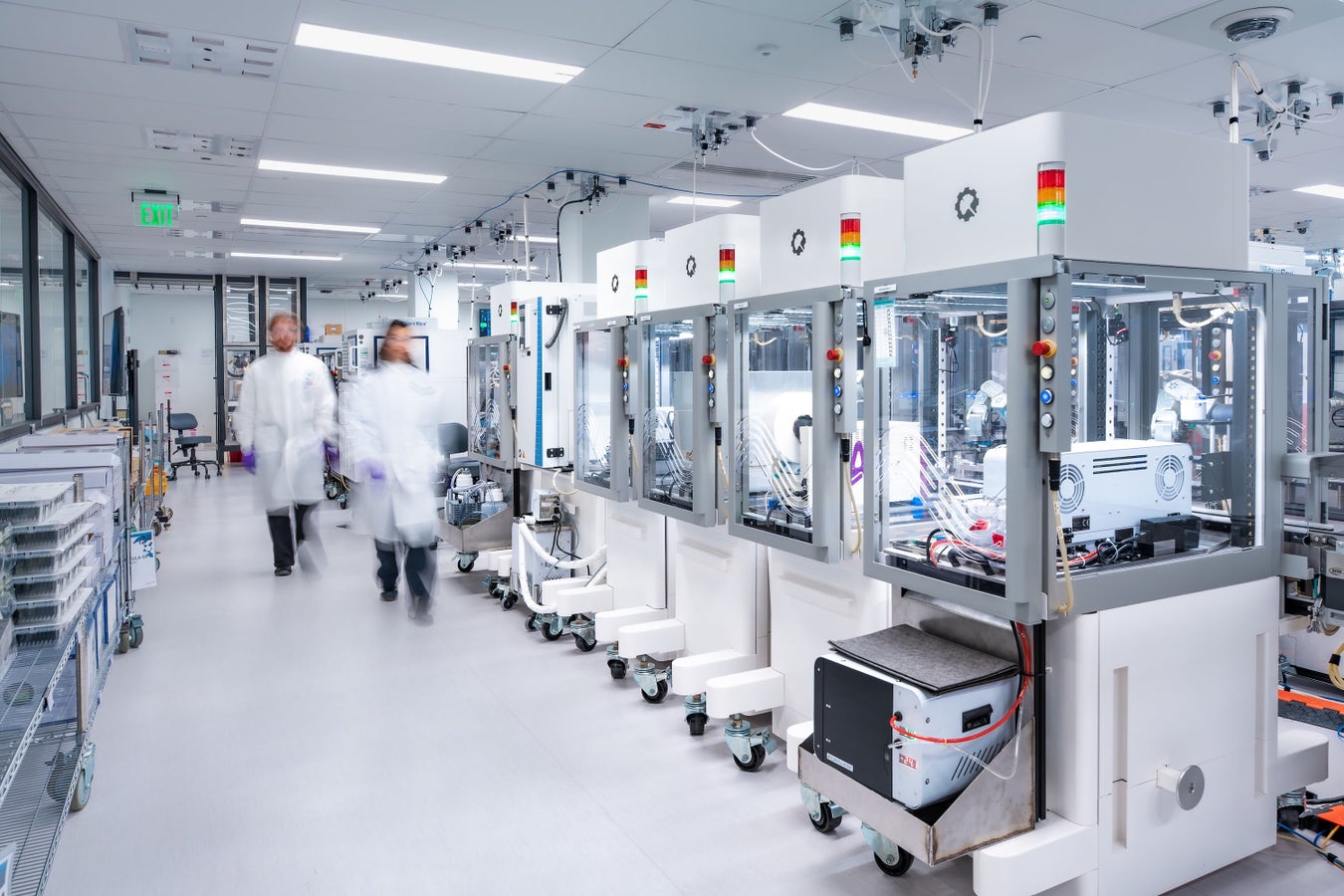
Ginkgo Bioworks is working with OpenAI to connect AI models to real laboratory systems, where they can design experiments, analyze data, and run iterative workflows. The collaboration integrates AI with robotic lab infrastructure, allowing models to operate directly inside research environments rather than supporting them from the outside.
The work moves beyond earlier uses of AI in biology, which focused on literature review and prediction. In the Ginkgo collaboration, OpenAI models designed experiments, generated protocols, and analyzed results from lab runs. In initial tests, the system produced measurable protein output, validating that models could generate viable experimental designs.
The shift comes as AI adoption in healthcare expands across administrative and clinical workflows. AI adoption in healthcare is spreading across drug discovery, clinical trials, and billing workflows, creating a base layer for more complex systems that operate deeper in research environments.
AI moves from analysis to execution in lab environments
The OpenAI system integrates models with tools commonly used by computational biologists, including protein structure prediction and pathway analysis. The model iterates on inputs, evaluates outputs, and refines experiments, mirroring how researchers work at a computer before moving into the lab.
Joy Jiao, Research Lead at OpenAI, described the progression from uncertainty to validation. “Can the model do any biology at all? Can it design experiments that actually make the product that we want?” she said on the OpenAI podcast. Early results showed that AI-generated experiments produced non-zero protein output, confirming functional designs.
The system also relies on agent-based orchestration. Multiple AI processes can run in parallel, handling literature synthesis, experiment planning, and data interpretation. This aligns with broader adoption of agentic systems in healthcare, where AI agents are now acting as intelligent systems across healthcare workflows.
Yunyun Wang, Product Lead at OpenAI, said the goal is to remove constraints on research throughput. “The true bottleneck for the speed and progress of scientific acceleration is at almost a human bottleneck,” she said. The system replaces sequential human tasks with parallel computation and automation.
Autonomous labs point to continuous research systems
The integration of AI with robotic labs introduces a closed-loop system where models propose experiments, machines execute them, and results feed back into the model. This creates continuous iteration cycles without requiring direct human intervention at each step.
Ginkgo’s lab infrastructure provides the execution layer, translating AI-generated protocols into physical experiments. OpenAI’s models act as the reasoning layer, determining what to test and how to adjust based on results. The combined system shifts scientific work from manual execution toward automated pipelines.
This approach addresses long-standing fragmentation in research workflows. Healthcare workflows remain fragmented across systems and processes, limiting reproducibility and scale. OpenAI is introducing structured tools, including workflow plugins and reusable task templates, to standardize common research operations.
The longer-term vision extends beyond individual experiments. Jiao described a model where autonomous labs operate continuously. “You have these autonomous labs… constantly running and curing human disease,” she said. In this model, researchers define high-level goals, while AI systems design and execute experiments at scale.
The expansion also introduces safety considerations. Biological research workflows can be dual-use, making it difficult to distinguish benign from harmful intent. OpenAI is developing differentiated access models, where advanced capabilities are restricted to verified researchers operating within regulated environments.
The broader direction points toward AI systems that manage full research pipelines. As AI platforms expand across care delivery, revenue systems, and research functions, AI platforms are expanding across care, revenue, and research workflows, creating the infrastructure for end-to-end automation.
OpenAI’s life sciences models remain in early deployment, but the Ginkgo collaboration provides a working example of AI executing real-world experiments. The system replaces isolated analysis with integrated experimentation, marking a shift toward autonomous research systems driven by compute and automation.


 Pharma