Retail Is Firing. Walmart Is Training. One of Them Is Wrong.
"We as big employers should be actively engaged in trying to equip our employees to be prepared for a world that is AI enabled and automated."
The retail industry is cutting. Target slashed 1,800 corporate roles in October 2025, 8% of its corporate workforce, affecting merchandising, engineering, analytics, strategy, and HR. It then cut a further 500 positions in early 2026, primarily in regional offices and distribution sites.
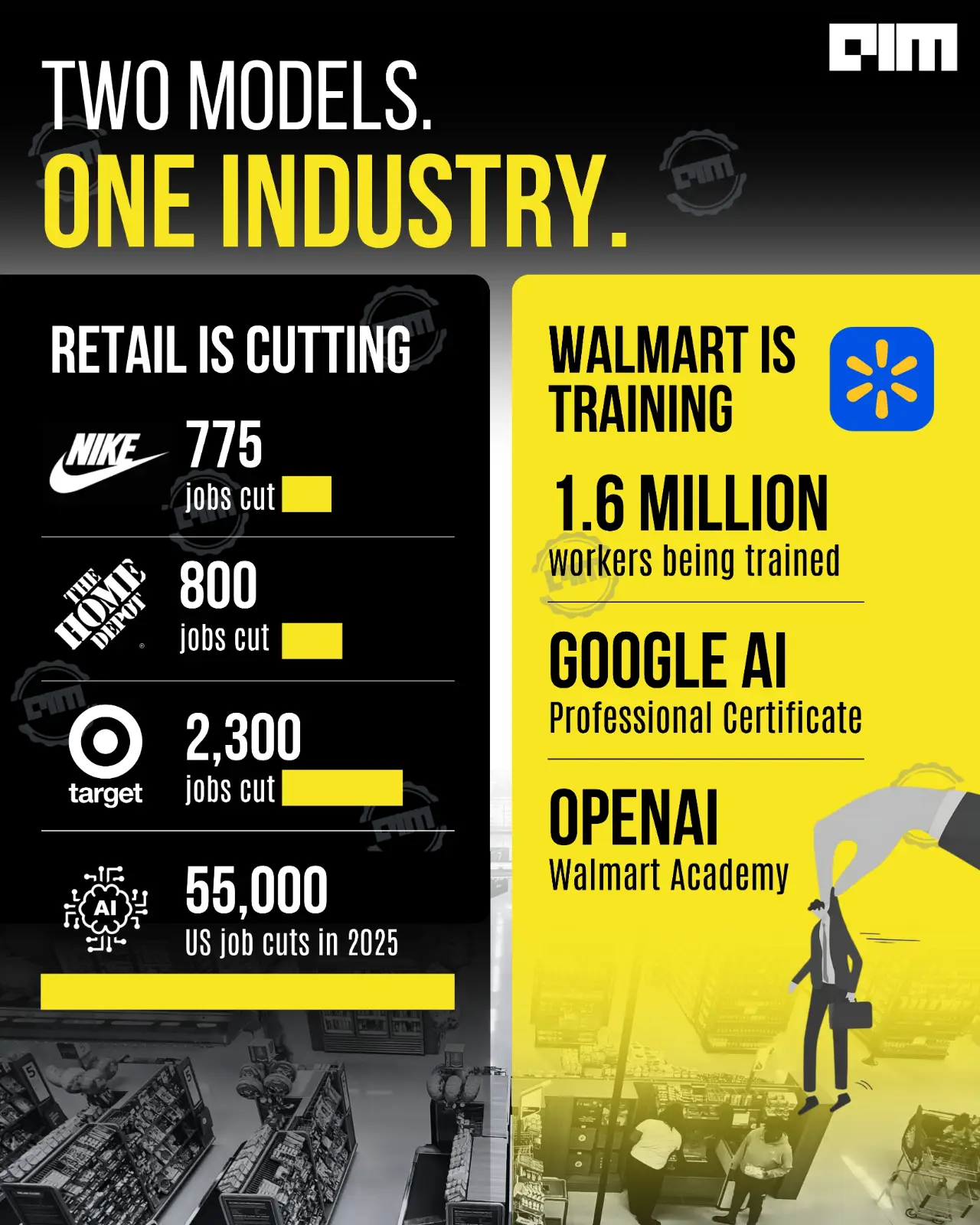
Nike is cutting 775 employees as it accelerates automation at its distribution centers. Home Depot eliminated 800 corporate jobs tied to its Atlanta store support center. Across the industry, the message is consistent. AI and automation have made certain roles redundant, and companies are acting accordingly.
Then there is Walmart.
The world's largest retailer, and the largest private employer in the United States, has announced it will provide free AI training to every single one of its 1.6 million US and Canadian workers. Not just corporate staff or managers. Every worker, including the ones who drive forklifts, push shopping carts, and scan items at checkout.
This raises a question that every large employer is going to have to answer eventually. When AI arrives at scale, do you cut or do you invest?
 >
>The Industry Is Cutting
According to consulting firm Challenger, Gray & Christmas, AI accounted for nearly 55,000 US job cuts in 2025, part of a total 1.17 million layoffs announced across the year. This was the highest level since the Covid pandemic in 2020.
The retail sector was not immune to this. Target's October 2025 cuts were the company's first major round of layoffs in a decade, affecting corporate roles across merchandising, engineering, analytics, strategy, and HR.
Target's incoming CEO Michael Fiddelke said the cuts were about reducing complexity, but they arrived as the company was also investing heavily in AI and technology.
Nike's 775 cuts are explicitly tied to accelerating automation at its distribution centers. Home Depot's 800 corporate job eliminations came alongside a push to drive greater agility and keep the company more closely connected to its frontline operations.
According to them, the logic is simple. If AI can perform tasks that previously required headcount, the rational response is to reduce that headcount and capture the efficiency gain.
For publicly traded companies with investor pressure and margin targets, the substitution model is appealing. It produces visible, immediate results on the income statement. Fiddelke framed Target’s cuts as a strategic necessity.
"The complexity we've created over time has been holding us back," he wrote in a memo to employees. "Too many layers and overlapping work have slowed decisions, making it harder to bring ideas to life."
But not everyone is convinced these cuts are what they appear to be. Sucharita Kodali, Vice President and Principal Analyst at Forrester, said to AIM Media House that the AI justification deserves scrutiny. "I think any company that lays people off and claims it's due to AI probably isn't telling the whole truth. That suggests that companies have already automated everything those employees do and have a plan to shift some of the work to other teams. I'm not sure that is the case. This sounds to me more like the standard downsizing that comes when company stock prices are challenged."
The problem is that it assumes AI productivity is a finite resource you extract by removing people from the equation. Walmart's leadership appears to believe something different.
The contrast is sharpest with Amazon, Walmart's most direct competitor in retail. The e-commerce giant cut roughly 16,000 corporate roles in late 2025 and early 2026, explicitly citing AI-driven efficiency as a primary driver. Two of the world's largest retailers, facing the same AI landscape, reached opposite conclusions.
Walmart’s Bet
Walmart has partnered with Google to provide its entire workforce with free access to Google's AI Professional Certificate, an eight-hour course covering core AI concepts, research, app building, and communication.
The company has also partnered with OpenAI to offer AI certification through its internal Walmart Academy. Both programs are available to frontline and corporate staff alike.
The person making the case for this investment is Donna Morris, Walmart's Chief People Officer. "We as big employers should be actively engaged in trying to equip our respective employees to be prepared for a world that is AI enabled and automated or digitized," Morris told Fortune ahead of the announcement, calling it "unfortunate" when companies use AI to replace workers instead of training them for what is ahead.
Walmart is not a tech company. It is a retailer with razor-thin margins and enormous wage pressure. If any company had the financial incentive to use AI as cover for headcount reduction, it is Walmart.
Its leadership still chose the opposite path, one that signals a belief that investing in workers will outpace the returns from cutting them.
Kodali is not fully convinced the retraining model is straightforward either. "Retraining may be possible but it depends on what you are retraining people to do and if those workers want to be retrained in the way the company wants. If Walmart needs people to stock shelves or unload trucks, that may not be the retraining that a back office employee would want."
Why Workforce Size Will Hold Steady
Former CEO Doug McMillon was direct about AI's scope last September. "It's very clear that AI is going to change literally every job," he said. His successor, John Furner, has been equally direct about what that change will not mean for headcount.
"When we look out two years, three years, five years, where I think we'll be is we'll have roughly the same number of people we have today," Furner told Fortune.
Furner's argument is that AI will reshape roles rather than eliminate them, and that workers who build AI skills will be better positioned to move into higher-value positions within the company.
Top-performing regional managers at Walmart earn between $420,000 and $620,000. For a frontline worker who completes an AI certification and demonstrates the ability to work alongside AI tools, the pathway to those roles becomes more credible, not less.
Morris reinforced the retention logic. "We want to make sure that we equip all of our associates with the best tools to allow them to be successful as Walmart continues to reshape as a people-led, tech-powered company," she said. "But equally so that each of our associates has the ability to navigate their own careers."
At a company employing 1.6 million people, recruiting and retention are operational imperatives. Free AI training that increases engagement and reduces attrition is pure business logic.
The backdrop to Walmart's announcement is a widening skills gap that makes the stakes of this decision clearer. New research from Google and Ipsos found that only 40% of US workers are currently using AI on the job. And just 5% qualify as AI fluent, defined as those who have meaningfully redesigned or reorganized significant parts of their work around AI.
That 5% carries disproportionate economic weight. Workers who are AI fluent are 4.5 times more likely to have received higher wages. The implication is that AI fluency is rapidly becoming a credential that commands a premium, and one that most workers currently do not have.
Morris has framed the skills gap as both a risk and a responsibility, arguing that large employers have an obligation to prepare their workers for an AI-enabled world rather than simply cutting those who have not yet adapted.
Walmart joins other major employers, including Verizon, Colgate-Palmolive, and Deloitte in providing access to the Google AI credential, but none of them are doing it at anywhere near the same scale.
Two Models, One Industry
Retail is showing what other large employers will face as AI scales. Target, Nike, and Home Depot have chosen the substitution model, using AI-driven efficiency as justification for reducing headcount, capturing the gain as margin, and moving on.
Walmart has chosen the multiplier model, investing in the workforce it already has, betting that AI fluency across 1.6 million workers is worth more than the short-term savings from cutting them.
Neither model is irrational. The substitution model produces faster results. The multiplier model requires patience, investment, and a belief that the productivity gains from a more AI-capable workforce will outpace the efficiency gains from a smaller one.
What makes Walmart's choice significant is not just its scale. It is the context. This is the world's largest retailer, operating in one of the most cost-sensitive industries on earth, looking at the same AI landscape as its competitors and reaching a different conclusion.
"I think new jobs will be created. I think new businesses will be created. I think the way we will do things will change. But that's not to say that humans are going to be left behind," Morris said. For 1.6 million Walmart workers, it is a promise.
Key Takeaways
- Walmart prioritizes employee training, providing free AI education to all 1.6 million workers.
- Retail giants like Target and Nike are cutting jobs due to automation and AI efficiency.
- The contrasting strategies of Walmart and other retailers pose critical questions about workforce management.
- AI and automation are reshaping the retail landscape, making certain roles redundant.
- Large employers must decide between layoffs or investing in employee upskilling as technology evolves.