
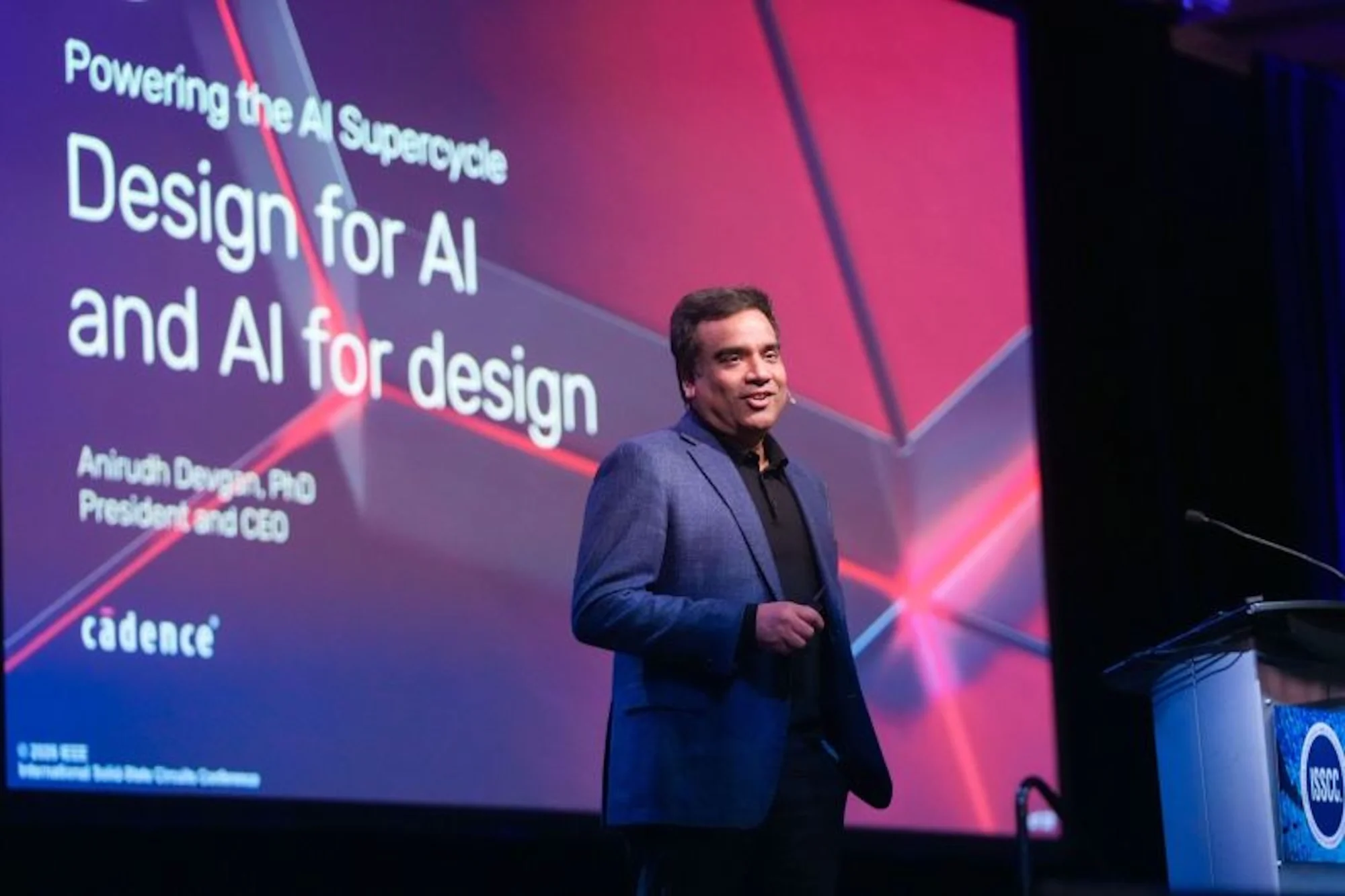
At CadenceLIVE Silicon Valley 2026, Cadence Design Systems closed the loop on what is arguably the most ambitious bet in electronic design automation today: an autonomous, end-to-end chip design flow built on AI Super Agents. The company introduced two new agents — ViraStack for analog design and verification, and InnoStack for digital implementation and signoff — joining the previously launched ChipStack Super Agent for digital RTL design and verification. With all three in place, Cadence now claims full agentic coverage from specification to signoff.
To stitch them together, Cadence also unveiled AgentStack, a unified "head agent" that orchestrates the three Super Agents through a common terminal interface, enabling knowledge and skill sharing across domains. AgentStack is extensible beyond chip design into 3D-IC, system-level design, and analysis — effectively positioning itself as the control plane for the next decade of Cadence's platform.
This is a substantial step-change from the "AI copilot" era most EDA vendors were still operating in six months ago, and a validation of the broader agentic AI wave sweeping enterprise infrastructure.
Why the timing matters
The semiconductor industry has been talking about a "design productivity gap" for years — transistor counts scaling exponentially while design teams scale linearly, and an acute shortage of senior engineers to close the gap. Paul Cunningham, Cadence's VP and GM of R&D, put it bluntly when ChipStack was first announced earlier this year: customers are staring down a senior-engineer deficit they cannot hire their way out of.
Agentic AI has emerged as the industry's answer. Synopsys has outlined its own vision of an "AgentEngineer" workforce — digital implementation agents, verification agents, analog agents — that customers can lease or buy within the next 12 to 24 months. Independent research, including a recent arXiv survey titled The Dawn of Agentic EDA, now formally classifies the shift from L2 "AI for EDA" to L3 "Agentic EDA" as a distinct paradigm, not an incremental improvement. Cadence's announcement is the most complete productisation of that paradigm to date.

The three Super Agents, decoded
ChipStack handles digital RTL design and verification. Given a specification and optionally any prior RTL or testbenches, it generates or refactors code, builds test plans, runs regressions, debugs failures, and fixes issues autonomously. Cadence reports up to 10X productivity improvements in early deployments at NVIDIA, Altera, Qualcomm, and Tenstorrent. Altera has publicly stated that verification effort on flagship FPGA projects has dropped by more than an order of magnitude.
ViraStack takes on the most stubborn part of the flow: custom and analog design. Historically this has resisted automation because it depends on tacit knowledge locked inside a small set of senior designers. ViraStack brings agentic automation to schematic creation, testbench development, circuit optimisation, and layout migration — and, critically, can mine a company's existing analog IP library (typically built up over decades in Cadence's Virtuoso environment) to migrate proven schematics to newer process nodes. For any fab-hungry company struggling to re-spin legacy analog blocks, this is the headline capability.
InnoStack covers everything from synthesis and place-and-route through signoff analysis and ECO execution. Because it can run parallel experiments at scale — tuning constraints, floorplans, and PPA (power, performance, area) goals — it can explore solution spaces that manual teams cannot practically attempt. The pitch here is not incremental speedup; it is finding fixes and optimisations that human engineers would never have the bandwidth to try.
ChipStack is available now in production. ViraStack and InnoStack are currently in early engagements with development partners — a rollout sequence that mirrors how enterprise AI buyers are approaching agent deployment more broadly.
What makes the architecture different
Cadence's core technical argument is that general-purpose LLMs generate designs based on probabilistic intuition rather than engineering principles. A language model can write plausible RTL; it cannot guarantee timing closure. To bridge that gap, Cadence has built two architectural primitives:
Mental Models are knowledge graphs that aggregate existing design data — specifications, diagrams, libraries, and any human-readable content that represents design intent. They function as a ground-truth reference layer that agents consult before acting. This is essentially the EDA-specific answer to the retrieval-augmented generation problem, with domain semantics baked in rather than bolted on.
Cadence Native Skills are prompt-engineering files that teach LLMs how to drive principled EDA tools at a low level — including how to interpret detailed trace and log files. In effect, they codify decades of senior-engineer know-how into reusable agent instructions.
The combination lets Cadence's Super Agents delegate hierarchically: a Super Agent breaks a complex objective into domain-specific sub-tasks, assigns them to sub-agents, which in turn invoke individual tool agents that call principled EDA tools directly. It is a textbook multi-agent architecture, but anchored to deterministic tool execution rather than free-form generation — a design pattern that the broader semiconductor EDA community is converging on.
The partner stack
The Cadence announcement does not stand alone. At the same event, Cadence expanded its partnership with NVIDIA, with AgentStack running on NVIDIA accelerated computing and leveraging NVIDIA Nemotron models, alongside integration with NVIDIA CUDA-X, AI Physics, and Omniverse libraries for the Cadence Physical AI Stack and AI factory digital twin solutions. Separately, Cadence and Google announced a collaboration to optimise ChipStack with Gemini on Google Cloud.
The read-through is clear: Cadence is not trying to build foundation models. It is building the agentic orchestration layer on top of whichever frontier model — Nemotron, Gemini, GPT, or customer-hosted open models — makes sense for a given deployment. That decoupling is strategically important, because it lets Cadence compound its moat (principled tools, Mental Models, Native Skills, decades of customer data) while treating the LLM itself as a commodity input.

What to watch
Three things are worth tracking over the next two quarters.
First, whether ViraStack delivers measurable productivity gains comparable to ChipStack's 10X. Analog has resisted automation for thirty years; if ViraStack clears even half that bar at scale, it reshapes the cost structure of the entire semiconductor industry.
Second, how customers govern autonomous agents touching production silicon. Chip design is a zero-tolerance environment — a missed timing violation can tape out a broken chip. Expect a new category of agent-observability and rollback tooling to emerge, echoing themes AIM has been tracking across the agentic AI stack.
Third, whether the rest of the enterprise AI stack follows EDA's blueprint. Mental Models plus Native Skills plus principled tool-calling is a pattern directly applicable to legal, clinical, and financial workflows — anywhere that "plausible output" is not good enough. The agentic EDA paradigm is early, but it is no longer theoretical. Cadence just shipped it.