How Will AI Transform 2026 FIFA World Cup?
The World Cup is one of the most publicly visible real-world tests of enterprise AI systems in 2026, leaving little room for failure.
For millions of fans, the 2026 FIFA World Cup is about football. But for a cluster of U.S. and global technology vendors, the tournament doubles as something else entirely: the largest live-fire test any enterprise AI system has faced.
Across 16 stadiums in three countries, over 104 matches and 39 days, AI is tracking the ball, assisting referees, translating emergency calls, flagging suspicious bets, and coordinating a workforce spread across four time zones, all in public, all in real time, with no dress rehearsal.
That combination of visibility and pressure is what makes the World Cup different from a typical AI rollout. A chatbot that hallucinates in a demo is embarrassing; a translation system that fails a 911 caller mid-emergency, or an offside call that a stadium of 80,000 people watches an AI system get wrong, is a different order of exposure.
Every system that holds up under those conditions becomes something vendors can point to in the next enterprise sales conversation: proof that the technology works under load. Here's who is running what, and what's actually been verified so far.
Lenovo Runs the Match-Day Infrastructure
Technology company Lenovo is FIFA's official technology partner for the 2026 World Cup and the 2027 Women's World Cup. "FIFA World Cup 2026, powered by Lenovo AI, will be the most technologically-advanced in history," Lenovo CEO Yuanqing Yang says. "We are providing complete IT solutions, enhancing the delivery and experience of the tournament at every level."
The centerpiece is Football AI Pro, an AI tool built on FIFA's own Football Language Model. It analyzes more than 2,000 performance metrics per game and returns results as text and video in multiple languages. FIFA has made the tool available to all 48 teams regardless of federation budget.
Lenovo's servers at the International Broadcast Center in Dallas move match content across ten channels to more than 1,000 screens at FIFA venues. The company says it has cut broadcast delay to under five seconds. A separate command center in Miami monitors the systems in real time.
Nearly 1,250 players have been laser scanned to build digital avatars used in officiating reviews and offside replays. FIFA says the scan takes about a second per player and gives referees more precise tracking data.
Adidas and Kinexon Turn the Ball Into a Sensor
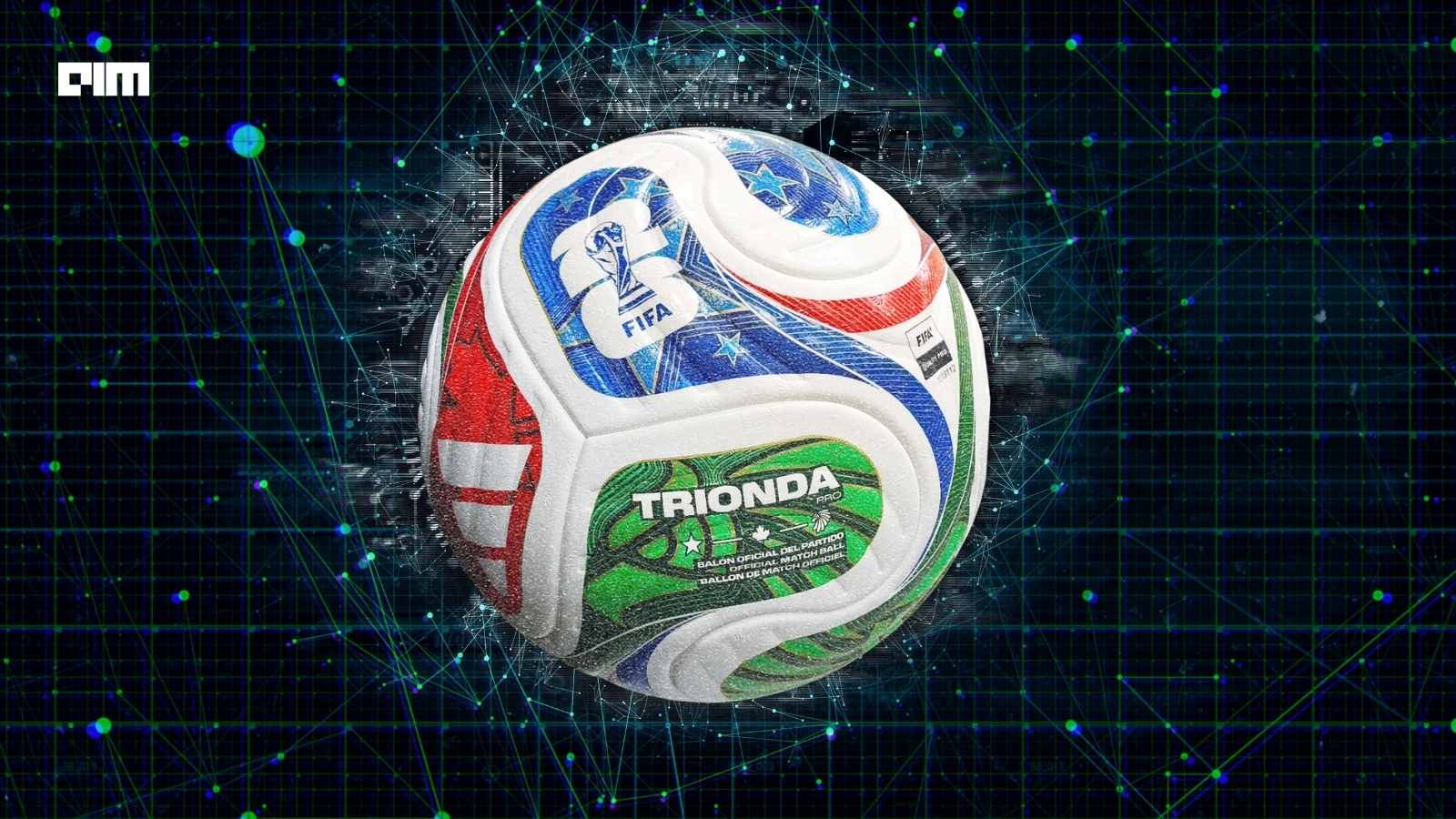
The officiating pipeline that Lenovo's avatars feed into starts with the ball itself. The official match ball, sportswear brand adidas' Trionda, carries a motion sensor built into one of its four panels, with counterweights in the other three to keep it balanced. The design replaces the center-mounted sensor used in the Al Rihla ball at Qatar 2022.
Adidas built the ball's sensor system with German sensor company Kinexon. The system streams motion data to the video assistant referee system in real time, and officials use it to help make offside and handball calls.
Verizon Carries the Data
Officials only get that sensor data if the network under the stadium can move it fast enough. Telecom carrier Verizon is FIFA's official telecommunication services sponsor for the World Cup and the Women's World Cup 2027. The company deployed private 5G networks at host stadiums and added spectrum to boost public 5G capacity by an estimated three to five times.
"This is about using innovation to bring the world closer to the game of soccer," says Nacho Fresco, Director of Technology at FIFA.
Verizon estimates fans inside a single stadium will use more than 50 terabytes of data per match. The company says that is roughly equal to three years of continuous HD streaming.
Google Brings Gemini to Fans
Verizon and Lenovo run systems fans never see. Search company Google's push is aimed directly at the people watching. Google confirmed a set of Gemini features across Search, Maps and its Gemini app in a June 8 post on its own blog.
The Gemini app can now reference live scores, highlights and standings for ongoing matches. For some topics it also generates images tied to the action.
Subscribers to Gemini's paid tiers can set up a daily match briefing through a feature called Scheduled Actions. The app's Images tab also offers World Cup photo templates that place a user's photo inside a stadium scene.
Google also sponsors several national teams, including Argentina, France and the United States. Gemini branding appears on Argentina's training kit under a partnership Google announced in March.
RapidSOS and Sportradar Watch for Risk
A different set of AI systems is not watching the games at all. It is watching for what could go wrong, on the ground and in the betting markets. Public safety company RapidSOS connects data from more than 723 million devices into 911 and other first responder systems.
RapidSOS is working with emergency centers in host cities, including Atlanta, on AI-based call translation during the tournament. Atlanta's E-911 center added the system ahead of the World Cup to translate incoming calls in real time.
"This is really going to be a game changer," says Desiree Arnold, Executive Director of Atlanta's E-911 center.
Sports data company Sportradar extended its integrity monitoring agreement with FIFA through 2031. The company runs AI-based bet monitoring through its Universal Fraud Detection System, backed by human investigators.
Analysts at Macquarie project global wagering on the tournament will top $50 billion. That would make it the largest betting event on record.
Salesforce Runs the Back End
Someone has to keep the people running the tournament connected to each other. Software company Salesforce is an official tournament supporter, providing Slack as what the company calls the tournament's operational layer. The platform coordinates workforce management and AI-driven workflows across all 16 host cities.
The partnership will extend to Salesforce's Agentforce 360 platform for fan support at the 2027 Women's World Cup in Brazil.
The Same Problem, Different Industries
Each system described above solves a version of the same problem: high volume decisions made across a distributed environment with little room for delay. Banks screen transactions for fraud on a continuous basis. Hospitals monitor patient data while conditions change by the minute.
FIFA's 2023-26 commercial cycle is projected to generate close to $13 billion. An estimated $8.9 billion of that is tied directly to the 2026 World Cup.
For the companies involved, a system that holds up through the tournament becomes a reference point. The next time an enterprise customer asks whether the technology is ready for production, these six weeks are the answer.
>
>
Key Takeaways
- Highlight the 2026 FIFA World Cup as a crucial test for enterprise AI systems under real-world conditions.
- Leverage AI technology for tasks like officiating, emergency translations, and data management in real time.
- Utilize Lenovo's AI infrastructure to enhance tournament delivery and provide advanced analytics for teams.
- Demonstrate AI's reliability to gain trust and validate technologies in high-pressure, public environments.
- Position successful AI implementations as compelling proof points in future enterprise sales discussions.