

PharmaOpinion
Why Big Pharma Is Renting Drug Discovery
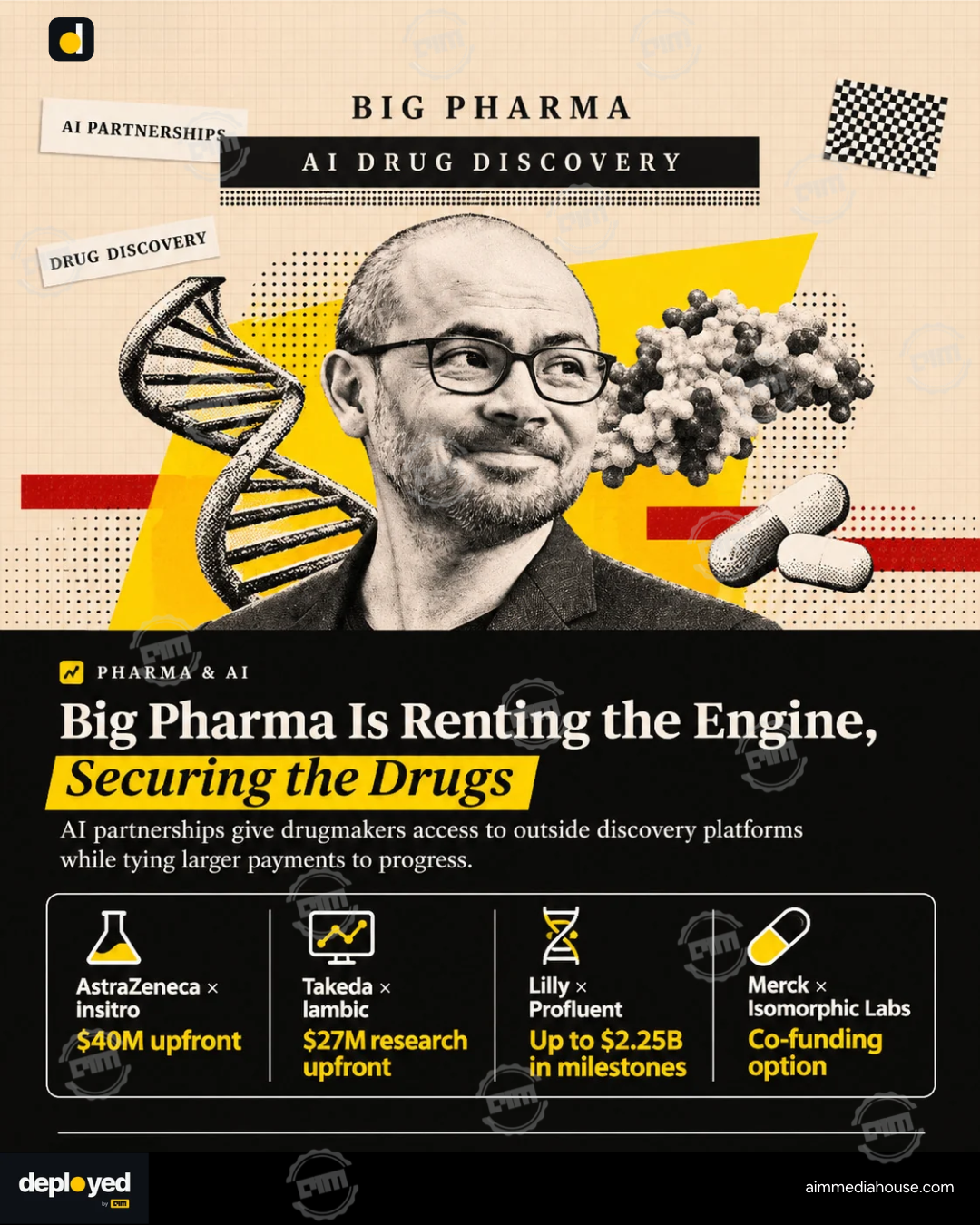
Takeda pays annual fees for access to Iambic’s AI model, while AstraZeneca’s insitro deal links up to $1.46 billion in additional payments to milestones.


The brief
- GSK expanded its collaboration with Chai Discovery after successful testing of the startup's molecular designs, gaining access to its protein-folding and design models.
- Takeda's partnership with Iambic includes an upfront payment of $27 million and potential earnings exceeding $1.7 billion based on success milestones, focusing on oncology and inflammatory diseases.
- AstraZeneca's agreement with insitro involves a $40 million upfront payment and up to $1.46 billion in potential milestones, targeting metabolic dysfunction and cardiomyopathies.
Deployment
- Company
- GSK
- System
- Chai’s protein-folding and design models
- Stage
- Live
- million payment
- 1
Before GSK expanded its relationship with Chai Discovery, it put the startup’s molecular designs through a test in its own laboratories. Chai generated designs against a panel of targets without target-specific training, and GSK found binders to every tested target, according to the companies’ announcement.
The brief
- GSK expanded its collaboration with Chai Discovery after successful testing of the startup's molecular designs, gaining access to its protein-folding and design models.
- Takeda's partnership with Iambic includes an upfront payment of $27 million and potential earnings exceeding $1.7 billion based on success milestones, focusing on oncology and inflammatory diseases.
- AstraZeneca's agreement with insitro involves a $40 million upfront payment and up to $1.46 billion in potential milestones, targeting metabolic dysfunction and cardiomyopathies.
Deployment
- Company
- GSK
- System
- Chai’s protein-folding and design models
- Stage
- Live
- million payment
- 1
The October collaboration gives GSK access to Chai’s protein-folding and design models across its pipeline. Its scientists can use those capabilities alongside internal models they continue to train on their own experimental data.
Similar arrangements are bringing outside discovery platforms into AstraZeneca, Takeda and Lilly. The drugmakers gain access to specialized models and research teams, while negotiated licenses give them rights to advance selected compounds into medicines.
The payments follow the work: an upfront commitment, funding for research or technology access, and potentially much larger sums as programs progress.
Paying for Access Without Buying the Company
Takeda’s February collaboration with Iambic combines two arrangements: research on selected drug targets and access to NeuralPLexer, a model that predicts how proteins and potential drug molecules fit together.
Under the research agreement, Takeda paid $27 million upfront and reimburses budgeted research costs. A separate agreement gives it model access for annual fees, according to Iambic’s IPO prospectus.
The initial work covers three targets, with Takeda able to add up to three more for additional fees. It receives exclusive rights to develop and commercialize qualifying compounds, while Iambic can earn more than $1.7 billion in success-based milestones across collaboration targets, plus royalties.
The partnership initially focuses on oncology, gastrointestinal and inflammatory diseases. Nine months after its announcement, Iambic reported a program milestone that triggered a $1 million payment.
That structure lets Takeda use Iambic’s discovery platform and secure rights to resulting compounds while Iambic continues developing its technology and its own pipeline.
Different Platforms Solve Different Problems
AstraZeneca’s October agreement with insitro starts further back in the research process: identifying which disease mechanisms to pursue.
The collaboration covers metabolic dysfunction-associated steatohepatitis (MASH) and cardiomyopathies. Insitro’s Virtual Human platform combines human and cellular data to investigate disease drivers and advance nominated targets toward development candidates.
“We know that disease biology is incredibly complex, and one of the most critical decisions in R&D is selecting the right target,” said Sharon Barr, EVP and Head of BioPharmaceuticals R&D at AstraZeneca.
AstraZeneca is paying $40 million upfront, with up to approximately $1.46 billion in potential milestones and additional sales royalties. It receives exclusive worldwide rights to advance selected programs and leads clinical development and commercialization.
Lilly is seeking another capability through its partnership with Profluent: designing enzymes that can edit DNA at chosen locations.
Profluent uses generative AI to design recombinases, with the aim of enabling edits spanning thousands of DNA letters. Lilly receives exclusive licenses to advance selected designs, funding research and potentially paying up to $2.25 billion in development and commercial milestones, plus royalties.
“Kilobase-scale DNA editing remains a holy grail in genetic medicine,” said Ali Madani, Co-Founder and CEO of Profluent.
Across these agreements, pharma is accessing different pieces of discovery expertise: disease biology at insitro, molecular design at Iambic and engineered DNA-editing tools at Profluent.
When the Discovery Partner Builds Its Own Pipeline
Merck’s recent agreement with Isomorphic Labs extends this model into development financing. Isomorphic will use its drug-design engine, IsoDDE, with selected Merck datasets to design small-molecule candidates against an oncology target.
Merck leads development and commercialization, while Isomorphic has an option to co-fund development in exchange for higher royalties. If exercised, Isomorphic would take on part of the development cost for a larger share of future drug sales.
Isomorphic also raised $5 billion to expand its engine and pipeline, including clinical-development capabilities. It is building wholly owned programs alongside its pharmaceutical partnerships.
Anthropic’s move into drug programs of its own creates another version of that relationship. Its acquisition of Mithril Medicine brought two rare muscular-dystrophy programs in-house, while Claude also helps Bristol Myers Squibb assess clinical development options.
GSK Chief Scientific Officer Tony Wood described Anthropic “as another competitor” in an interview with Reuters. Novo Nordisk and Sanofi told the news agency they do not provide proprietary data to frontier-model companies for training.
The relationship is already reaching the boardroom. Novartis CEO Vas Narasimhan sits on Anthropic’s board, appointed by its Long-Term Benefit Trust in April. As Anthropic builds its own drug-development capabilities, one of pharma’s largest companies has its chief executive helping oversee the AI company’s direction.
These arrangements put access rights and development economics alongside model performance in the partnership decision. A drugmaker can license an outside platform, secure rights to selected candidates and still retain its own research capabilities.
Chai’s collaborators now include Lilly, Pfizer, Novartis, Bristol Myers Squibb, GSK and Roche, as well as argenx. At GSK, its technology is joining the AI capabilities pharma continues to build internally.
“Their technology complements our own internal models that we continuously retrain against our own wet-lab data,” said Christopher Austin, SVP, R&D Technologies at GSK.
Join the discussion
0 answers
People who run these systems answer here. Your verified role is shown, never your employer unless you choose.
Sign in with LinkedIn to answer
Read next


Chaos Predictions — every Monday
Where enterprise AI is heading next, read from the week’s deployments across banking, pharma, manufacturing and retail.
Free. One email every Monday. Unsubscribe in one click.


