What are the Top AI Use Cases in Logistics for 2026?
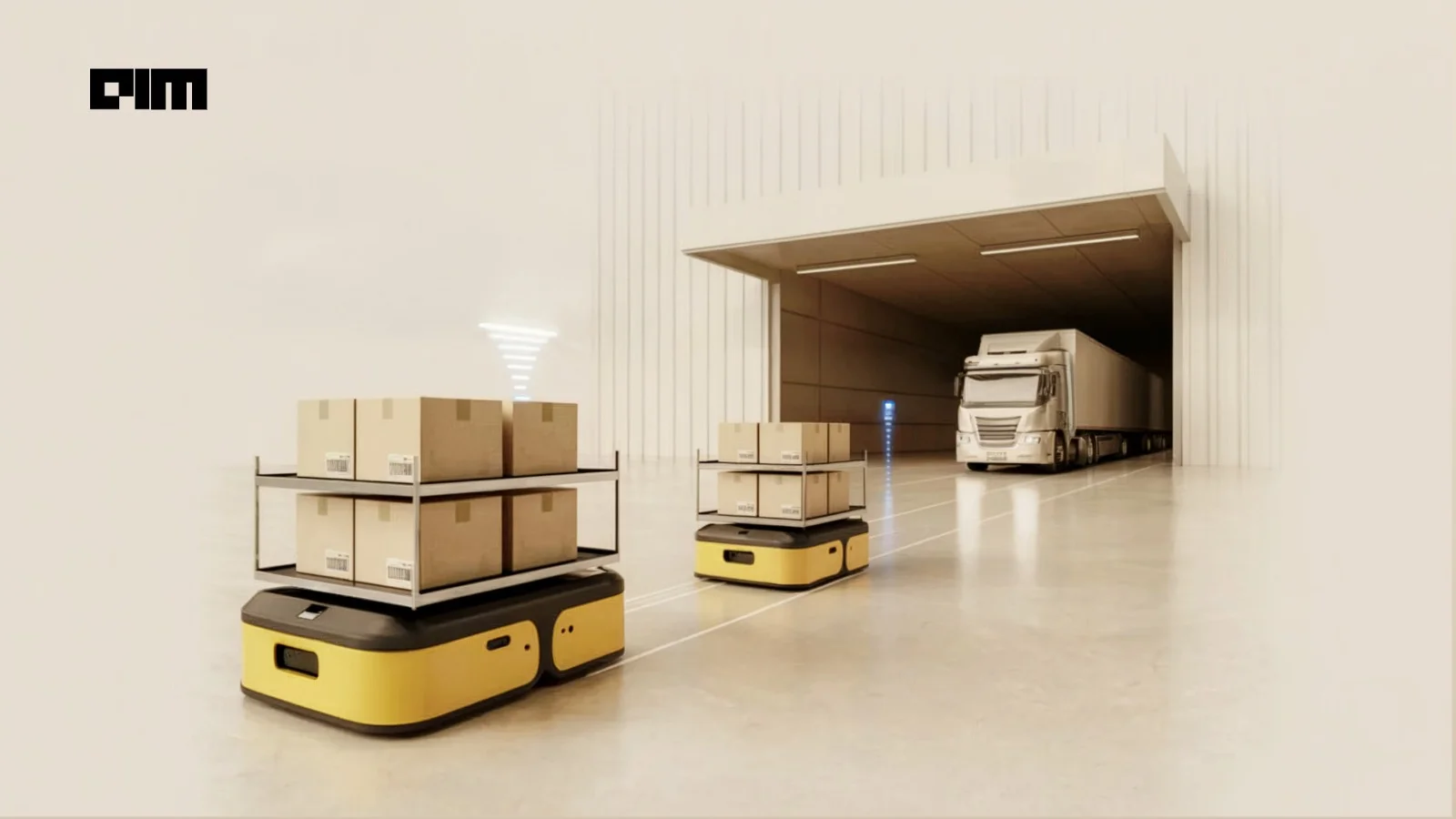
These seven use cases are reshaping how enterprises move goods, reduce costs, and compete in an increasingly complex global supply chain.
The logistics industry is bleeding billions annually on inefficiency. Warehouses still rely on workers manually picking items from sprawling facilities. Delivery routes are calculated by algorithms that ignore real-time traffic. Docks coordinate trucks through paper and spreadsheets. Predictive maintenance is a calendar, not intelligence. Meanwhile, a handful of enterprises have quietly moved to a different operating model, AI-native logistics.
They're rebuilding logistics from the ground up around machine intelligence. The result? Cost reductions, productivity improvements, same-day delivery capabilities, and competitive advantages that rivals will struggle to match. Here are the 10 most impactful AI use cases reshaping the industry, and the enterprises proving that AI logistics works at scale.
1. Warehouse Robotics & Coordination
Manual picking and packing in warehouses remains one of logistics' most labor-intensive, error-prone processes. Workers spend hours navigating sprawling facilities to locate items, carry them to packing stations, and process orders. This creates bottlenecks, high labor costs, and human error. The challenge isn't just speed, it's the fundamental inefficiency of human movement across vast warehouse spaces. AI-powered autonomous mobile robots solve this by eliminating unnecessary human movement while keeping humans focused on decision-making tasks that require dexterity and judgment. Computer vision identifies products instantly, AI calculates optimal warehouse navigation paths, and robots autonomously transport items to human pickers. The result combines human judgment with machine speed, creating a collaboration model that's more efficient than either alone.
Locus Robotics has fundamentally transformed how enterprises like GEODIS operate their distribution centers. GEODIS deployed Locus's autonomous mobile robots (AMRs) that work seamlessly alongside human workers, eliminating the friction that plagued earlier automation attempts. The results were great. GEODIS achieved a 50% increase in picking efficiency. The beauty of Locus's approach is augmentation, not replacement. Human workers remain central, but they're empowered to focus on high-value decisions rather than repetitive movement. GEODIS's deployment demonstrates that warehouse automation works best when humans and machines collaborate, with AI orchestrating the movement across the facility.
2. Route Optimization
Delivery networks waste billions annually on inefficient routing. Dispatch teams make decisions based on incomplete information. They can't simultaneously optimize for traffic patterns, delivery windows, vehicle capacity, fuel consumption, weather conditions, and product freshness requirements. Trucks take longer routes, waste fuel, miss delivery windows, and damage time-sensitive products. Modern supply chains demand precision optimization across thousands of variables that human planners cannot simultaneously evaluate. AI route optimization analyzes real-time and historical data to calculate delivery sequences that minimize cost while meeting every constraint. For food products, this means accounting for temperature requirements. For pharmaceuticals, it means ensuring cold-chain integrity. The algorithm continuously learns from new data, improving optimization over time.
UPS ORION (On-Road Integrated Optimization and Navigation), developed by UPS in Atlanta, Georgia, represents the gold standard in route optimization. The system analyzes billions of data points daily to optimize delivery routes across the entire UPS network. The result? 100 million fewer miles driven annually, $400 million in operational cost savings, and 100,000+ metric tons of CO₂ emissions avoided. ORION famously optimizes for right-hand turns, a seemingly minor detail that reduces idling, improves fuel efficiency, and decreases accident rates. The system processes over 1 billion data points daily, accounting for traffic patterns, delivery windows, vehicle capacity, fuel consumption, and weather conditions. For logistics companies nationwide, ORION demonstrates that route optimization isn't theoretical, it's a proven driver of margin expansion and environmental impact reduction.
3. Predictive Maintenance
Equipment and vehicle failures in logistics create cascading disruptions. A broken conveyor system stops an entire warehouse. A failed truck engine means a shipment misses its delivery window. Companies respond reactively, calling emergency repair services at premium rates, losing productivity during downtime, and paying for unplanned maintenance. Maintenance happens on a calendar schedule (every 10,000 miles) rather than based on actual equipment condition. Predictive maintenance uses AI to analyze sensor data like vibration, temperature, fuel consumption, idle patterns, to forecast failures weeks in advance. This shifts logistics from reactive emergency response to proactive planned maintenance, reducing downtime by 30-50% and extending equipment lifespan.
UPS has deployed AI-driven predictive maintenance across its massive vehicle fleet through dynamic maintenance scheduling and real-time monitoring systems. The platform analyzes sensor data from engines, brakes, tires, and operational patterns to identify potential failures before breakdowns occur, generating tailored maintenance schedules for each vehicle rather than fixed intervals. Spare parts optimization forecasts demand based on predicted failures, ensuring components are available without excess inventory. UPS's implementation has significantly reduced unplanned vehicle breakdowns, minimized downtime, and improved fleet uptime while optimizing maintenance resources. Dynamic scheduling eliminates unnecessary servicing, extending vehicle lifespan and contributing to long-term cost efficiency. For the world's largest package delivery company, this deployment demonstrates predictive maintenance as a strategic advantage.
4. Dock Scheduling & Freight Automation
Warehouse docks are chaotic coordination points where inbound and outbound shipments collide. Dock managers manually schedule arrivals, verify freight against bills of lading, and coordinate space allocation. This manual process creates bottlenecks where trucks idle while waiting for dock space, shipment discrepancies aren't caught until after delivery, and damage documentation is tedious. AI transforms the dock into an automated, self-optimizing system. Computer vision verifies freight instantly against shipping documents, flags discrepancies with photographic evidence, and optimizes dock allocation to minimize truck idle time. Automated systems push inventory data directly to customer systems in real-time, eliminating manual data entry and reconciliation. The dock becomes a frictionless handoff point rather than a bottleneck.
Kargo's computer vision and AI platform addresses one of logistics' most persistent inefficiencies, the dock itself. Wayne-Sanderson (food processing), Aurobindo (pharmaceuticals), Tillamook (dairy), and Mercedes-Benz (automotive) have deployed over 1,000 Kargo towers to automate dock operations. A truck arrives and Kargo's cameras verify the bill of lading against actual freight instantly. AI flags discrepancies with photographic evidence. Dock scheduling algorithms coordinate inbound/outbound traffic to minimize idle time. Deployed customers see payback in weeks. Kargo has grown from 3 enterprise customers in 2022 to 45+ Fortune 500 companies by 2025. The reason? Once a warehouse implements Kargo, customers naturally want upstream (supplier) and downstream (customer) integration, creating a powerful network effect that drives rapid adoption.
5. Load Planning & Fuel Optimization
Aircraft and truck loading is a complex optimization problem. How do you arrange cargo to maximize space utilization, ensure weight distribution is balanced for safety, and minimize fuel consumption? Traditionally, human planners load aircraft and trucks based on experience and rules of thumb. But optimal loading considers physics (weight distribution), economics (fuel burn rates), safety (balance and stability), and operational constraints (item accessibility). AI load planning algorithms evaluate thousands of possible configurations to find the optimal arrangement. For air cargo, where fuel represents 25-40% of operating costs, even marginal efficiency improvements translate to massive bottom-line impact. The system generates optimal plans faster than manual processes, improving fuel efficiency while reducing planning workload.
Champ AI Solutions, a US-based logistics optimization company, deployed load planning algorithms for CMA CGM Air Cargo operations in the United States. The system considers weight distribution, balance requirements, fuel consumption, and flight safety regulations to generate optimal load plans faster than traditional manual processes. For air cargo operations where fuel represents a massive cost component, even marginal efficiency improvements translate to substantial bottom-line impact. Champ's algorithms improved fuel efficiency across the network, reduced planning latency significantly, and increased operational safety through better load balancing. The deployment demonstrates that AI optimization extends beyond ground logistics into aviation, where physics constraints are more rigid and optimization gains are immediately measurable.
6. Transportation Management System (TMS) AI
Multi-warehouse enterprises face a coordination nightmare of how to route shipments across 5, 10, or 50 warehouses, select the optimal carrier for each shipment, consolidate orders to maximize truck utilization, and manage unified billing across complex logistics networks. Traditional TMS systems help, but require constant manual decision-making. Which warehouse should fulfill this order? Which carrier offers the best combination of price, speed, and reliability? Should we wait to consolidate shipments, or send them immediately? AI-native TMS systems make these decisions autonomously, continuously optimizing carrier selection, route planning, and consolidation strategies based on real-time market conditions. The system learns which carriers perform best on specific lanes, how consolidation decisions impact total cost, and when to prioritize speed versus cost.
Parade Freight, a San Francisco-based AI freight brokerage and TMS platform, serves multi-warehouse retail and distribution operators across North America. The platform intelligently matches freight with carriers using real-time market data, automatically selects optimal carriers based on performance, pricing, speed, and consolidates shipments to maximize truck utilization. Parade's AI system analyzes real-time carrier capacity, lane performance, historical pricing, and reliability metrics to recommend optimal carriers for each shipment. Freight brokerages like Lane One and Kirsch Transportation serve multi-warehouse retail and distribution operators across North America using Parade. Lane One increased digital freight coverage to 30%, gaining dramatically improved efficiency and better insights into carrier capacity and pricing across their network. Kirsch Transportation transformed operations to become faster and more consistent, capturing capacity they previously missed before implementing Parade. For these brokerages serving enterprises with multiple warehouses, Parade's CoDriver AI handles inbound carrier calls and emails, qualifies opportunities, captures quotes in real-time, and syncs data automatically into the platform
7. End-to-End Last-Mile Optimization
The last mile represents 53% of total shipping costs, an industry-wide inefficiency. Last-mile delivery involves coordinating routing, managing inventory buffers across distribution centers, forecasting demand to pre-position stock, and allocating labor to peak delivery periods. Traditional systems handle each problem separately. Demand forecasting feeds inventory planning, which informs routing decisions, but these systems don't communicate. The result? Forecast errors cascade into inventory misallocation, which creates routing inefficiencies. End-to-end optimization breaks down these silos. AI systems simultaneously optimize forecasting, inventory positioning, routing, and labor allocation, making decisions that globally optimize outcomes rather than locally optimizing each function separately. When integrated holistically, these decisions create multiplicative efficiency gains.
FarEye, a US-based SaaS platform headquartered in New Jersey, serves FMCG/food distributors, e-commerce platforms, and retail chains across North America with end-to-end last-mile optimization. The platform coordinates dynamic routing, real-time ETAs, multi-carrier orchestration, and proof-of-delivery for enterprise customers nationwide. FarEye's AI algorithms optimize delivery sequencing, carrier allocation, and exception handling simultaneously across B2B/B2C verticals. Customers report 22% higher first-attempt deliveries (food distributor), 15% faster deliveries at double volume (retail), and 97% ETA accuracy (e-commerce furniture), capturing multiplicative gains from integrated decision-making.End-to-end optimization works because breaking down silos reveals how decisions in one area create cascading benefits in others. When demand planning informs inventory positioning, which drives routing, which optimizes labor allocation, each function becomes more efficient than when optimized in isolation.
Key Takeaways
- Transform logistics operations by adopting AI-native models for enhanced efficiency and cost savings.
- Utilize machine intelligence to optimize warehouse operations and automate item picking processes.
- Implement real-time algorithms for dynamic delivery routing to improve service speed and reliability.
- Leverage predictive maintenance powered by AI to reduce equipment downtime and operational costs.
- Gain competitive advantages by adopting AI solutions that enable same-day delivery capabilities.