Is AI Causing CEO Changes in Major Companies?
"I started thinking about everything that needs to happen over the next few years, and it really caused me to think that now was the right time to step down."
Within weeks of each other, the CEOs of two of America's most iconic companies, Walmart and Coca-Cola, sat down for television interviews and said something almost identical.
Both men had led their companies for nearly a decade. Both had overseen billions in revenue, navigated pandemics, and economic shocks. And both had decided, looking at what was coming next, that it was time for someone else to take over.
The reason both gave was the same: Artificial Intelligence.
Till now, the conversation about AI and layoffs has focused on the bottom of the organizational chart, entry-level and midsized roles, the positions most exposed to automation. But now, some of the most recognizable names in business are stepping down.
 >
>The Departures
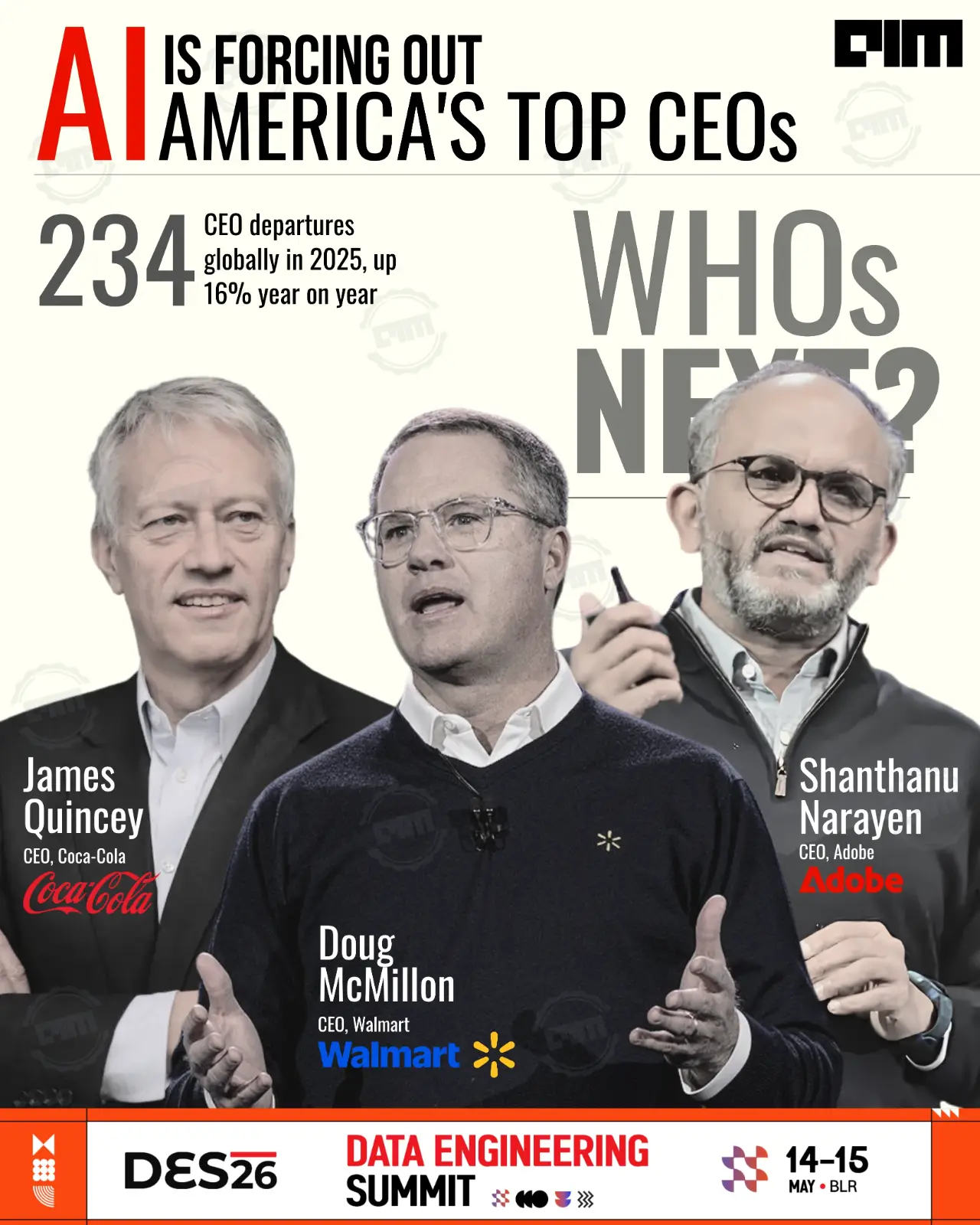
James Quincey, who has led Coca-Cola since 2017, announced he would step down at the end of March 2026, to be succeeded by current COO Henrique Braun.
Speaking on CNBC's Squawk Box, Quincey tied the decision directly to the company's AI trajectory. "My job is also to think about who's the best team to put on the field to get the next wave done," he said. "And I concluded that, actually, it was time to put someone else on the field for the next wave of growth."
Quincey was explicit about the nature of the shift. "In a pre-AI, a pre-gen-AI mode, we made a lot of progress. But now there's a huge new shift coming along." He said the company needs "someone with the energy to pursue a completely new transformation of the enterprise."
Coca-Cola reinforced that framing structurally. Under Braun, the company created a new Chief Digital Officer role, a move the company said was designed to bring the business closer to consumers and enable faster technology adoption.
Doug McMillon, who led Walmart since 2014, had already made a similar departure in January 2026, handing over to John Furner, who had previously led Walmart US. McMillon told CNBC in December that the decision came down to the pace of what he could see coming.
"With what's happening with AI, I could start this next big set of transformations with AI, but I couldn't finish," he said. "About a year ago, I really started feeling like this next run, you could see what agentic commerce was going to look like, the vision for AI shopping, and I started thinking about everything that needs to happen over the next few years, and it really caused me to think that now was the right time to step down."
McMillon said he wanted Walmart led by someone "faster." He described what is coming next as scaling what the company has already started, building on top of it, and using AI to transform the whole operation.
Adobe's situation adds a third data point. CEO Shantanu Narayen announced his planned departure as investors were already scrutinizing Adobe's AI positioning and questioning how well its subscription model would hold up against faster-moving generative AI competitors.
In his message to employees, Narayen wrote that "the next era of creativity is being written right now, shaped by AI, by new workflows and by entirely new forms of expression." Adobe has not yet named a successor.
A Pattern, Not a Coincidence
These are not isolated events. S&P 1500 companies named 168 new CEOs in 2025, the highest total in more than 15 years, according to Challenger, Gray & Christmas data cited by Fortune. Already in 2026, the CEOs of Lululemon, Disney, and Target have stepped down or announced departures.
Dirk Jenter, Professor of Finance at the London School of Economics, told Fortune that investor pressure is a significant driver. "Investors are not necessarily super patient," Jenter said. "They see billions being spent on AI investments, and they see very little in short-term return on investment, and that puts pressure on company leadership."
A World Economic Forum survey found that half of CEOs now believe their job stability depends on successfully integrating AI in 2026. Among non-CEOs, more than half believe the CEO or board should resign if the company loses market share to competitors due to an inadequate AI strategy.
The pattern suggests that boards are applying a sharper lens to whether sitting executives are the right people to lead the next phase of AI transformation.
The Succession Profile Is Changing
The departures are reshaping what boards expect from the next generation of leaders, not just in terms of tenure, but in terms of disposition.
Chad Hesters, CEO of executive search firm Boyden, put it bluntly saying, "Between the compression of the disruption cycle and the risk that's inherent, boards' expectations for CEOs are that you've got to be an AI native. You've got to understand this stuff, and you've got to understand it is not a gradual shift."
That expectation is showing up structurally. External CEO appointments in the S&P 500 nearly doubled, from 18% in 2024 to 33% in 2025, marking the highest level in eight years, as boards prioritized fresh perspectives over institutional familiarity.
Average global CEO tenure has also declined to 7.1 years, below the highs of 8.3 years recorded in 2021 and 2023, according to Russell Reynolds Associates.
The firm attributes the drop to boards more closely monitoring whether executives respond to change with precision and adaptability, considerations AI is rapidly bringing to the fore.
Jason Baumgarten, a partner at Spencer Stuart, put it simply saying, "What we are seeing across the board is a desire for CEOs who bring more of a beginner's mind and adaptability."
Current Leadership Not Right for the AI Push?
The McMillon and Quincey departures offer a specific answer to that question, not that current leaders are inadequate, but that the horizon of an AI transformation may extend beyond what a CEO in the later years of a tenure can credibly commit to completing.
McMillon said that he could start the transformation but could not finish it. Quincey framed it as a question of energy and commitment for what he called a "completely new transformation." Neither described a skills deficit. Both described a time horizon problem.
What these departures suggest is less that AI requires a different kind of executive intelligence and more that it requires a leader with a long enough runway to see a multi-year transformation through.
OpenAI CEO Sam Altman has gone further, suggesting on the MD Meets podcast that AI systems may eventually be better suited to executive decision-making than humans.
"I think there will come a time when AI can be a much better CEO of OpenAI than me, and I will be nothing but enthusiastic the day that happens," Altman said.
That moment remains distant, but the direction Altman describes is consistent with what McMillon and Quincey are acknowledging in practical terms. The role of a CEO is being redefined by AI faster than any individual tenure can fully absorb.
The Full Stack of Disruption
AI's impact now spans the full organizational chart. While boards navigate leadership transitions at the top, the pressure on workers below the C-suite is more acute.
Anthropic CEO Dario Amodei has said AI could replace half of entry-level white-collar roles within five years. "I think, to be honest, a large fraction of them would like to be able to use it to cut costs, to employ less people," Amodei said of business leaders deploying AI.
At the top, the pressure is subtler but no less structural. The departures of McMillon, Quincey, and Narayen suggest that even strong, long-tenured executives are concluding they cannot credibly see an AI transformation through to its end. Their successors are being chosen not for what they have built, but for how far they can run.
Jeff Clavier, co-founder of venture firm Uncork Capital, advises the CEOs of his portfolio companies to imagine what the fully AI-enabled version of their company and industry would look like, because for each of their companies, he tells them, there are another ten startups gearing up for exactly that.
"The key characteristic for CEOs in an AI world is the ability to accept that fundamental changes will happen way, way faster than typical innovation curves," Clavier says.
Key Takeaways
- Recognize the trend of top CEOs resigning due to AI advancements.
- Understand that AI is reshaping leadership needs in major corporations.
- Note the shift from entry-level layoffs to executive departures influenced by technology.
- Acknowledge the importance of new leadership for navigating AI-driven growth.