As AI Gets Cheaper, Palantir Is Getting Bigger

Palantir’s Q1 earnings highlight enterprise AI deployments cutting workflows from hours to seconds, with $1.17B in new contracts and 133% U.S. commercial growth.
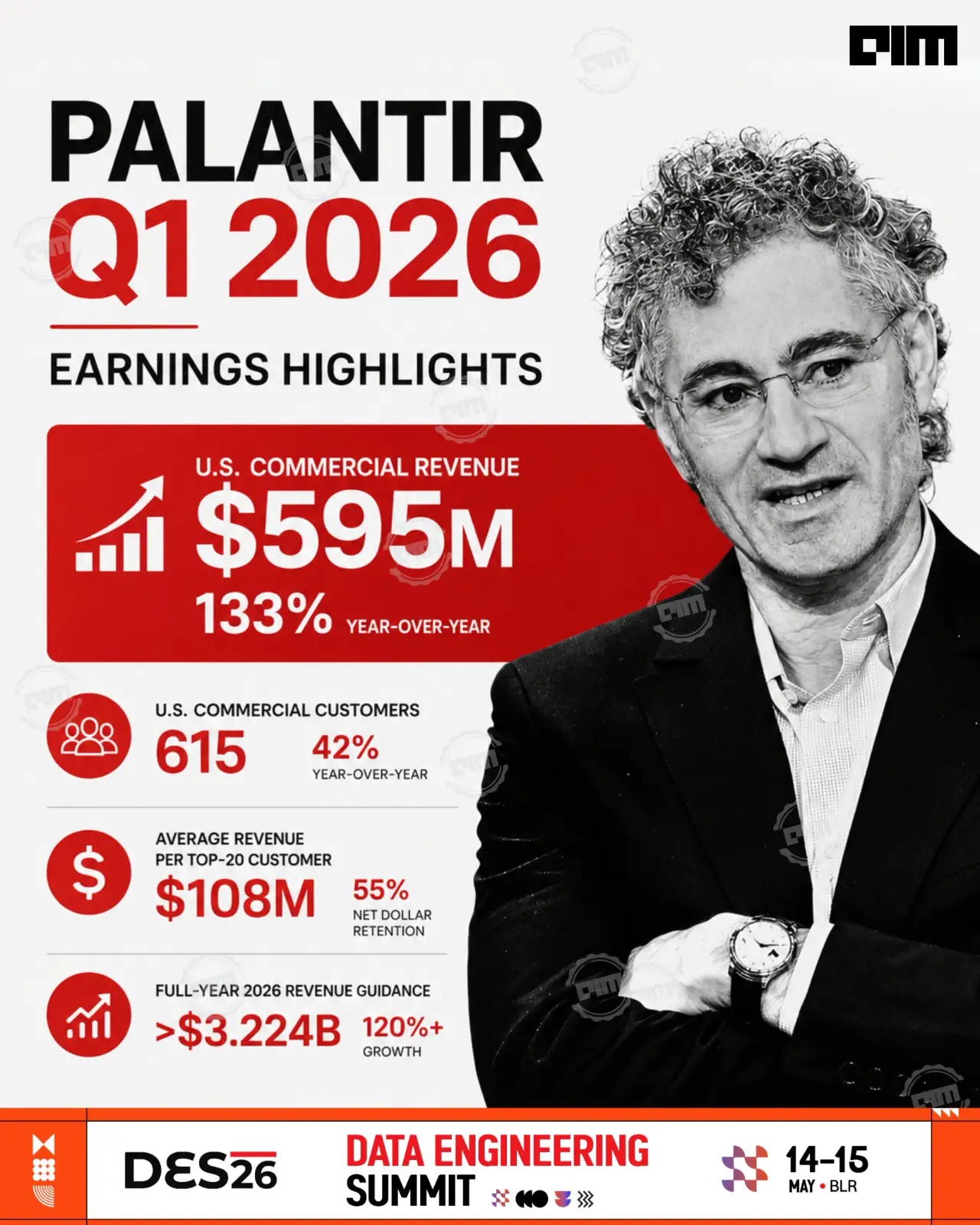
Palantir reported U.S. commercial revenue of $595 million in Q1 2026, up 133% year-over-year, as adoption of its Artificial Intelligence Platform (AIP) expanded across enterprise customers. Total revenue reached $1.63 billion, up 85% year-over-year, driven by increased deployment of AI systems in production environments.
Total contract value reached $1.176 billion, with remaining commercial deal value at $4.92 billion. The company said deployments continued across defense manufacturing, aerospace, financial services, and agriculture.
Executives said falling inference costs are increasing demand across deployments, with customers running larger volumes of AI-driven tasks in production. As costs decline, demand for execution rises, expanding activity within existing systems, reflecting a broader pattern where efficiency gains increase consumption.
Palantir’s AIP connects AI models to enterprise data and workflows through a structured ontology layer, allowing systems to execute actions inside operational environments rather than generate outputs alone.
The company cited operational deployments as the primary driver of these outcomes. A manufacturing approval process for the U.S. Navy fell from 200 hours to 15 seconds after deploying Palantir’s Ship OS, the company said in its earnings call. The system also increased contract review cycle speeds by 57% to 73% and reduced monthly material planning time by 94%.
Ryan Taylor, Chief Revenue Officer at Palantir, said: “The last three months have been some of the most exciting in the history of Palantir as we have watched the whole world begin to see the incredible promise of operational AI as well as the risks and perils of being beholden to models alone.”
 >
>Deployments expand across sectors
Palantir extended deployments across multiple sectors as customers scaled AI systems inside production environments.
In aerospace, GE Aerospace, an aerospace manufacturer, expanded its partnership with Palantir after deploying AI systems across production and military aviation supply chains. Palantir said these deployments contributed to a reported 26% increase in engine performance.
In financial services, Palantir partnered with Freedom Mortgage, a U.S. mortgage lender, to deploy AI-driven systems across lending and servicing operations. Ryan Taylor, Chief Revenue Officer at Palantir, referenced a statement from Moder Chairman Michael Middleman, who said: “This strategic partnership will reshape the future of our industry. Together, we are building technology that can help improve affordability, lower borrowing costs, and expand access to homeownership for millions of Americans.”
In the public sector, the U.S. Department of Agriculture awarded Palantir a contract of up to $300 million to support applications including farmland security, supply chain resilience, and fraud prevention.
Palantir said deployments are increasingly embedded in core operational systems, including supply chain planning, contract execution, and production workflows in manufacturing and defense environments.
The company said these outcomes are tied to its ontology-based system architecture, which governs how AI systems access data, permissions, and actions across enterprise environments.
CEO Alex Karp said: “When the whole world is saying AI slop without an ontology that allows you to put true statements and truths into the ontology, and therefore produce actual results, we stuck to our guns.”
Chief Technology Officer Shyam Sankar said: “The ontology is the body to the AI brains. You cannot actually interact with the enterprise or affect the world; your agents can go nowhere without ontology.”
As part of AIP, Palantir introduced an agent engine software development kit (SDK) and cost attribution tools that allow enterprises to deploy AI agents with controls for execution, cost tracking, authorization, and auditability.
Platform architecture and governance systems
This architecture underpins the operational gains seen in deployments across sectors.
Palantir said its system design is structured to address a constraint in enterprise AI adoption, where model capability increases but reliability declines without control systems.
The ontology layer defines how enterprise data, permissions, and actions are structured, allowing AI systems to operate within controlled boundaries while executing real-world tasks.
Executives said this approach allows organizations to deploy AI systems that interact directly with operational environments while maintaining traceability and governance across workflows.
Customer expansion and usage drive revenue growth
As deployments expanded, customer adoption and spending increased.
Palantir reported continued expansion among commercial customers as deployments scaled across enterprise operations.
U.S. commercial customer count reached 615, up 42% year-over-year. Average revenue per top-20 customer reached $108 million, up 55% year-over-year.
Palantir said commercial growth is being driven by both customer expansion and increased depth of usage within existing accounts. This is reflected in net dollar retention of 150%, which measures how much existing customers expand their spending over time.
Palantir raised its U.S. commercial revenue guidance to exceed $3.224 billion for full-year 2026, representing at least 120% growth.
CEO Alex Karp said: “The reality that we will be able to drive 100% growth in the U.S. is being driven by the fact that our customers either know or will know that you need actual results.”
Key Takeaways
- Palantir's Q1 2026 U.S. commercial revenue surged 133% to $595 million, driven by AI adoption.
- Total revenue reached $1.63 billion, reflecting an 85% year-over-year increase from AI deployments.
- Falling AI inference costs are fueling demand, enabling faster execution of tasks across industries.
- Palantir's AI Platform significantly reduces operational times, exemplified by a Navy process cut from 200 hours to 15 seconds.
- The company highlights operational deployments as key to improving efficiency and expanding usage of AI systems.