How is Caterpillar Using AI in Construction Equipment?
"Physical AI is the next wave of AI. Nvidia is pioneering that with computers that train the models"
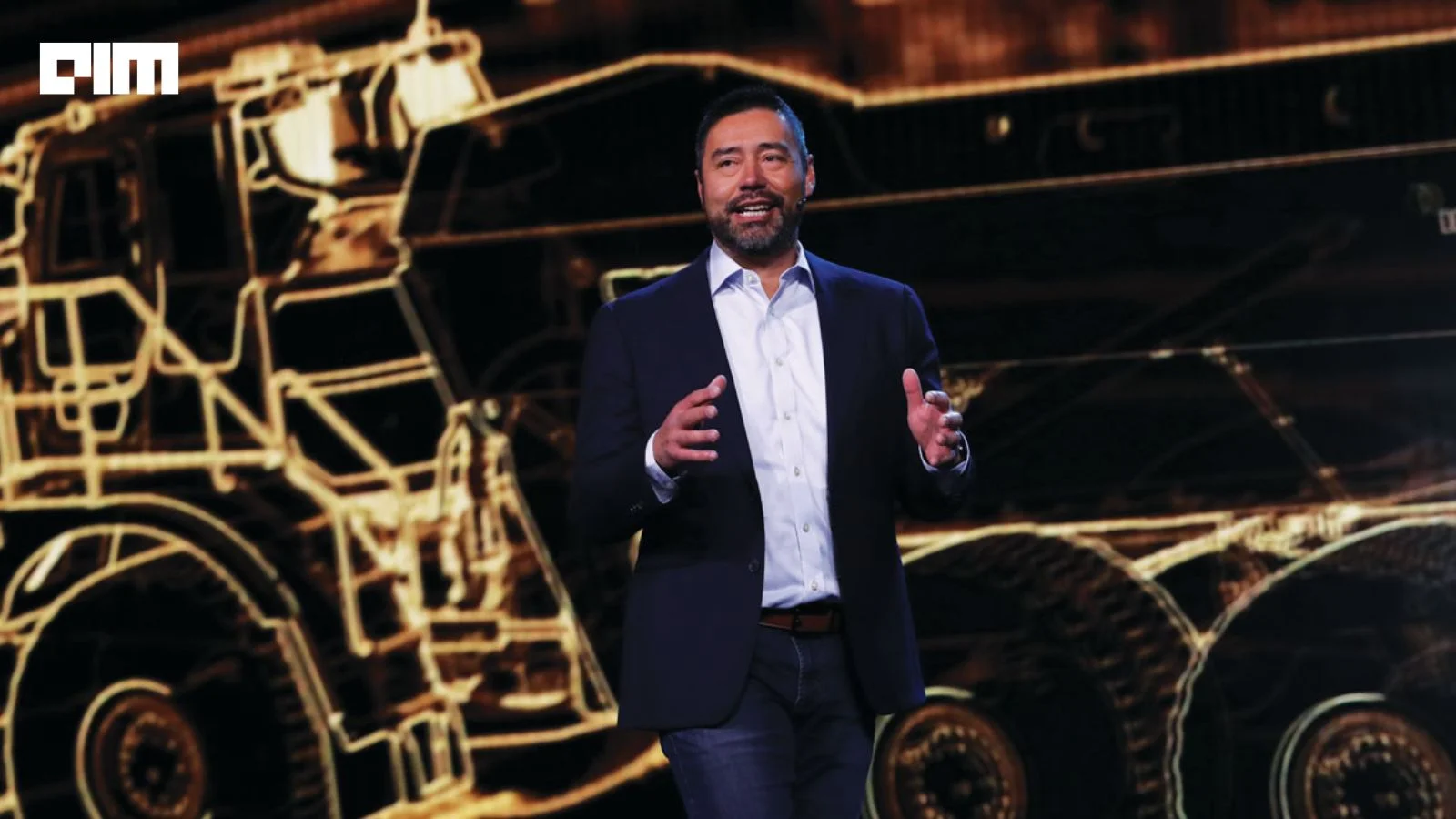
During Caterpillar's keynote at CES 2026 on January 7, CEO Joe Creed showcased something very intriguing. A six-ton piece of heavy machinery. The camera showed Caterpillar's booth, where a Cat 306 CR Mini Excavator stood ready for a live demonstration.
An operator sat in the cab, asked the machine a simple question. "Hey Cat, how do I get started?", and an AI system running directly on the machine responded with natural language understanding, interpreted the request, and the excavator's arm lifted on command. For a moment, at a conference about software, data and cloud computing, the future of industrial AI seemed promising. .
Caterpillar and Nvidia announced an expanded collaboration on January 7 that positions edge AI, artificial intelligence running directly on machines rather than in cloud data centers, as the basis for the next generation of construction equipment.
The partnership uses Nvidia's Jetson Thor processor, a Blackwell-powered edge AI platform delivering 2,070 FP4 teraflops of performance in a compact form factor designed for robots and industrial systems. For Caterpillar, a company that spent the last 30 years mastering autonomous mining equipment but has never deep-integrated AI into consumer-facing construction machinery, the partnership explains their future goals.
"Our customers don't live in front of a laptop day in and day out; they live in the dirt," Brandon Hootman, Caterpillar's Vice President of Data and AI, told TechCrunch. "The ability to get the insights and take the action that they need while they're doing the work is very important to them."
Construction equipment operators work in dynamic, variable, dangerous environments. Cloud connectivity is unreliable and latency kills productivity. Decision-making needs to happen in milliseconds, not seconds. Edge AI is the only architecture that makes sense at the jobsite.
The Cat AI Assistant
The main highlight of the partnership is the Cat AI Assistant, a conversational AI system that debuted at CES 2026. Built using Nvidia's Riva open speech models, the Cat AI Assistant integrates Caterpillar's Helios unified data platform, which stores trusted machine data and historical operational context with natural language processing and generative AI to create a machine that understands what operators ask and provides personalized guidance in real time.
The technical architecture is complicated. The Cat AI Assistant runs on Jetson Thor hardware, leverages Qwen3 4B language models served locally via vLLM, and uses Nvidia Riva for speech-to-text and text-to-speech processing. Critically, all processing happens on the machine itself. Operators interact via voice commands while working, and the AI responds without requiring internet connectivity.
Hootman revealed that Caterpillar's machines already send roughly 2,000 messages back to the company every second. The Cat AI Assistant synthesizes that data stream into actionable insights delivered directly to operators in the moment they need it.
The in-cab capabilities are great. The system can provide real-time coaching, productivity tips, safety alerts, equipment recommendations, maintenance scheduling, and resource guidance. An operator working in a confined space can ask the Cat AI Assistant about safe ranges of motion. A bulldozer driver preparing for a shift can ask about weather conditions affecting soil consistency.
The diversity of applications reflects a core advantage of edge AI. Once the computational foundation is in place, the intelligence layer can expand across use cases without infrastructure bottlenecks. Delivered by Blackwell processors, Jetson Thor supports multi-modal sensor processing, real-time inference on complex generative AI models, and low-latency decision-making.
Bill Dally, Nvidia's Chief Scientist, told TechCrunch in 2025 that the chipmaker considers physical AI to be the next frontier for the company and its powerful GPUs. Deepu Talla, Nvidia's Vice President of Robotics and Edge AI, expanded that definition: "Physical AI is the next wave of AI. Nvidia is pioneering that with computers that train the models, that do the simulation to test the models and deploy the models into the robots, whether that's an autonomous car or a Caterpillar machine."
AI was generally positioned as a cloud computing problem. Send all the data to distant servers in data centers, process it there, and send the results back. However, construction equipment can't work that way. Machines operating on jobsites need to make decisions instantly. The Cat AI Assistant running on Jetson Thor shows a shift where intelligence lives at the edge, processes sensor data locally, and acts in real time
Caterpillar is also piloting factory digital twins built on Nvidia's Omniverse libraries and OpenUSD standards across multiple U.S. manufacturing sites. These digital twins are operational planning tools. Caterpillar teams use digital replicas of factory layouts to simulate production line changes, test scheduling scenarios, optimize material flow, and calculate building material requirements before any physical retooling occurs.
Manufacturing lead times are extended across Caterpillar's high-volume engine models. The 3600 family is experiencing wait times of approximately 107 weeks, according to Raymond James research. Digital twins allow Caterpillar to optimize production more aggressively by testing scenarios in simulation before implementing changes in physical factories. This accelerates time-to-production for equipment already facing surging demand from both existing customers and new markets adopting construction automation.
The data feeding these simulations comes from Caterpillar's fleet. The company's machines send approximately 2,000 messages per second, collectively generating an enormous stream of operational telemetry. That data, combined with historical context stored in the Helios platform, becomes the foundation for increasingly accurate digital simulations. Over time, these simulations become prediction engines like tools for forecasting demand, optimizing inventory, and anticipating maintenance requirements across entire fleets.
From Mining to Construction
Caterpillar has operated fully autonomous vehicles in the mining sector for over 30 years. The company has deployed hundreds of autonomous trucks in mining operations globally, generating operational data and expertise that few companies can match. At CES 2026, Caterpillar previewed five autonomous construction machines.
Mining autonomy operates in relatively controlled environments with defined routes, predictable terrain, minimal human interaction on the jobsite. Construction is fundamentally different. Jobsites are heterogeneous, dynamic, and unpredictable. Site layouts change daily. Hazards are variable and integration with human workers is constant.
The technical challenges of deploying autonomous equipment in construction are orders of magnitude more complex than in mining. The Cat AI Assistant and Jetson Thor infrastructure provide the foundational architecture for solving those challenges at scale
The autonomous construction equipment market was valued at approximately $4.4 billion in 2024 and is projected to grow to between $9.77 billion and $14.2 billion by 2030-2032, with compound annual growth rates of 12.8 to 14.2 percent. The drivers are acute labor shortages in construction, rising operational costs, increasing regulatory pressure on safety, and customer demand for 24/7 operations without human hours-of-service limitations. Caterpillar is planning to capture market dominance by deploying a proven technology stack (Jetson Thor + Helios + Riva) across its entire product portfolio.
Over the past 20 years, Caterpillar invested $30 billion in research and development. The company announced plans to increase investment in digital and technology by 2.5 times through 2030. The Nvidia collaboration accelerates that timeline by providing validated technology platforms (Jetson Thor for edge inference, Omniverse for simulation, Riva for natural language) that Caterpillar can integrate rapidly across construction, mining, and power equipment.
For Nvidia, the partnership is equally valuable. Jensen Huang, Nvidia's founder and CEO, framed the collaboration as connecting "the full spectrum, from autonomous construction fleets to the AI data centers powering the next industrial revolution."
Recognizing that autonomous and AI-enabled equipment reshapes skill requirements, Caterpillar is investing in workforce preparation. The company pledged $100 million over five years for workforce training and education, including a $25 million Global Workforce Innovation Challenge designed to identify and scale solutions for preparing workers for next-generation, AI-enabled industrial systems.
Key Takeaways
- Caterpillar partners with Nvidia to integrate AI into construction equipment for enhanced performance.
- Demonstrates edge AI, allowing machines to process data directly on-site rather than in cloud centers.
- Showcases a live AI interaction with a mini excavator, highlighting advancements in natural language processing.
- Nvidia's Jetson Thor processor powers the AI capabilities, offering significant computational performance in a compact design.
- Caterpillar aims to provide actionable insights directly to operators working in challenging environments.