
Artificial intelligence is everywhere in the enterprise. Adoption is climbing, budgets are expanding, and pilot programs are turning into permanent line items. Yet for all the activity, measurable return on investment remains rare.
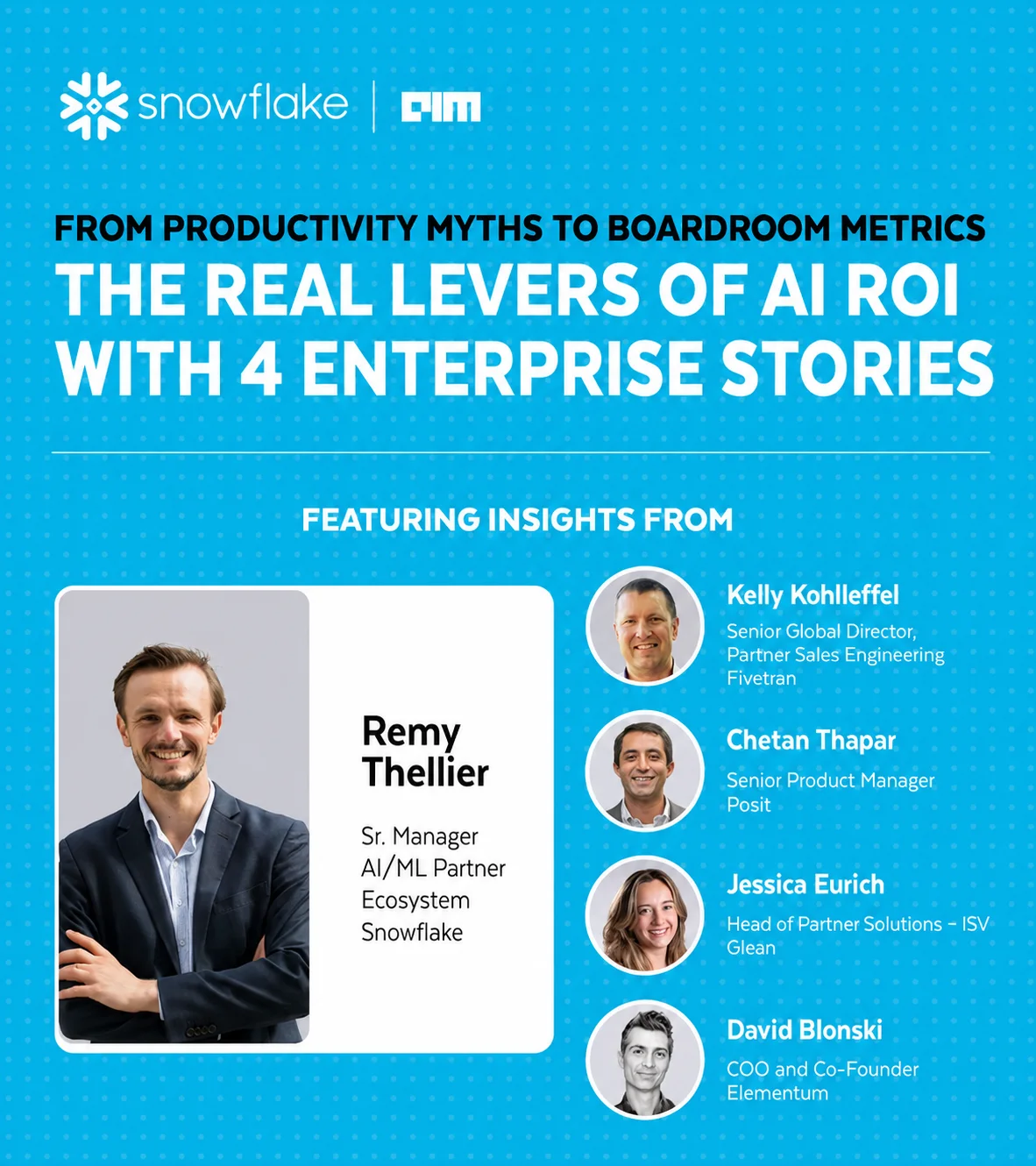
That was the core message of Remy Thellier’s presentation at CDO Vision LA, the fourth city stop of the CDO Vision AI World Series. Remy Thellier, who leads the AI/ML Partner Ecosystem at Snowflake delivered a keynote titled “From Productivity Myths to Boardroom Metrics: The Real Levers of AI ROI.” Joined by leaders from Snowflake’s AI and ML ecosystem, he laid out a sharp argument: most companies are not failing because AI tools do not work. They are failing because they are measuring the wrong things and expecting activity to somehow become impact.
“AI can absolutely make teams faster,” Thellier said. “But speed by itself is not ROI. If that time is not translated into lower costs, faster revenue, or reduced risk, the business hasn’t actually changed.”
His point cut through one of the defining contradictions in enterprise AI today. Organizations are seeing more experimentation, more usage, and more internal enthusiasm. But when boards and CFOs look for evidence in the P&L, the gains are often hard to find.
The Boardroom Paradox
Thellier described this disconnect as the Boardroom Paradox: executives hear that teams feel more productive because of AI, but that productivity rarely shows up in meaningful financial results.
According to the Atlassian AI Collaboration Index (2025), only 4% of executives report seeing meaningful AI ROI. The other 96% are often capturing something much easier to achieve: the feeling of progress.
This is the illusion at the center of many AI programs. Employees may save time on research, drafting, summarization, or analytics. But if the operating model stays the same, the savings never get converted into business value. Costs do not materially fall. Revenue does not move faster. Risk does not decline in a measurable way. Local speed improves, while enterprise economics stay flat.
That is why, Thellier argued, activity alone does not equal impact.
The Productivity Illusion
At the heart of the problem is a simple mistake: companies confuse usage with value.
Many AI programs celebrate metrics such as number of prompts, number of users, copilots launched, or business units onboarded. Those are adoption metrics. They show motion, not return.
“The board does not fund prompts,” Thellier said. “It funds outcomes.”
In his framework, companies need to stop asking, What can AI do? and start asking, Where does ROI reliably appear?
That shift moves the conversation away from novelty and toward economics. Real AI ROI, he argued, appears when organizations deliberately connect deployment to one of three outcomes: faster revenue, lower cost, or lower risk.
The Three Traps That Keep ROI Out of Reach
1. Measuring Activity Instead of Outcomes
The first trap is focusing on visible signs of adoption rather than the financial levers that matter. High engagement can look encouraging, but it does not prove economic value. Thellier argued that the true tests of ROI are far more concrete: spending down, revenue in faster, losses reduced, and working capital improved.
2. Chasing Easy Attribution Instead of High Payback
The second trap is putting AI in the most visible places rather than the most valuable ones. Front-office use cases often get attention because they are easy to demo and easy to explain. But many of the strongest returns come from the back office: reducing BPO and agency spend, eliminating SaaS waste, and streamlining manual document operations.
3. Treating Governance as Friction
The third trap is assuming governance slows innovation. Thellier made the opposite case. Governance, he said, is a speed layer. It reduces rework, standardizes deployment, builds trust, and allows successful use cases to scale safely. In enterprise AI, governance is not the enemy of speed. It is what makes speed repeatable.
Where AI ROI Actually Shows Up
Thellier argued that reliable AI returns tend to appear in three arenas.
Cycle Time: Faster Revenue
The first is cycle time, especially in processes where days directly affect dollars. Quote-to-cash, claims-to-pay, and release-to-market are all examples where acceleration can create measurable financial value.
Spend Compression: Lower Cost
The second is spend compression. AI can replace or reduce external spend across agencies, contractors, outsourcing arrangements, software overlap, and manual document-heavy operations.
Risk Reduction: Lower Losses
The third is risk reduction. Fraud, leakage, compliance failures, outages, and quality escapes are all expensive. AI that meaningfully lowers the frequency or severity of those failures can generate significant economic value, even when the return shows up as avoided cost rather than visible new revenue.
Why the Ecosystem Matters
A major theme of the presentation was that AI ROI is not simply a model problem. It is a systems-and-execution problem. That is where the ecosystem becomes essential.
External partners, Thellier argued, improve the odds of success because they bring repeatable playbooks, production-grade architecture, workflow redesign expertise, and the discipline to measure outcomes against a financial narrative.
“The key to unlocking ROI is ecosystem execution,” Thellier said. “The companies moving beyond pilots are not doing it alone. They are combining the right data foundation, the right governance model, and the right partners to operationalize value.”
That argument framed Snowflake not just as a platform, but as a case study in how ecosystems create enterprise outcomes.
Cisco and Fivetran: Building the AI-Ready Data Foundation
A strong example came from Cisco’s work with Fivetran and Snowflake.
Cisco had to contend with massive data sprawl across on-premises Oracle ERP systems and more than 50 SaaS applications. Its environment was slowed by hand-coded Python integrations, data silos, and operational complexity. The result was a fragmented system that made fast, reliable analytics difficult.
Using Fivetran to move data into Snowflake, alongside transformation, activation, and governance capabilities, Cisco created a unified backbone for data movement and strategy.
The ROI was clear. Automated ingestion across more than 50 SaaS systems reduced onboarding time from weeks to hours. Manual scripts were eliminated, making it possible for one person to manage pipelines efficiently. Data deployment time into Snowflake fell by 85%, enabling near real-time sales forecasting and much faster time to insight. At the same time, governance improved through stronger security, role-based access, and compliance controls.
The broader payoff was not only operational efficiency, but an AI-ready foundation that could support future platforms and use cases.
Pinterest and Posit: Rigorous Decision Intelligence, Inside Snowflake
Another case focused on Pinterest’s People Analytics team, which analyzes sensitive employee data - including roughly 15,000 employee comments per survey cycle. Because personally identifiable information could not leave Snowflake, the challenge was to bring data science to the data rather than moving data out for analysis.
By deploying Posit as a Snowflake Native App inside Snowflake’s governance perimeter, Pinterest unlocked a class of analysis that had been previously out of reach. The team can now run rigorous, reproducible decision intelligence on one of the most regulated datasets: validated driver analysis, auditable coefficient modeling, and large-scale analysis of unstructured survey comments, all without moving sensitive data.
The payoff is not a faster pipeline. It is work that leadership can trust, audit, and act on, with one standardized methodology replacing a multi-step manual workflow across analysts. Operationally, the infrastructure became simple enough to be described as "set it and forget it."
The same architecture has shown up in very different ROI shapes. At a global insurer running Posit on Snowflake, the gains were measured in speed and scale. Total build and scoring time per model dropped from 24 hours to 2 hours, the model pipeline became 12 times faster, and scoring 11 million customer records fell from two hours to 24 seconds -with proof of concept-to-results in just three days. The acceleration changed what was possible operationally: ability to move from annual to monthly model refreshes, which translates into more accurate targeting on the same marketing spend.
Across both cases, the same point lands. Governance and security are not barriers to ROI when they are built into the architecture. They are part of what makes ROI possible.
Glean + Snowflake: Self-Serve Data Insights for Every Employee
The session also highlighted examples involving Glean, which was presented as the Work AI Platform that delivers enterprise context and powers agentic workflows, complementing Snowflake’s role as the trusted source of truth for governed data insights.
In one marketing automation company, Glean Agents gave teams across the business natural language access to governed Snowflake data directly, enabling faster decisions and reducing dependence on central data teams.
At a leading finance company, Glean and Snowflake were used together for agentic analytics and self-service BI. The result was a single governed way for nontechnical employees to query live Snowflake data in natural language without creating AI sprawl or bypassing enterprise controls.
These use cases showed how ROI can come not only from efficiency, but from removing bottlenecks. When employees can access trusted data directly, decision-making speeds up and technical teams stop being the constraint, and organizations can optimize cycle time for a faster path to revenue.
Elementum: SaaS Replacement as a Source of Hard-Dollar ROI
The most direct cost-takeout examples came from Elementum, whose work focused on SaaS replacement and operational transformation.
At a global sports retailer, Elementum supported SaaS replacement for L1 support and IT service management, including a ServiceNow replacement, as well as offshore call-center replacement. The annual ROI was substantial: about $1 million per year in L1 support and $4 million per year in ITSM.
At a global pharmaceutical manufacturer, the scope was even broader. Elementum drove replacement across software asset management, procure-to-pay, ITSM, and CRM functions. The reported gains were striking: $20 million in SAM, $25 million in P2P, $45 million in ITSM, and $30 million in CRM-related value.
For heavily regulated industries, the ability to run intelligence where the data already lives, without moving it beyond the company’s security and governance perimeter, was a key part of the value proposition.
Snowflake’s Role: Governance, Security, and No Data Movement
Across all four partner stories, one theme remained constant: Snowflake’s value was not just storage or compute. It was governed execution.
Fivetran delivered trusted data into Snowflake. Posit ran analytics as a natively inside the Snowflake governance perimeter. Glean connected enterprise context and structured data while preserving permissions and trust. Elementum deployed intelligence directly to data inside the customer’s cloud without breaking governance.
That combination matters because enterprise AI gets harder, not easier, as it scales. Security, permissions, compliance, and standardization cannot be bolted on later. They have to be part of the operating model from the start.
The Next Phase of Enterprise AI
Thellier’s presentation landed at a moment when enterprise AI is moving from experimentation to accountability. The early phase of the market rewarded ambition, speed, and proof-of-concept culture. The next phase will reward execution, discipline, and measurable business outcomes.
That raises the bar for everyone involved. It is no longer enough to show that employees like the tools, or that workflows feel faster. The question is whether AI is changing revenue velocity, compressing cost structures, or reducing risk in ways that finance leaders can measure.
“Companies do not need more AI theater,” Thellier said. “They need fewer vanity metrics and a much tighter link between deployment and financial outcomes.”
The Bottom Line
The message from CDO Vision LA was blunt but timely: most companies are still mistaking AI motion for AI value. The technology is real. The adoption is real. But ROI appears only when organizations redesign workflows, govern correctly, and anchor every use case to a boardroom metric.
That is the real lever of AI return.
Until more enterprises make that shift, AI will continue to produce what it already produces for many organizations today: a great deal of activity, a powerful sense of momentum, and very little movement where it matters most.