How is Wraith Shield Changing Drone Warfare?

L3Harris and DataShapes AI have introduced Wraith Shield — a software-only upgrade that converts existing tactical radios into AI-enabled counter-drone sensors, marking one of the clearest examples yet of edge AI reshaping modern combat.
L3Harris Technologies (NYSE: LHX) has announced Wraith Shield™ — an AI-enabled software upgrade that transforms its widely fielded tactical radios into counter-unmanned aerial system (counter-UAS) sensors. Built in partnership with DataShapes AI, the capability turns the radio in a soldier's pack into a distributed RF sensor that can detect, classify, and disrupt small drone threats — without adding new hardware.
The announcement, made on May 13, 2026, is one of the cleanest demonstrations in 2026 of how edge AI is reshaping modern defence. It is also a textbook example of a strategic pattern enterprise AI watchers should pay attention to: software unlocking dormant capability in installed hardware, at a scale that no greenfield deployment could match in the same timeframe.
For readers tracking AI's expansion across regulated, high-consequence sectors, Wraith Shield sits at the intersection of three of the most consequential trends in defence technology — counter-UAS, electronic warfare, and edge-native AI inference.
The problem Wraith Shield solves
Drone warfare has reshaped combat in a way few military planners anticipated five years ago. Adversaries can now field everything from sophisticated, military-grade UAS down to attritable commercial drones — first-person view (FPV) quadcopters that cost a few hundred dollars but can be weaponised for one-way attack missions against personnel and critical assets.
The economics of this asymmetry are brutal. A single air defence system cannot contend with every drone in an area of operation. And it makes no sense — financially or operationally — to use the same kinetic effects against a $500 FPV drone as against a large UAS. The result is a layered defence problem: bigger, more elaborate systems for large unmanned threats, paired with cheaper, more distributed countermeasures for small drones.
This is precisely the gap Wraith Shield is built to close.
[IMAGE 2 — Visual: FPV drone / small commercial drone weaponisation visual. Suggested source: stock photography, news imagery of commercial drones in conflict zones, or original AIM-produced graphic]
Chris Aebli, President of Mission Critical Communications at L3Harris, framed the value proposition directly: Wraith Shield is a prime example of L3Harris continuing to innovate as the "Trusted Disruptor" in the market. The capability enables operators to disrupt hostile drone signals directly from their radios — meaning that with the press of a button, personnel can neutralise attritable unmanned systems and cause them to drop from the sky.
This is software-defined warfare in its purest form. No new physical kit. No additional weight on the soldier. No supply-chain delay between capability identification and capability fielding. Just a software upgrade that activates dormant capability in radios that have already been distributed across U.S., NATO, Five Eyes, and allied forces.
How the technology actually works
Wraith Shield builds on L3Harris's existing Wraith™ waveform — described by the company as the first wideband, fast frequency-hopping tactical waveform, developed in the early 2020s and already fielded in operations facing sophisticated electronic warfare attacks. L3Harris's Rapid Prototyping Group began developing the Wraith Shield upgrade last year specifically to counter the proliferation of small commercial drones.
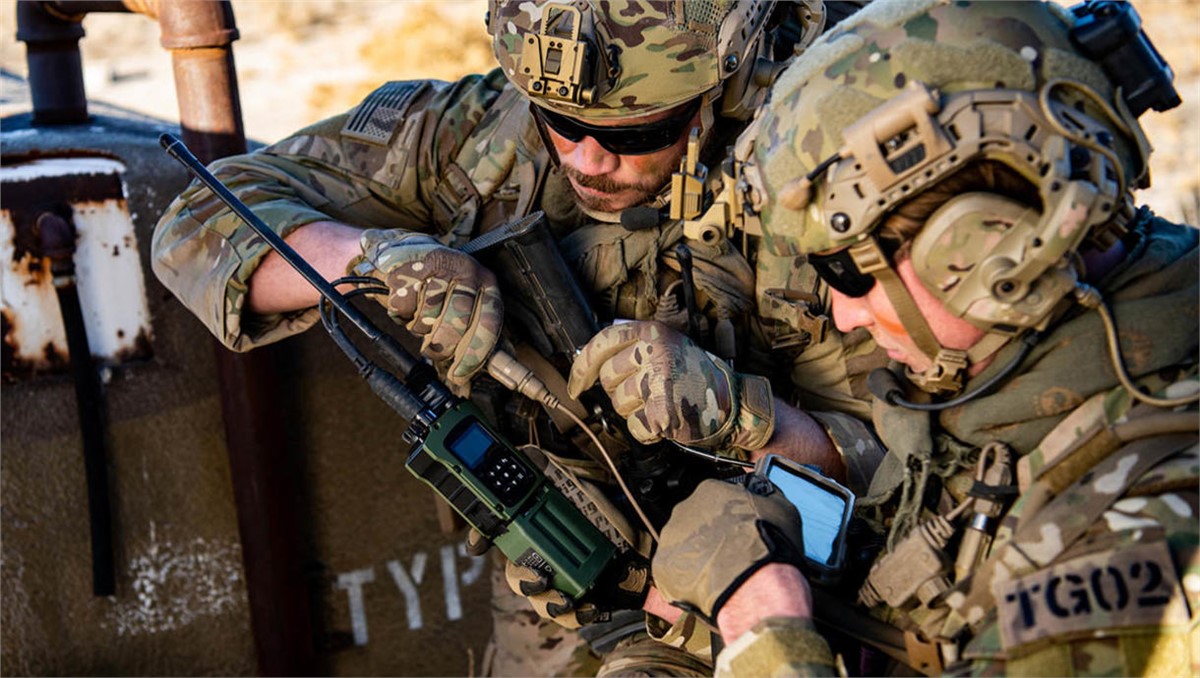
The capability will first deploy on the RF-9820S Compact Team Radio (also known as the AN/PRC-171) and its embeddable variant, the RF-9820S-ER, later this year. Critically, the upgrade will then become available as a future software upgrade on all Wraith-capable tactical radios — including more than 100,000 systems already in the field, such as the AN/PRC-158C, AN/PRC-163, and AN/PRC-167.
That is the headline number worth pausing on. A software upgrade rolled out across an installed base of 100,000-plus radios immediately becomes one of the largest distributed sensor networks in any defence context. It is the kind of compounding capability that vertically integrated incumbents can deliver and pure-play startups cannot.
Rob Mariuz, Director of Product Management at L3Harris, captured the strategic intent: the company's role as an industry partner to U.S. and coalition forces is to protect ground operators and provide reliable, secure, assured communications. Wraith Shield is designed to seamlessly integrate with and enhance existing air defence systems by adding thousands of distributed sensors to the picture.
The DataShapes AI piece
 >
>The AI capability inside Wraith Shield comes from DataShapes AI, a company that delivers edge-native AI for electromagnetic spectrum awareness. Together, L3Harris and DataShapes built a visualisation system that lets users actively see potential threats in the local electromagnetic spectrum.
DataShapes AI's GlobalEdge platform transforms distributed RF data into real-time, actionable intelligence — enabling warfighters to detect, classify, and respond to threats directly at the tactical edge, without reliance on centralised infrastructure. The model interprets RF signatures, classifies them, and presents an end-user view that lets soldiers identify what is flying above them and instantly target potential threats.
Paul Craft, President of DataShapes AI and former U.S. Army Chief of Cyber and Electronic Warfare, framed the operational impact: the capability closes the gap between sensing and action in a way that directly impacts survivability on the battlefield. By delivering clear, real-time visibility of the electromagnetic environment at the tactical edge, DataShapes is giving warfighters the situational awareness and — most importantly — the speed they need to outpace adversaries in increasingly complex and contested environments.
Craft's military background matters here. The credibility of any AI deployment into a tactical context depends heavily on whether the system has been built by people who understand the operational reality. A former Army Chief of Cyber and EW running the AI vendor is the kind of pairing that compresses the trust cycle inside defence procurement.
Why this architecture is a template
Three things about Wraith Shield are worth pulling out for enterprise AI strategists tracking edge deployments and the broader agentic AI buildout in regulated industries.
First, software-defined upgrades to installed hardware. The same play L3Harris is running in defence is visible across enterprise sectors — automotive (Tesla's OTA updates), industrial automation, medical devices. When the hardware is already in place, the company that owns the software upgrade path captures massive scale advantage. Wraith Shield is that play applied to one of the largest installed bases of tactical radios in the world.
Second, edge-native AI is non-negotiable in tactical contexts. Centralised AI inference requires backhaul to a cloud or data centre — neither of which can be relied on at the tactical edge. DataShapes AI's GlobalEdge platform is designed to do classification and decision-making directly on the device. This is the same architectural principle now reshaping industrial AI, autonomous vehicles, robotics, and any deployment where latency, bandwidth, or connectivity cannot be assumed. It is also a recurring conversation among enterprise AI leaders at events like MachineCon GCC Summit 2026 and adjacent global tech forums.
Third, the moat is in the integration, not the model. Wraith Shield works because it is built on top of L3Harris's Wraith waveform, fielded radios, and ecosystem of layered defence systems — VAMPIRE™, Drone Guardian®, MissionOps™, and hC2™ suites. DataShapes AI provides the AI layer, but the value comes from how cleanly that AI integrates into existing assured-communications infrastructure. This is the consistent pattern across enterprise AI deployments in 2026: foundation-model capabilities are commoditising; integration depth and domain integration are the durable advantages.
The broader counter-UAS market
 >
>The counter-UAS market has become one of the fastest-growing segments in defence, driven by drone proliferation in active conflict zones from Ukraine to the Red Sea. Competitors and adjacent players include Anduril, Shield AI, Epirus, Northrop Grumman, RTX (Raytheon), Lockheed Martin, and Teledyne FLIR — each pursuing different combinations of detection, classification, and disruption.
Wraith Shield's specific differentiation is its distribution model. By turning every Falcon® IV-class radio in the field into a sensor, L3Harris collapses the deployment cost and timeline of building a distributed sensor network. Tom Sheehan, Lead Product Manager at L3Harris, captured the elegance of the approach: it brings sensors to the front line because the soldiers already have the body-worn communications systems. The RF-9820S supports operation in the same frequency bands commonly used by most attritable FPV drones — meaning the soldiers who would benefit most from Wraith Shield already carry the equipment needed to use it.
That last detail matters. The frequency-band alignment between the radios and the threats is what makes the architecture work at all. Without it, no software upgrade would be sufficient. With it, every existing radio becomes a candidate sensor.
What to watch next
A few things will determine whether Wraith Shield matures into a category-defining capability or a useful add-on.
Deployment velocity. L3Harris has flagged the RF-9820S as the first platform, with broader Wraith-capable radio support coming later. The pace at which the upgrade reaches the full installed base will determine how quickly the distributed-sensor advantage materialises.
International rollout. With NATO and Five Eyes already fielding the underlying radios, the path to allied deployment is unusually short — assuming export-control and interoperability hurdles clear. Expect early international interest from European armies absorbing counter-drone lessons from Ukraine.
Adjacent integrations. Wraith Shield is explicitly designed to feed into C5ISR applications — MissionOps tactical network management, hC2 battle management suites. The deeper this integration goes, the more durable the capability becomes within the broader L3Harris stack.
Competitive responses. Expect Anduril, RTX, and Northrop Grumman to announce comparable software-defined counter-UAS capabilities within two quarters. The architectural pattern — software upgrade on installed sensor infrastructure — is replicable, and the market opportunity is too large for incumbents to cede.
For defence-tech watchers, Wraith Shield is a useful template. For enterprise AI watchers more broadly, it is a reminder that the most consequential AI deployments in 2026 may not look like AI deployments at all. They look like software upgrades to systems already in the field — quietly turning installed infrastructure into intelligent infrastructure, one waveform at a time.
Key Takeaways
- Transform existing tactical radios into AI-powered counter-drone sensors with Wraith Shield software upgrade.
- Leverage edge AI to enhance military capabilities without requiring new hardware investments.
- Address emerging drone warfare threats through innovative electronic warfare solutions.
- Highlight strategic trends of software unlocking potential in established military technology.
- Recognize the economic and operational advantages of using AI in modern combat scenarios.