
The promise of enterprise AI was efficiency. The reality arriving in June 2026 is a budget crisis that the companies experiencing it are no longer hiding.
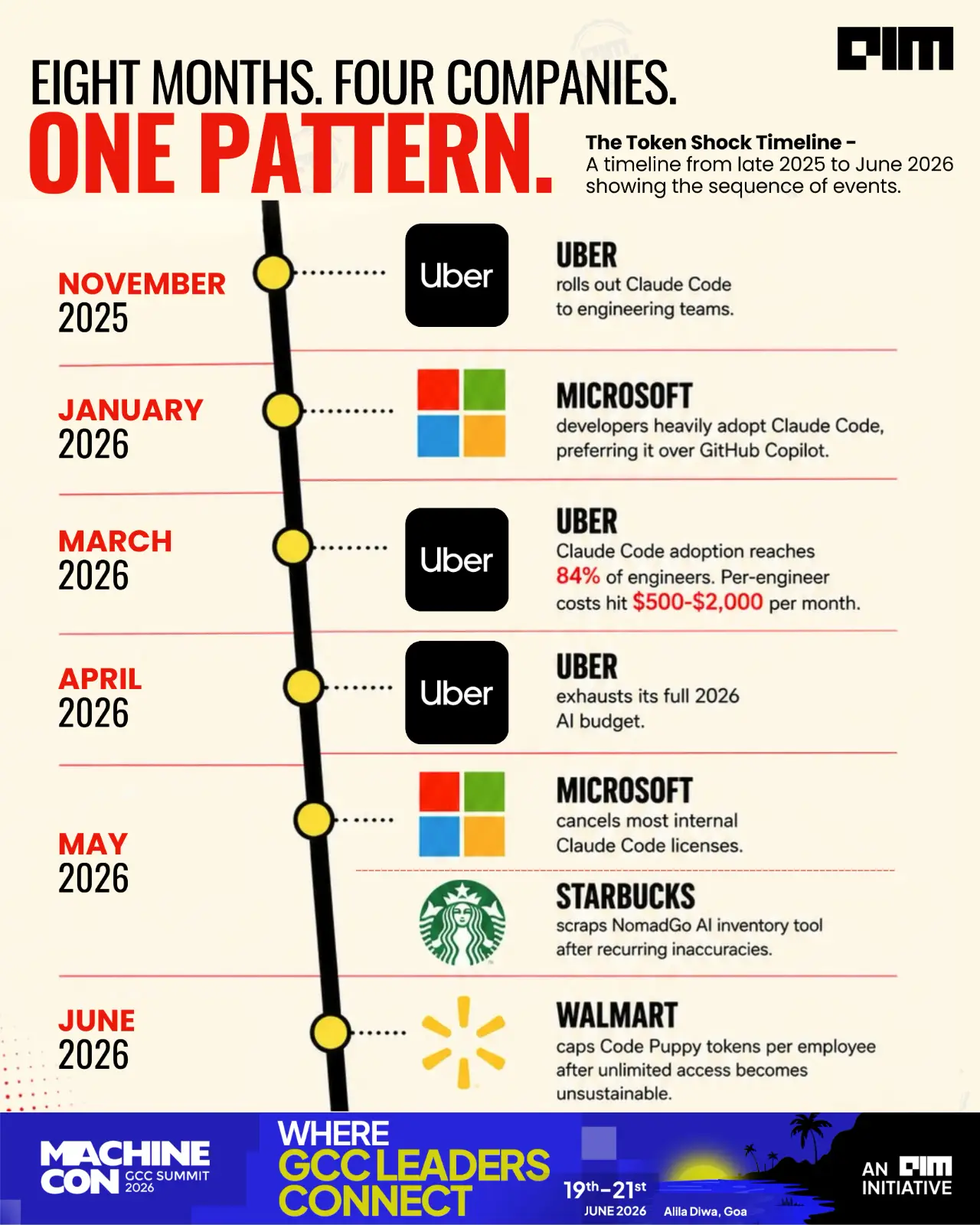
Walmart, one of the most advanced AI adopters in US retail, capped employee usage of Code Puppy, its in-house AI agent, after demand for the tool ran so high that unlimited token access became financially unsustainable.
Before the cap, staff had an unrestricted supply of tokens, the unit of data that AI computing runs on. Now each employee receives a set amount. The company told Bloomberg it wants employees to use "the right AI for the right task."
This is a framing that translates, in operational terms, to: we cannot afford to let everyone use as much as they want. The same dynamic has been hitting companies across the technology and enterprise landscape simultaneously, and the pattern is consistent enough that it has a name. Token shock.
How Three Companies Hit the Same Wall
Uber's case is the most documented. CTO Praveen Neppalli Naga told The Information in May 2026 that the company had burned through its entire 2026 AI budget by April.
"I'm back to the drawing board, because the budget I thought I would need is blown away already," he said. Uber had rolled out Claude Code, Anthropic's AI coding assistant, to its engineering teams starting in late 2025.
Adoption shot up from 32% to 84% of engineers by March 2026. Per-engineer monthly costs were running between $500 and $2,000. The company's full 2026 AI budget was $3.4 billion. All of it was gone by the end of April.
The more uncomfortable disclosure came from Uber COO Andrew Macdonald, who admitted publicly that there is no clear evidence higher token consumption translates to proportionally better products for users.
Uber's engineers were producing 70% of their code with AI assistance by early 2026. Whether that means better software is a question the company cannot yet answer.
Microsoft went the other direction. After a pilot in which developers heavily adopted Claude Code, preferring it over Microsoft's own GitHub Copilot, the company canceled most of its internal Claude Code licenses in mid-May 2026.
Access in its Experiences and Devices division ends June 30, coinciding precisely with the last day of Microsoft's fiscal year. The timing was not accidental. The cancellation was a budget reset, not a technical judgment.
Microsoft's own AI workplace report simultaneously claimed 80% productivity gains from AI tools, making the pullback on Claude Code one of the more striking contradictions in enterprise AI right now.
Walmart's Code Puppy cap is the retail version of the same story. Employees also have access to Claude and ChatGPT alongside the in-house tool, which means the cap is not a retreat from AI, it is a governance decision about which tool gets used at what volume.
The company wants employees to apply AI in ways that create value, its spokesperson said. The implicit acknowledgment is that not all AI usage creates value, and unlimited access makes it impossible to tell which usage does.
The Structural Problem
The financial friction all three companies hit traces back to the same root cause. Traditional enterprise software was priced per seat or on a fixed subscription basis, a cost structure that finance teams could forecast, budget, and control.
Token-based consumption pricing breaks that model. A surge in internal experimentation, a new product rollout, a poorly optimized prompt, or a team of engineers adopting an agentic coding tool at 84% penetration can cause costs to spike in ways that no annual budget was designed to absorb.
The number of FinOps teams actively managing AI spend has doubled from 31% to 63% of enterprises within a single year.
Companies are now retrofitting financial controls onto AI rollouts that moved fast in late 2025, layering quotas, internal leaderboards, and cheaper model routing onto deployments that previously ran open.
Big Tech AI capital expenditure hit $650 billion in Q1 2026. The infrastructure investment is not slowing down. The question is whether the consumption on top of it can be governed.
The Two-Sided Risk
The cost problem is only one direction of the enterprise AI accountability reckoning. The other direction is operational failure, and it looks different from a budget overrun but is equally damaging.
Starbucks scrapped an AI inventory-counting tool across North America less than a year after deployment after the system produced recurring inaccuracies in stores.
The tool, developed by NomadGo, used tablet-based scanning with camera and LiDAR inputs to count stockroom items, a specific, bounded task where AI should theoretically perform well. It did not.
The reversal landed while Starbucks was attempting to convert its turnaround into margin recovery, adding operational complexity to a company that needed the opposite.
Walmart's Code Puppy cap and Starbucks' NomadGo reversal are not the same story. One is a cost governance decision, the other is a product failure. But together they define the two-sided risk that enterprise AI is now producing at scale.
Too much successful adoption creates unaffordable bills. Too much unsuccessful adoption creates operational disruption. Both are failure modes that the pilot stage was not designed to surface.
What Comes Next
Companies are now asking the question that the enthusiasm of 2024 and 2025 deferred. Does the output justify the cost? Uber's COO asked it out loud. Microsoft answered it quietly by not renewing licenses. Walmart answered it by introducing a cap.
The next quarter will show whether governance can keep consumption flat while productivity gains continue to compound. If it can, the enterprise AI case holds.
If governance suppresses usage enough to eliminate the productivity gains that justified the investment, the math breaks down in a different way.
Either way, the era of unlimited tokens is over. Enterprise AI is in its budget-and-control phase now, and the companies that figure out how to measure outcomes rather than consumption will have a meaningful advantage over the ones still counting tokens.