Wall Street's Most Profitable AI Trade Is a Bond Morgan Stanley Designed.
"Dollar amounts that used to be $1bn, $2bn, $5bn are now $10bn or $20bn and higher."
Morgan Stanley reported record Q2 2026 results on July 15, 2026 including $21.3 billion in net revenues, a 27% year-over-year increase, and earnings per diluted share of $3.46, up 62%, with fixed income underwriting delivering a record $788 million quarter driven by bond issuance across investment-grade and non-investment-grade tiers.
Behind those numbers is a specific strategic bet the bank made early: that AI infrastructure would need financing structures that did not yet exist, and that designing them would be among the most valuable things a Wall Street bank could do in 2025 and 2026.
That bet has paid off in fees, according to the company. Morgan Stanley's debt and equity capital market fees grew to $2.3 billion in the first half of 2026 from $1.4 billion a year earlier, lifting the bank to second place globally in debt and equity capital markets fees specifically, behind JPMorgan Chase and past Goldman Sachs, up from fourth a year earlier, according to LSEG data reported by the Financial Times.
The engine of that growth was AI dealmaking, which the Financial Times reported on July 20, 2026, has made Morgan Stanley the dominant adviser on the biggest and most inventive AI infrastructure financings of the past year.
"Dollar amounts that used to be $1bn, $2bn, $5bn are now $10bn or $20bn and higher," said Mo Assomull, Morgan Stanley's co-head of investment banking.
The Deals That Built the Template
The financing structure Morgan Stanley pioneered is built around a specific insight: hyperscalers like Google, Amazon, Meta, and Microsoft entered the AI boom with pristine balance sheets and impeccable credit ratings. When one of them guarantees the leases on a data center, the cost of financing the underlying infrastructure roughly halves.
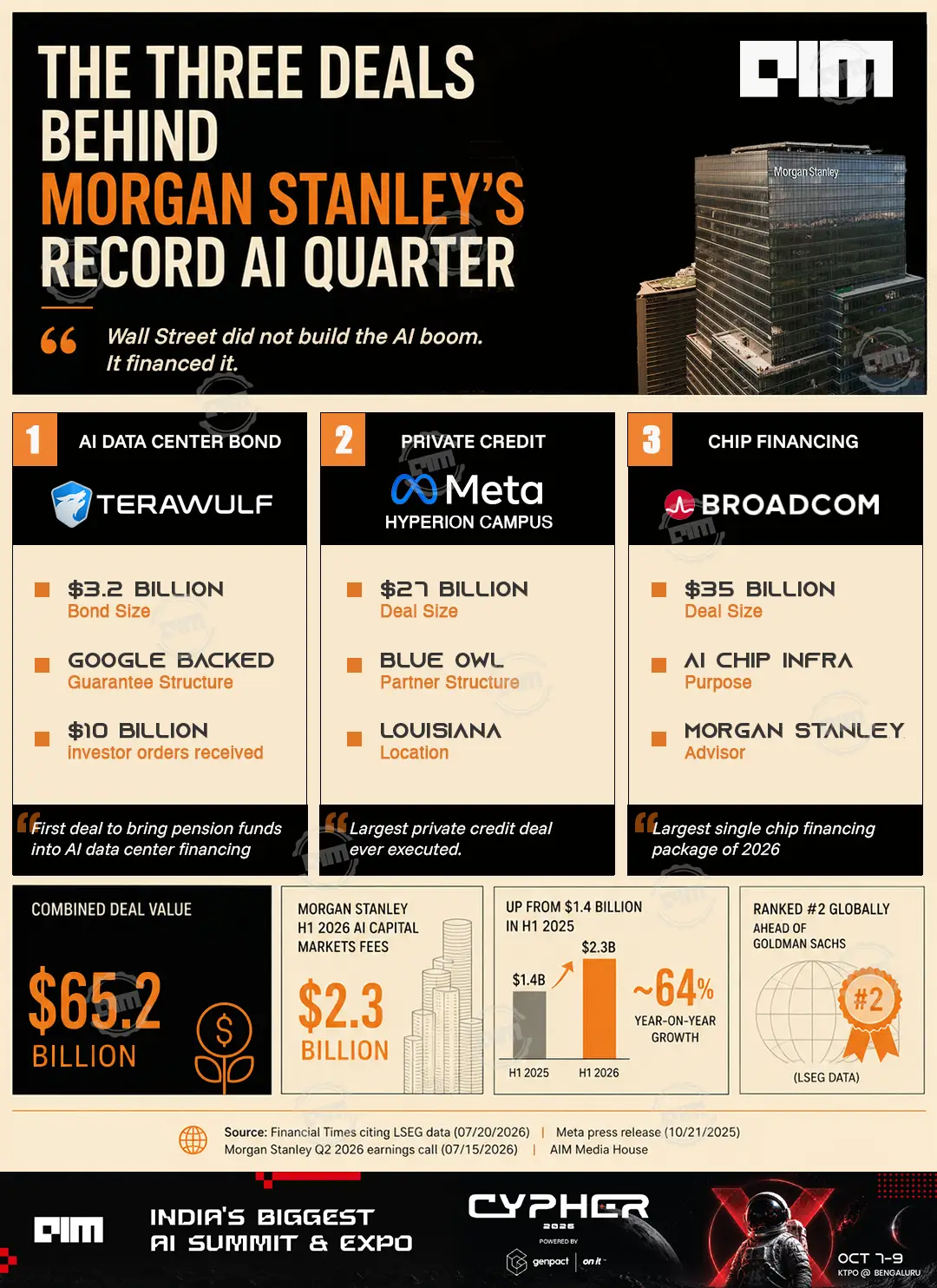 >
>"Where do you want to raise money, at mid-to-high single digits or double that?" Assomull said. The TeraWulf bond, a $3.2 billion instrument designed by Morgan Stanley's leveraged finance co-head William Graham, demonstrated the model.
The bank created a hybrid security that could be sold widely like a bond but carried the protections of a project loan, backstopped by Google, which guarantees $3.2 billion in leases on the New York campus.
Most of the capacity will serve Anthropic. The deal attracted $10 billion of orders at a 7.75% yield and brought a new category of credit investor into data center financing for the first time.
The same structure was applied at greater scale to Meta's Hyperion data center campus in Louisiana, where Morgan Stanley arranged a $27 billion debt package via Blue Owl, confirmed by Meta's October 2025 press release as the largest private credit deal ever executed.
Blue Owl owns 80% of the campus, which keeps the debt off Meta's balance sheet. The bank also advised Broadcom on a $35 billion chip financing deal.
The Investment Cycle Is Early
On the Q2 2026 earnings call, CEO Ted Pick made the clearest public quantification yet of how the bank views the AI capital expenditure cycle. AI CapEx for 2026, originally forecast at $575 billion in late 2025, is coming in at approximately $850 billion. The 2027 forecast has moved from $700 billion to $1.3 trillion. The 2028 projection could reach $1.5 trillion.
Pick framed the cumulative trajectory against a historical pattern. "Each major tech cycle has produced a 10-fold increase in compute capacity," he said. "Applied to AI, that would suggest a progression from roughly $1 trillion of cloud computing to $10 trillion of AI compute." At current spending rates, he estimated the cycle is "around 10% to 15% of the way through."
Data centers require an estimated $2.9 trillion through 2028, according to Morgan Stanley's own financing analysis reported by Forbes. Big Tech's cash flows cover only half of that gap, meaning the bond market, structured finance, and private credit will need to fund the difference.
Morgan Stanley expects total AI debt issuance to reach $570 billion in 2026 alone, with up to $236 billion already sold by May 31 at four times last year's pace.
There are early signs of cooling in buyer appetite. In February, bond investors bought nearly five times as many Big Tech bonds as were on offer.
By July, that ratio had fallen to under two. "There will be periods when technology or capital investment is ahead of adoption, that we know," Pick told analysts.
Key Takeaways
- Morgan Stanley reported record Q2 2026 results, driven by AI-related bond issuance.
- The bank's strategic bet on AI financing structures significantly boosted its capital market fees.
- Morgan Stanley became a leading adviser on major AI infrastructure financings in 2026.
- Debt and equity capital market fees rose to $2.3 billion, up from $1.4 billion year-over-year.
- Financing amounts have surged, with deals now exceeding $10 billion, reflecting increased AI investment.