What Are the Top AI Soonicorns to Watch in 2024?

The soonicorns are capitalizing on this influx of capital, proving their product-market fit and scaling sales at unprecedented rates.
A new wave of startups, dubbed "soonicorns," is stealing the spotlight in the AI space, with valuations between $600 million and $800 million. Positioned on the brink of unicorn status, these AI soonicorns are the next big bets for investors, offering high growth potential and market disruption. In 2024 alone, 126 AI unicorns have emerged, fueling a gold rush in the AI sector as investors race to back the next tech giants.
What’s driving this frenzy? AI investment is skyrocketing, with projections suggesting it could hit up to 4% of GDP in the U.S. and 2.5% in AI-leading nations. The soonicorns are capitalizing on this influx of capital, proving their product-market fit and scaling sales at unprecedented rates. These companies are spread across diverse sectors—healthcare, finance, transportation, and more—showing that AI’s reach goes far beyond traditional tech and has the potential to transform every corner of the economy.
As these AI Soonicorns inch closer to billion-dollar valuations, they’re not just reshaping industries—they’re reshaping the future of investment itself. Investors are betting big on AI’s ability to disrupt, and the next unicorn might already be hiding in plain sight among these soon-to-be giants.
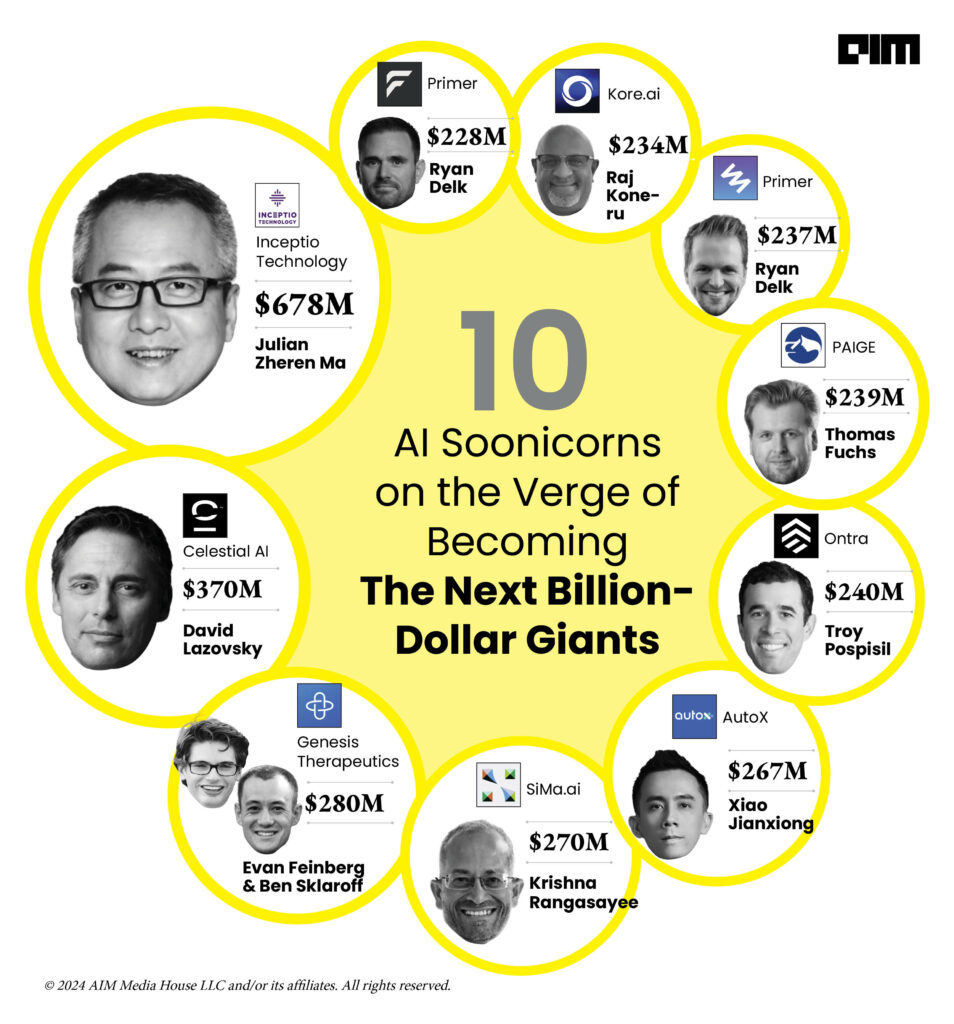 >
>1- Inceptio Technology
Founder: Julian Zheren Ma
>Funding: $678M
>Potential unicorn due to: Inceptio's "XUANYUAN" system uses deep learning for perception, path planning, and decision-making. They employ computer vision algorithms for object detection and tracking, and reinforcement learning for optimizing driving strategies. Their AI also handles fleet management, optimizing routes and schedules for multiple trucks.
2- Celestial AI
Founder: David Lazovsky
>Funding: $370M
>Potential unicorn due to: While not developing AI algorithms directly, Celestial AI's Photonic Fabric enhances AI system performance. Their technology allows for faster data transfer between AI processors, enabling more complex neural networks and reducing energy consumption in AI computations..
3- SiMa.ai
Founder: Krishna Rangasayee
>Funding: $270M
>Potential unicorn due to: SiMa.ai's MLSoC supports various AI models, including convolutional neural networks (CNNs) for computer vision and recurrent neural networks (RNNs) for natural language processing. Their hardware accelerates AI inference at the edge, enabling real-time processing of sensor data and video streams.
4- Genesis Therapeutics
Founders: Evan Feinberg and Ben Sklaroff
>Funding: $280M
>Potential unicorn due to: Applies AI to drug discovery. Their platform uses 3D spatial graph modeling and machine learning to predict drug properties and simulate drug-target interactions. They employ deep learning techniques to predict drug properties and simulate drug-target interactions, potentially speeding up the drug discovery process.
5- AutoX
Founder: Xiao Jianxiong (also known as Professor X)
>Funding: $267M
>Potential unicorn due to: Develops autonomous driving technology for robotaxis and delivery vehicles. They use AI for real-time perception, HD mapping, and fleet management.AutoX utilizes deep learning for perception, using sensor fusion to combine data from cameras, lidar, and radar. They employ reinforcement learning for decision-making in complex traffic scenarios and use AI for real-time HD mapping and localization.
6- Ontra
Founder: Troy Pospisil
>Funding: $240M
>Potential unicorn due to: Ontra utilizes AI through its proprietary Ontra Synapse technology, which is built on a large language model trained on over 800,000 private capital contracts. This AI powers their Contract Automation platform, enabling rapid contract analysis, automated markup suggestions, and data-driven insights for negotiation. The system combines machine learning with human expertise, allowing for efficient contract processing while maintaining accuracy and compliance in the complex world of private market legal agreements.
7- PAIGE
Founders: Thomas Fuchs
>Funding: $239M
>Potential unicorn due to: Paige uses convolutional neural networks and other deep learning techniques for image analysis of pathology slides. Their AI can detect and classify cancer cells, predict treatment outcomes, and identify biomarkers, supporting more accurate and efficient cancer diagnostics.
8- Primer
Founders: Ryan Delk
>Funding: $237M
>Potential unicorn due to: Primer employs various NLP techniques, including transformer models like BERT and GPT, for tasks such as named entity recognition, text summarization, and machine translation. They also use unsupervised learning for topic modeling and sentiment analysis.
9- Kore.ai
Founder: Raj Koneru
>Funding: $234M
>Potential unicorn due to: Kore.ai uses natural language understanding (NLU) models to interpret user intent in conversations. They employ dialogue management systems based on reinforcement learning to handle complex, multi-turn conversations. Their platform also integrates with robotic process automation (RPA) for end-to-end task completion.
10- RRAI (Rebranded as Forterra)
Founder: Josh Araujo
>Funding: $228M
>Potential unicorn due to: Forterra uses computer vision and sensor fusion for environmental perception. They employ reinforcement learning for decision-making in complex, unstructured environments. Their AI also handles mission planning and multi-vehicle coordination for defense applications.
Key Takeaways
- Investors are increasingly backing AI soonicorns, with valuations nearing unicorn status.
- AI investment is projected to significantly impact GDP in the U.S. and leading nations.
- Soonicorns are demonstrating strong product-market fit and rapid sales growth across various sectors.
- These startups are not just reshaping industries but also the future of investment.
- The next billion-dollar AI giant may be hidden among these emerging soonicorns.