How is AI Reshaping Atlassian's Workforce Amid Layoffs?
Atlassian's 1,600 person layoff is the latest in a wave of AI-driven cuts sweeping enterprise software. Together, they reveal an industry quietly rebuilding itself around a smaller, more automated workforce.
"Our approach is not 'AI replaces people,' but it would be disingenuous to pretend AI doesn't change the mix of skills we need or the number of roles required in certain areas. It does."
That was Atlassian CEO Mike Cannon-Brookes, writing to employees on March 11 as the company announced it would lay off roughly 10% of its workforce (1,600 employees).
With that, Atlassian joined the growing list of enterprise software companies that have decided the AI era requires a fundamentally different workforce.
Their purpose is to self-fund greater investment in AI and enterprise sales. Shares rose nearly 2% in extended trading. For a stock that had fallen around 33% in the prior year, the market's response reflected a broader reality.
Investors are no longer rewarding software companies for holding headcount steady. They are rewarding the ones that cut fastest and pivot hardest.
The Restructuring Behind the Numbers
Atlassian's layoffs are not attributed to cost-cutting. The company has framed them explicitly as self-funding, a way to redirect capital toward AI development and enterprise sales without taking on additional debt or diluting shareholders.
The restructuring carries an estimated charge of $225 million to $236 million. Of that, $169 million to $174 million is tied to severance, notice periods, employee transition costs, and benefits.
The remaining $56 million to $62 million relates to office space exits. Most of those charges are expected to land in Q3, with the full restructuring substantially complete by the end of Q4 fiscal 2026.
The geographic spread of the cuts reflects where Atlassian's workforce is concentrated. North America bears the largest share at 40%, followed by Australia at 30% and India at 16%. Smaller reductions are expected across Europe, the Middle East, Africa, Japan, and the Philippines.
Alongside the workforce reduction, Atlassian announced a leadership reshuffle. Rajeev Rajan, who served as CTO for nearly four years, will step down effective March 31.
In his place, the company is splitting the CTO function in two. Taroon Mandhana will take the role of CTO of Teamwork, while Vikram Rao will serve as CTO of Enterprise and Chief Trust Officer, with oversight of the company's AI roadmap.
The structural signal tells that Atlassian is not just cutting, it is reorganizing around AI as a distinct operational priority, with dedicated leadership to match.
"We are doing this to self-fund further investment in AI and enterprise sales, while strengthening our financial profile," Cannon-Brookes wrote. "We're also changing the way we work and reorganising around our System of Work to move faster."
A Pattern Too Impossible to Ignore
Atlassian's announcement follows a clear pattern. It is the latest in a sequence of major restructurings across enterprise software, each one linked to AI-driven changes in how work gets done and how many people are needed to do it.
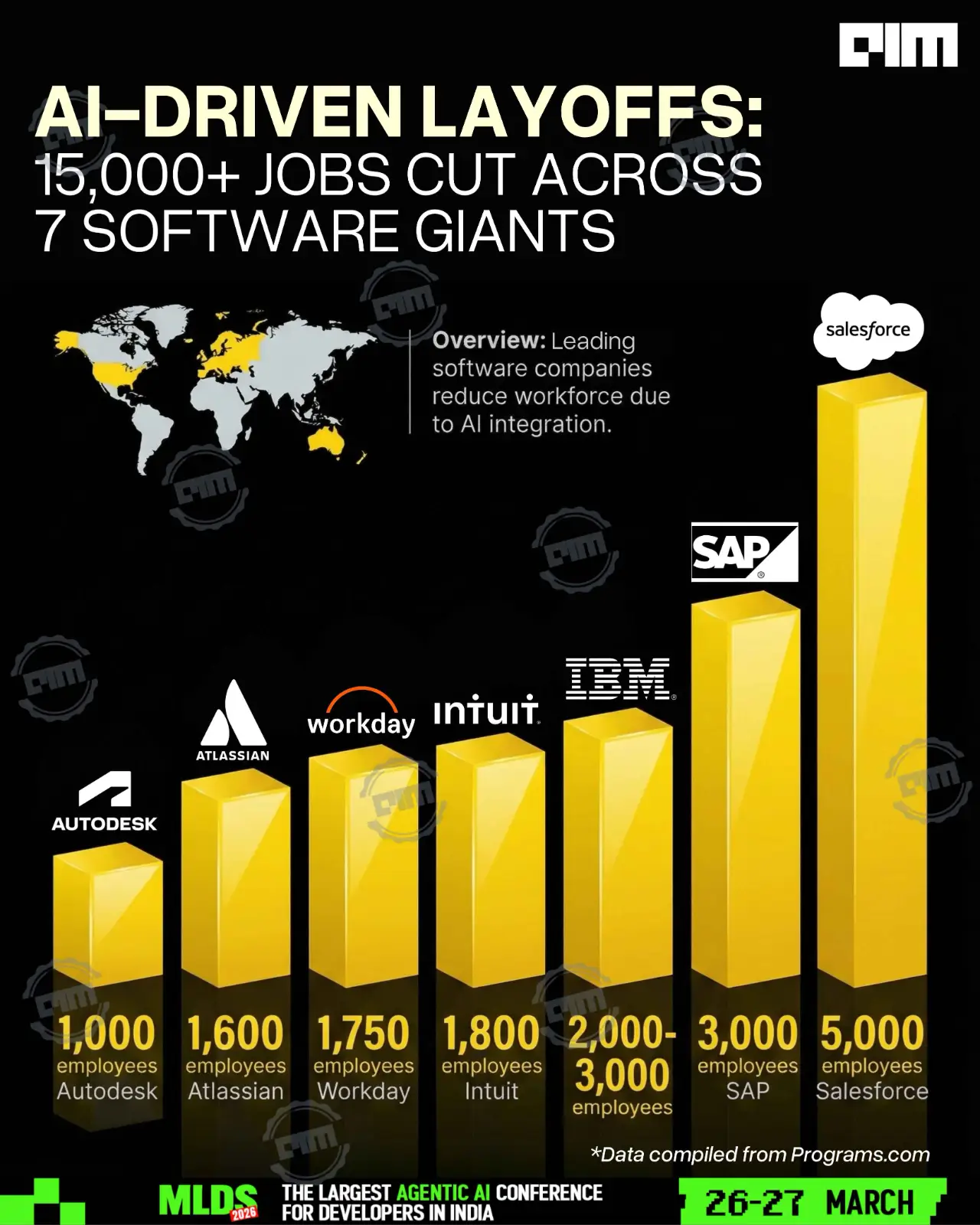 >
>Salesforce has been among the most aggressive. The company cut around 4,000 customer support roles in August 2025 after deploying AI systems capable of handling a growing share of service requests.
CEO Marc Benioff stated plainly that AI agents were now managing approximately 50% of customer interactions, allowing the company to rebalance headcount accordingly. A further 1,000 jobs followed in early 2026. In total, Salesforce cut roughly 5,000 roles over eight months, not because business was contracting, but because AI had changed the ratio of humans required to deliver it.
SAP moved earlier. In April 2025, the enterprise software giant announced layoffs of approximately 3,000 employees as part of a shift toward what it calls "Business AI," with automation reducing internal staffing needs. The company had originally flagged that as many as 10,000 jobs could ultimately be affected as the transition deepens.
IBM confirmed a similar trajectory in November 2025, cutting between 2,000 and 3,000 roles after AI agents replaced hundreds of back-office positions. CEO Arvind Krishna described the layoffs as a direct outcome of automation, one of the more candid admissions from a major technology executive about the causal relationship between AI deployment and headcount reduction.
Intuit followed in July 2025, reducing its workforce by approximately 1,800 as AI-assisted workflows became more common across finance, tax, and customer support functions. CEO Sasan Goodarzi described the move as reallocating investment toward the company's most critical strategic areas.
Autodesk added approximately 1,000 jobs to the tally in January 2026, framing the cuts as strategic shifts toward AI. CEO Andrew Anagnost explicitly stated the changes were not driven by AI replacing people.
Workday also moved in February 2025, cutting approximately 1,750 employees as part of a broader restructuring that prioritised investments in AI and platform development. The company cited efficiency gains from AI adoption as having lowered staffing needs across certain teams, an early and telling sign that even HR and finance software, long considered relatively insulated from automation, was not immune.
What Analysts Are Saying
The market response to these announcements has been broadly positive, which is itself a signal worth noting. Atlassian shares climbed nearly 2% after its announcement.
Salesforce was rewarded similarly after its cuts. Investors appear to be treating AI-linked restructuring not as a sign of distress, but as evidence of operational discipline.
D.A. Davidson analyst Gil Luria offered a straightforward read of the Atlassian situation. "Software companies such as Atlassian have an opportunity to make their business more efficient by adopting AI tools, especially within their product development," he said. "By reorganizing that way they can reduce the resources necessary to deliver their current business and grow more profitably."
That framing, AI as an efficiency multiplier that changes the denominator of the headcount equation, is the thesis driving most of these restructurings. The argument is not that revenue is falling. It is that the same revenue can now be generated with fewer people.
Not everyone is convinced the math is that clean. Top executives at the World Economic Forum's annual meeting in January acknowledged that while jobs would disappear, new ones would emerge.
But also noted that AI was being used as cover by companies that had already decided to cut. The distinction between genuine AI transformation and convenient narrative is one analysts and employees are increasingly trying to draw.
An Industry in Transition
What the accumulation of these announcements suggests is a structural adjustment playing out across an entire industry simultaneously.
Enterprise software built its workforce models around a set of assumptions. About how long development takes, how many support agents are needed per customer, and how much manual work goes into financial reporting and legal review.
AI is now disrupting that at speed. Companies that have been early and aggressive in AI deployment are finding that their headcount requirements are changing faster than their hiring plans anticipated.
For Atlassian specifically, the pivot carries particular urgency. Its core products, Jira for project management and Confluence for content creation, sit directly in the path of AI disruption. Rovo, the company's AI product, has already reached over five million monthly active users.
The question the restructuring is designed to answer is whether Atlassian can grow that AI layer fast enough, and profitably enough, to compensate for the pressure on its legacy collaboration tools. Cannon-Brookes is betting it can. The 1,600 people leaving Atlassian are, in his framing, the cost of finding out.
Whether the rest of the industry's similar bets pay off is a question that won't be answered this quarter, or even this year. But the direction of travel is no longer ambiguous. Across Atlassian, Salesforce, SAP, IBM, Workday, Intuit, and Autodesk, the message from the C-suite is consistent. AI has changed the calculus, and the workforce is being adjusted to match.
The only real debate now is whether those adjustments are a response to genuine transformation, or whether the industry is using AI as cover for workforce reductions it wanted to make regardless.
For the 15,000+ software workers who lost their jobs in the name of AI efficiency, the distinction may not matter much. What's clear is that the software industry's workforce model is being rewritten in real time, and the final chapters are yet to be written.
Key Takeaways
- Atlassian cuts 1,600 jobs, marking a significant shift towards AI-driven workforce restructuring.
- CEO emphasizes AI's role in changing required skills, not merely replacing employees.
- Layoffs aim to self-fund investments in AI and enterprise sales without incurring debt.
- The restructuring incurs estimated costs of $225 million to $236 million, mainly for severance and office exits.
- Investors favor companies that rapidly adapt to AI trends over those maintaining steady headcounts.