Broadcom's AI Business Doubles, Aims $100B Revenue by 2027
A record quarter and a bold forecast reinforce Broadcom's position at the center of the AI infrastructure boom
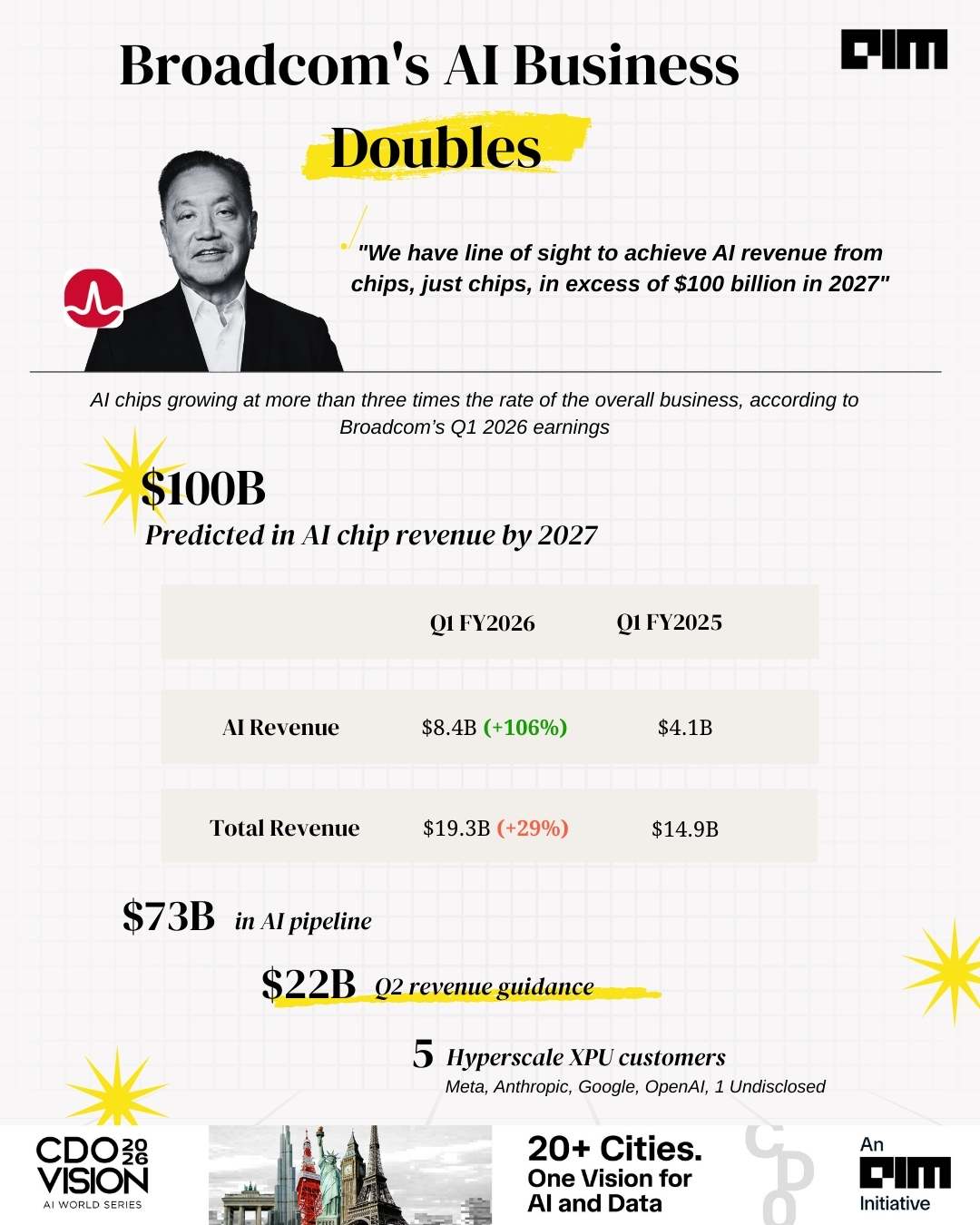
Broadcom reported first-quarter fiscal 2026 results Wednesday, posting revenue of $19.3 billion, ahead of the $19.2 billion analysts had expected, while beating on adjusted earnings per share of $2.05 against a $2.02 consensus estimate. AI semiconductor revenue came in at $8.4 billion, more than doubling year over year and surpassing the company's own guidance of $8.2 billion.
</> Raw HTML Block — preview on published page
>
"We have line of sight to achieve AI revenue from chips, just chips, in excess of $100 billion in 2027," CEO Hock Tan said on the earnings call. "We have also secured the supply chain required to achieve this." The statement, which far exceeds current Wall Street estimates for the company's total AI business, sent shares rose sharply in extended trading.
The results arrived alongside guidance for the second quarter that caught analysts off guard. Broadcom projected revenue of approximately $22.0 billion for the current quarter, well above the approximately $20.5 billion consensus estimate, representing 47 percent growth year over year.
 >
>Five Customers, One Dominant Theme
Broadcom's custom AI accelerator business now serves five hyperscale customers, all but one of whom Tan addressed by name on the call.
Google's seventh-generation Ironwood TPU continues to ramp through 2026, with next-generation demand expected to strengthen further in 2027. Anthropic, a major end user of Google's Broadcom-built TPUs, is targeting one gigawatt of compute this year and more than three gigawatts in 2027: a demand trajectory Tan highlighted directly. Meta's custom accelerator program, which some analysts had questioned, is shipping now with multi-gigawatt ambitions ahead. OpenAI, meanwhile, is on track to begin deploying its first-generation custom chip in 2027, as part of a broader arrangement expected to scale across 2027 through 2029.
AI networking revenue kept pace with accelerator demand.
Broadcom's Tomahawk 6 switch, running at 102 terabits per second, continued to book at a record rate, with the AI switch backlog alone exceeding $10 billion. Total AI-related backlog across accelerators and networking stands at $73 billion.
Software Segment Trails Some Estimates
Not all of the results were unambiguously strong. Infrastructure software revenue, which houses the company's VMware business, came in at $6.8 billion, in line with Broadcom's own guidance but short of what some analysts had modelled.
Tan pushed back on suggestions that generative AI could disrupt the segment, saying the business "is not threatened by AI," though he did not address the gap to external expectations directly.
Overall profitability held firm. Adjusted EBITDA reached a record $13.1 billion, representing 68 percent of revenue, while free cash flow came in at $8.0 billion, or 41 percent of revenue. The company guided for the same 68 percent EBITDA margin in the second quarter, even as CFO Kirsten Spears flagged that a growing shift toward full rack-level system sales would introduce margin dilution in the second half of the fiscal year as third-party component costs are passed through.
As part of its 2027 ambitions, Broadcom disclosed investment in a new Singapore packaging facility and early-stage work on glass substrate technology, a next-generation packaging approach designed to address interconnect bottlenecks as AI cluster sizes grow. The company also shipped its first 3.5D face-to-face compute system-on-chip in February.
For the second quarter of fiscal 2026, Broadcom guided revenue of approximately $22.0 billion and adjusted EBITDA of approximately 68 percent of revenue.
The company did not provide full-year guidance but said AI revenue in the current quarter is expected to reach $10.7 billion, representing year-over-year growth of 140 percent.
Key Takeaways
- Broadcom's AI semiconductor revenue doubled to $8.4 billion, exceeding expectations.
- Company reports $19.3 billion in revenue, surpassing analyst forecasts.
- Aims for $100 billion in revenue by 2027, signaling strong growth ambitions.
- Strong Q1 performance reinforces Broadcom's position in the AI infrastructure market.
- Adjusted earnings per share reached $2.05, beating the consensus estimate.