

ManufacturingOpinion
Industrial Firms Say AI Is Delivering Gains. Only 4% Require Human Oversight or Approval.
“The factory floor is moving at full speed.”


The brief
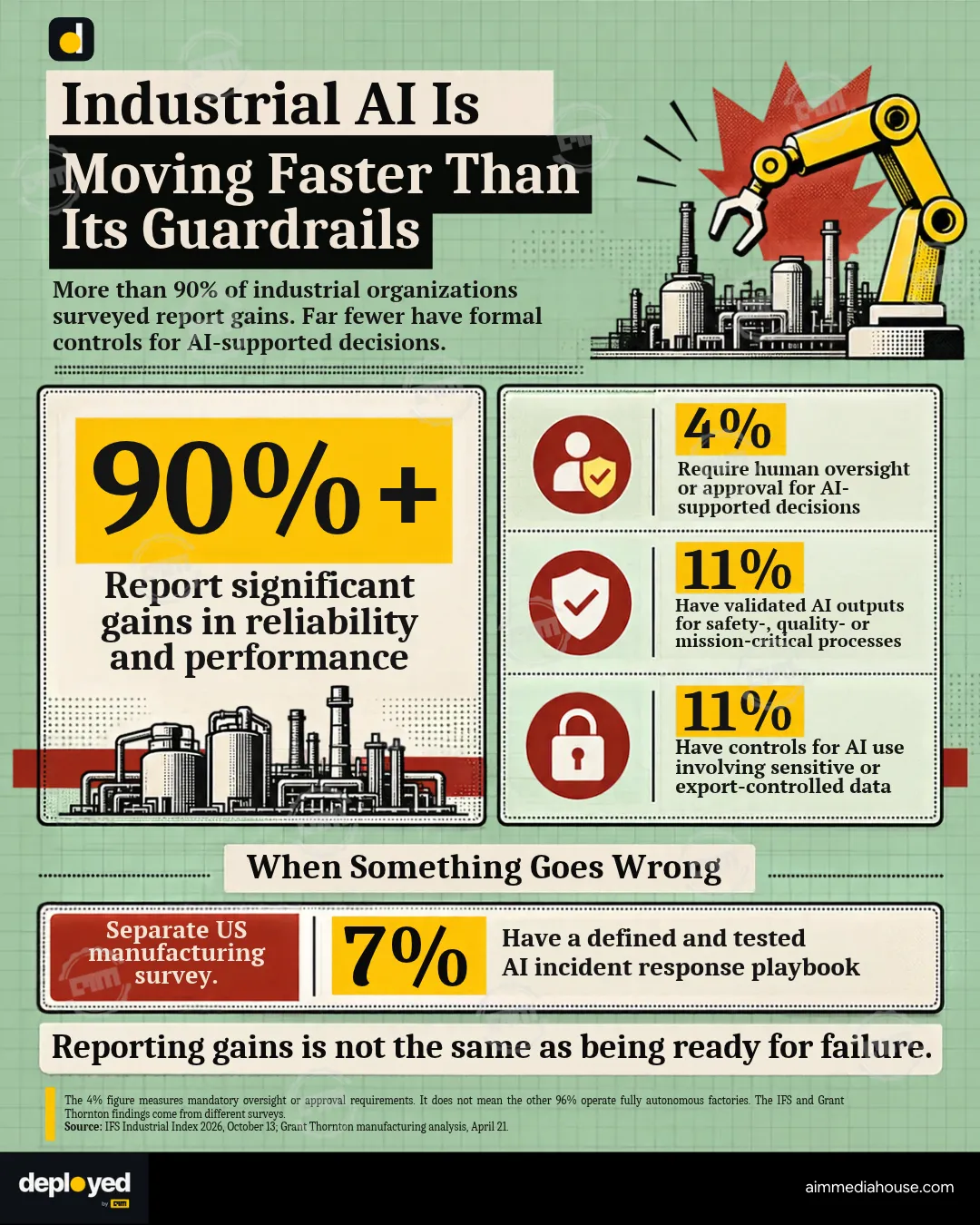
- Over 90% of industrial organizations reported significant gains in reliability and performance from AI, but only 4% have mandatory human oversight for AI-supported decisions.
- Only 11% of organizations have validated AI outputs for safety-, quality-, or mission-critical processes.
- A survey found that 70% of organizations expressed confidence in their safety and data policies, yet specific safeguards for AI use were limited.
Factory-floor teams are putting AI to work. The controls for checking its decisions and responding when it fails are further behind.
The brief
- Over 90% of industrial organizations reported significant gains in reliability and performance from AI, but only 4% have mandatory human oversight for AI-supported decisions.
- Only 11% of organizations have validated AI outputs for safety-, quality-, or mission-critical processes.
- A survey found that 70% of organizations expressed confidence in their safety and data policies, yet specific safeguards for AI use were limited.
Industrial companies are reporting results from AI. Far fewer have put formal checks around the decisions it supports.
IFS’s Industrial Index 2026, released October 13, found that more than 90% of organizations surveyed reported significant gains in reliability and performance.
Yet only 4% had mandatory human oversight or approval requirements for AI-supported decisions. Only 11% had validated AI outputs for safety-, quality- or mission-critical processes.
The gap is not simply between companies experimenting with AI and companies using it. It is between the operational benefits respondents describe and the safeguards they report having in place.
The Factory Floor Moves First
IFS, an industrial software vendor, commissioned Censuswide to survey 2,275 executive leaders and frontline workers between August 17 and September 3.
Respondents came from large businesses across manufacturing, aerospace and defense, energy, construction, transportation and telecoms, including in the US.
The findings suggest adoption is being driven close to the work. Over the previous year, 43% reported training and introducing agentic digital workers into daily operations.
Another 37% reported upskilling peers to use industrial AI tools, while 36% had directly trained staff to collaborate with digital workers.
Management’s most commonly reported AI effort was different: improving its own AI literacy, at 41%. Leadership confidence was also identified as an operational barrier by 30% of respondents.
“The factory floor is moving at full speed,” said Cathie Hall, IFS’s chief product and customer officer. “Workers see the operational insights, know their data better than anyone.”
The survey also points to where companies are directing capacity freed by AI: 36% prioritized workforce safety, training and operational compliance, while 35% prioritized asset performance and reliability. Those are respondents’ reported priorities, not independently measured outcomes.
Confidence Without the Checks
More than 70% of organizations expressed confidence in their safety and data policies. The reported controls were much less widespread.
Alongside the limited validation and human-approval requirements, only 11% had established controls for AI use involving sensitive or export-controlled data.
The 4% figure needs care. It measures mandatory oversight or approval requirements for AI-supported decisions. It does not establish that the other 96% let autonomous systems run factories without people.
A separate Grant Thornton survey illustrates why that distinction matters. Across industries, 95% of respondents said they did not permit AI agents to make fully autonomous, high-stakes decisions without human review.
That question is narrower than IFS’s measure and comes from a different sample. The figures cannot be treated as competing estimates of the same behavior.
What the IFS findings expose is a gap between confidence in policy and the presence of specific safeguards. They do not show how often AI decisions have caused operational failures.
Who Handles the Failure?
Grant Thornton’s manufacturing analysis, published April 21, found a related weakness: only 7% of manufacturers had a defined and tested AI incident-response playbook. Only 12% were confident they could pass an independent AI governance audit.
The manufacturing subgroup comprised 100 respondents within a broader survey of 950 US business leaders conducted between February 23 and March 18. It is separate, earlier evidence—not a follow-up measurement of the IFS respondents.
Manufacturers also identified operations as the function most in need of additional AI focus, at 62%, higher than any other sector. That measures where respondents wanted more attention, not the share of factory operations already controlled by AI.
“Manufacturers have AI running in the places where failure is most consequential, and most of them have not rehearsed what happens when it goes wrong,” said Kelly Schindler, Grant Thornton Advisors’ head of manufacturing.
Efficiency Is Not the Whole Return
Grant Thornton found that 64% of manufacturers reported increased efficiency from AI. But only 14% reported accelerated innovation, compared with 31% across the full sample.
None of the manufacturing respondents reported significant revenue uplift or significant cost savings.
That does not invalidate IFS’s findings. The surveys ask different questions, cover different populations and measure different outcomes.
Together, they show why operational improvement, financial return and readiness to manage failure should not be collapsed into one claim.
For industrial leaders, the next test is whether they can connect those three. A reported gain in reliability is useful. Knowing which decisions require approval, whether outputs have been validated and who owns recovery makes that gain more defensible.
The factory floor is finding uses for AI. Leadership’s job is to make sure the controls can follow it into daily operations—not arrive after the first failure.
Join the discussion
0 answers
People who run these systems answer here. Your verified role is shown, never your employer unless you choose.
Sign in with LinkedIn to answer
Read next


Chaos Predictions — every Monday
Where enterprise AI is heading next, read from the week’s deployments across banking, pharma, manufacturing and retail.
Free. One email every Monday. Unsubscribe in one click.


