Target Said AI Traffic Is Growing 3.5 Times Faster Than the Industry

As more consumers begin to explore the benefits of agentic shopping, Target's digital traffic sourced from external AI platforms is growing more than 3.5 times the industry.
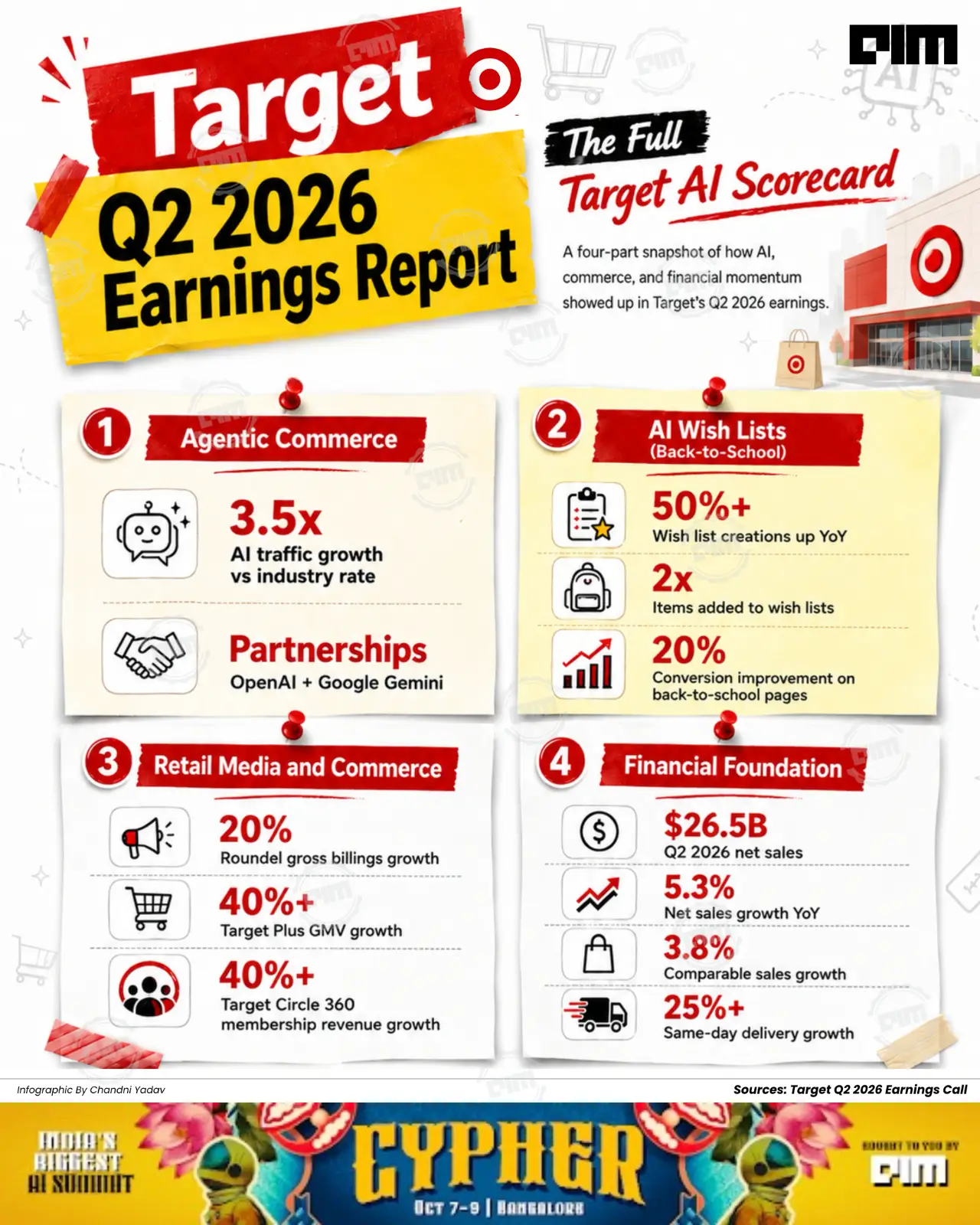
On August 19, Target reported Q2 2026 net sales of $26.5 billion, up 5.3% year over year. CEO Michael Fiddelke also used the earnings call to disclose two specific AI performance metrics covering agentic commerce traffic and AI-powered wish list conversion.
The first metric covers digital traffic sourced from external AI platforms. Target's traffic arriving from ChatGPT, Google Gemini, and other AI systems that research and recommend products on behalf of users is growing more than 3.5 times the industry rate year over year.
Adobe Analytics data from May 2026 confirmed that AI-referred traffic to US retailers had already grown 393% in Q1 2026 and converted 54% better than non-AI traffic, establishing that AI-sourced retail traffic is a documented and accelerating industry-wide shift.
Target's 3.5 times the industry rate figure positions the company as outpacing that baseline substantially, not merely participating in it.
The second metric is more directly tied to revenue conversion. AI-powered teacher and college wish lists, deployed as part of Target's back-to-school digital experience, drove total wish list creations up more than 50% year over year. Items added to those lists more than doubled, and conversion across Target's key back-to-school pages up nearly 20%.
The wish list feature uses AI to personalize recommendations based on grade level, subject requirements, and purchasing history, surfacing the right products at the right moment in the shopping journey rather than presenting a generic catalog, according to the company.
"Earlier this year, we became one of only a small number of retailers to partner initially with OpenAI, Google Gemini, and other leading platforms to shape the future of agentic commerce," Fiddelke said. "While still small in total today, as more consumers begin to explore the benefits of agentic shopping, Target's digital traffic sourced from external AI platforms is growing more than 3.5 times the industry."
 >
>Agentic Commerce
Agentic commerce is the channel where Target is placing its biggest AI bet. Under that model, AI agents research products, evaluate options, and in some cases complete purchases on behalf of consumers, without the consumer visiting a retailer's website or app directly. Target has established partnerships with both OpenAI and Google Gemini to compete in that channel before it reaches scale.
For retailers, visibility in that channel depends on being discoverable by the agent rather than by the consumer directly Fiddelke acknowledged explicitly that agentic commerce traffic is "still small in total today."
The growth rate (3.5 times the industry) indicates that Target's early partnerships with OpenAI and Google Gemini are translating into a disproportionate share of the agentic traffic that does exist, even if that traffic is still in early development as a channel.
To build on that position, Fiddelke confirmed the appointment of Chandhu Nair as Target's first Chief AI Officer, a hire announced the week prior and referenced directly on the earnings call as the leader who will "accelerate how we harness the power of AI to create better guest experiences and unlock new capabilities across our business."
AI Across Operations and Retail Media
Beyond the consumer-facing AI disclosures, Target's operations team disclosed Proxima. Described as a digital twin of the company's middle mile inventory positioning system, Proxima allows Target's supply chain team to test and iterate on inventory flow plans before committing them to production, simulating the downstream impacts of routing decisions across the network.
The tool contributed to meaningful improvements in inventory reliability in Q2, with Target reaching some of its strongest in-stock levels in recent years on its most frequently purchased items.
On the merchandising side, Fiddelke referenced AI as the tool helping merchants identify and respond to emerging trends faster, a capability underpinned by Target Trend Brain, Target's AI-powered trend forecasting tool that identifies styles, colors, and materials customers will search for ahead of the demand curve.
The tool was previously disclosed in Target's earlier 2026 communications and connects the consumer-facing AI investments to the merchandising decisions that determine what appears on the shelf in the first place.
Roundel, Target's retail media business, reported gross billings growth of nearly 20% in Q2. The transcript does not attribute that growth specifically to AI; Roundel's expansion is driven by its position as one of the largest retail media networks in the US, with AI-powered targeting capabilities supporting the broader platform.
Target Plus marketplace GMV grew more than 40% and Target Circle 360 membership revenue grew more than 40%, with both described as higher-margin revenue streams that contribute disproportionately to bottom-line growth.
Target raised its full-year comparable sales guidance to around 5% growth and its full-year EPS guidance range to $9.90-$10.90, both increases reflecting the company's confidence in sustaining Q2 momentum through the back half of the year.
Key Takeaways
- Target's AI-sourced digital traffic is growing over 3.5 times faster than the retail industry average.
- AI-driven wish lists increased creation by more than 50% and boosted conversion rates nearly 20%.
- AI traffic to US retailers surged 393% in Q1 2026, converting significantly better than non-AI traffic.
- Target's strategic use of AI enhances personalization, improving customer engagement and sales during key shopping seasons.